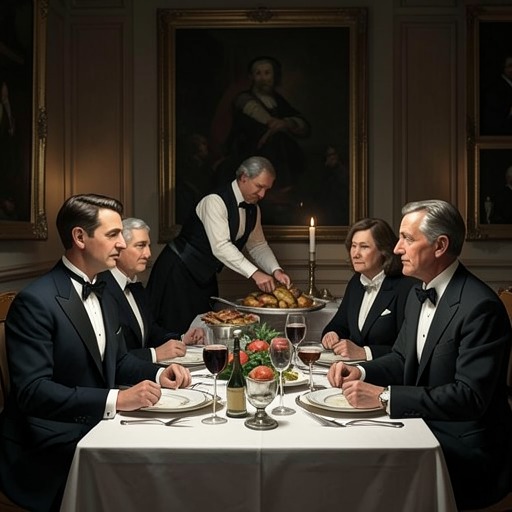
Funeral of Thomas Buddenbrook
BuddenbrooksThe Funeral of Thomas Buddenbrook turns the death of the family’s senator and head into an elaborate public ritual, joining civic honors to the intimate act of lowering him into the family vault. Its procession gives visible form to the status he had cultivated, but the figures left standing after the burial—his half-distracted brother Christian and his withdrawn young son Johann—make the display of continuity feel fragile. Flowers, official uniforms, family memory, and inherited words of business duty all gather around a man whose carefully maintained public image cannot settle what will become of his line.
Preparation and public mourning
Thomas is laid out in the cleared salon, dressed and covered in white silk and placed on white silk pillows inside his casket. Flowers fill the room: tuberoses and violets contribute to the heavy potpourri, while wreaths, baskets, and bouquets line the walls and lie across the coverlet. A semicircle of branched silver candlesticks surrounds Thorvaldsen’s Christ, raised on a pedestal draped in black crape. The presentation is meticulous, but death remains physically visible: Thomas’s face is abraded, his nose badly bruised. His hair and moustaches have been arranged as he wore them in life, and an ivory cross rests between his folded hands.
His sister, Frau Permaneder, takes charge of much of the mourning. She supervises the demonstrations of respect, receives visitors, reads aloud newspaper tributes to her brother, consults others about the funeral, and arranges opportunities for people from the office and warehouse to say goodbye. The visitors’ responses are not all as moving as she imagines: the warehouse workers file through, first astonished by the display and then increasingly bored, fidgeting with their caps before departing. She chooses to believe that some leave with tears in their beards. The contrast between her emotionally charged interpretation and their plainly impatient behavior makes mourning itself part of the performance staged around Thomas’s remains.
As the burial approaches, the metal casket is sealed and covered with flowers, candles are lit, and the house fills with mourners. Pastor Pringsheim stands at its head. A hired butler manages the overflowing rooms, directing uniformed civil servants from the tax office and grain haulers in their work clothes toward the remaining space along the corridor. The mixture of official visitors, business workers, family, and townspeople establishes the breadth of the public assembled to honor Thomas.
The funeral procession
Pastor Pringsheim’s measured voice fills the house as he speaks beside the figure of Christ. Outside, a four-horse hearse waits under the winter sky, followed by a long line of carriages extending toward the river. Soldiers stand in two rows facing the door, rifles at their sides, with Lieutenant von Throta at their head and his drawn sword held in his arm. Onlookers gather in the street and watch from surrounding windows. The funeral is thus at once a family farewell and a civic spectacle, organized through religious ceremony, military display, and public attention.
At the lieutenant’s command, the soldiers present arms with a crack and he lowers his sword as the casket emerges. Four men in black coats and three-cornered hats carry it through the front door. The wind scatters the scent of flowers, stirs the hearse’s black plumes, tosses the horses’ manes, and tugs at the black ribbons on the coachmen’s hats; slow snowflakes begin to fall. The funeral coach’s horses are shrouded in black, their restless eyes left visible. As they move off, led by four black grooms, the military closes in behind them and the carriages follow one by one. Christian rides in the first carriage with the pastor; little Johann follows in the next with relatives from Hamburg. Flags fly at half-mast as the procession winds solemnly through the streets, accompanied on foot by civil servants and grain haulers.
Burial in the family vault
The mourners follow the casket through the cemetery, past crosses, statues, chapels, and bare weeping willows, toward the Buddenbrook family vault. A guard of honor waits there and presents arms again, while the muted, heavy rhythms of a dirge sound from behind shrubs. The great stone cover, carved with the family crest, has been pushed aside. The town’s wealthy and accomplished men gather at the edge of the leafless woods to watch Thomas lowered into the brickwork vault, joining his parents. Legislators can be recognized by their white gloves and neckties; behind them stand civil servants, grain haulers, office workers, and warehouse hands. The family tomb gathers the town’s social ranks around a single act of descent.
When the music ceases, Pastor Pringsheim gives the benediction. The mourners then line up to shake hands with the deceased’s brother and son. This final ritual transfers attention from the dead man to those who remain, presenting Christian and Johann as the living recipients of public sympathy and, by implication, as the family’s next generation. Yet neither appears to inhabit the ceremonial role with ease. Christian accepts each condolence with the same half-distracted, half-embarrassed expression he wears on solemn occasions. Johann, dressed in a thick pea-jacket with gold buttons, keeps his blue-shadowed eyes lowered and his head tilted against the wind; his face registers hurt, and he does not look directly at anyone.
Family memory and the question of succession
The funeral’s public commemoration has an intimate counterpart in the family’s longer habit of preserving its past. The Buddenbrook papers include old letters from mothers to sons abroad, citizenship certificates, insurance policies, poems, business correspondence, and records of births, illness, and travel. The family chronicle and genealogy organize these documents into a record passed from one generation to the next. Tony, reading her own life in the chronicle, sees even ordinary events as worthy of preservation and imagines herself a link charged with shaping the family’s history. The funeral likewise treats an individual life as part of a continuing family story, but the gathering cannot make that continuation secure.
At the firm’s centenary, a framed plaque had gathered four generations of its owners beneath a golden ear of grain, with the years 1768 and 1868 and an inherited business maxim. Thomas examined it and remarked on the value of a good night’s sleep. That earlier ceremony joined portraits, commercial identity, and family inheritance in a single object; his funeral now assembles public honors around the man who had carried that legacy. Yet the son’s position at the grave complicates the picture of seamless succession. When Johann later finds the genealogy open among the family papers, he draws two lines through the space beneath his own name. That act is not part of the funeral itself, but it gives the burial’s scene of apparent continuity a stark subsequent counterpoint: the family can preserve its names and ceremonies without ensuring that its line will continue.
The funeral’s scale makes Thomas’s importance legible to the town, from the half-mast flags and military honors to the long procession and crowded cemetery. Its final image is less assured. The casket has joined Thomas to his parents in the vault, while Christian and Johann remain above ground to receive condolences, unable to turn the ceremony’s public respect into an answer to the family’s future. The ritual commemorates a powerful life and places it within a lineage; the subdued posture of its surviving representatives leaves that lineage’s prospects unsettled.