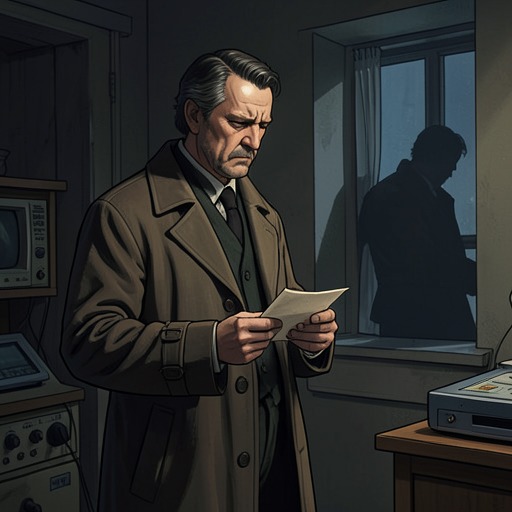
Johann Buddenbrook Sr.'s death
BuddenbrooksJohann Buddenbrook Sr.'s death closes his active role in the family firm and makes inheritance more than a transfer of property: his children inherit a chronicle, a business, and competing ideas of what it means to continue the family. His final bedside words offer encouragement to some of his descendants, but his refusal to mention Gotthold leaves an old estrangement unhealed.
Retirement and the final illness
Two months after his wife’s death, Johann announced that advancing age required him to retire. The firm, founded by his late father in 1768, was transferred under the same name, with its assets and liabilities, to Johann’s son and former partner, Jean Buddenbrook, as sole proprietor. Johann then refused to enter the office, and his growing apathy became so marked that a case of spring sniffles sent him to bed.
The family gathered around him during his final illness. He urged Jean to have good luck and courage, and told Thomas to help his father. To Christian he gave a different charge: to make something of himself. These brief, distinct instructions placed the next generation before him in the roles he imagined for them—as successor, support to the family head, and individual striving to establish himself.
Death and the unresolved estrangement
After addressing his sons, Johann looked at those gathered and fell silent, turning his back with the final word, “Curious.” His death followed that night. In the morning Jean told Gotthold that their father had died, and, with emotion, called him the best of fathers.
Gotthold’s first response was to ask whether anything had changed, even at the end. Jean withdrew his hand and answered that nothing had. Johann had not mentioned Gotthold before dying; even a message summoning the eldest son to his father’s bedside had received no reply. Gotthold nevertheless appeared at the house early the next morning, before the death announcements had been sent. The encounter confirms that death did not resolve the estrangement or settle the inheritance grievance between father and son.
The family chronicle and its inheritance
Johann’s death is framed by the Buddenbrook family chronicle, a large notebook in which successive generations recorded family events in a restrained, stately style. Its entries ranged from children’s illnesses and family journeys to a genealogy tracing the family’s origins and its commercial establishment. An earlier ancestor’s counsel urged descendants to conduct business in a way that permitted a peaceful night’s sleep, joining commercial discipline to a moral ideal of responsibility.
The notebook’s record of ordinary events gave them a place in a longer family history. Tony, reading it after her father’s death, found her birth, childhood illnesses, schooling, and confirmation entered with the same respect for fact as earlier generations’ milestones. She understood herself as a link in a chain, charged with helping shape the family’s history. The record thus turns Johann’s death into part of a continuing pattern of succession, even as the family’s belief in continuity depends on the choices and fortunes of those who follow.
Estate and the future of the firm
After Johann’s death, the family discovered that he had left a more substantial fortune than expected. The firm had suffered losses, including a serious blow from a Bremen bankruptcy in 1851 and costs associated with political unrest, but profits over the preceding fifteen years had offset them. The family’s share in the Kröger estate had also been reduced as Justus spent much of his inheritance; excluding real estate, the family fortune was estimated at about 750,000 marks courant.
Johann’s later descendants would face a sharper break between family continuity and commercial continuity. Thomas’s will directed that the firm be liquidated and dissolved within a year, a decision that deeply upset Tony because the business’s historic name and inherited standing would end despite the existence of Thomas’s son and heir, Johann, known as Hanno. The firm’s eventual liquidation shows that the business Johann transferred to Jean could not simply serve as an enduring vessel for the family name. His death begins a succession, but it cannot guarantee that the institution he handed on will survive the generations.