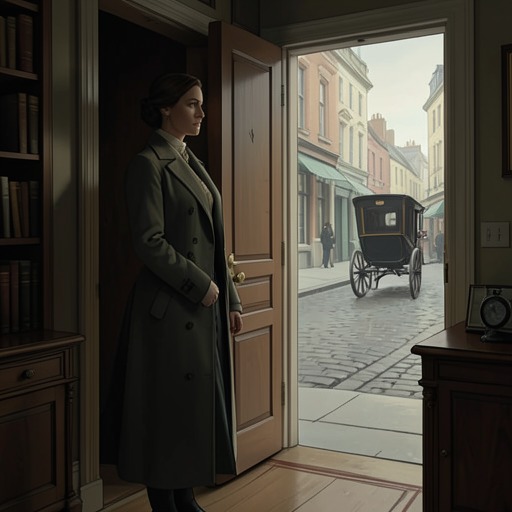
Tony Buddenbrook and Bendix Grünlich's engagement
BuddenbrooksTony Buddenbrook and Bendix Grünlich's engagement is a family-arranged turning point in which the Buddenbrooks’ ideal of continuity overrides Tony’s stated attachment to Morten Schwarzkopf. It is recorded not only in correspondence and family decisions but, strikingly, in Tony’s own hand in the family chronicle: a public-looking declaration of a commitment that her earlier letter had emphatically refused.
Background and Tony’s refusal
Tony’s resistance is explicit in a letter to her father. She sends back Grünlich’s letter and ring, rejects his account of an alleged promise, and asks her father to make clear that she is less willing than before to accept his proposal. She identifies Morten Schwarzkopf as the man she loves and says that he intends to seek her hand after becoming a doctor. Though Tony acknowledges her family’s custom of marrying a merchant, she argues that Morten’s scholarly profession is respectable and that wealth does not guarantee happiness.
Her letter makes the conflict more than a contest between two suitors. Tony understands the family’s preference for a merchant match, but tries to set personal affection and a different conception of respectability against it. Grünlich, meanwhile, continues to press his suit: Tony reports that he has treated her supposed promise as binding and will not leave her in peace. Her father’s response does not accept her account of her feelings for Morten as decisive.
Family argument and inherited obligation
Jean Buddenbrook tells Tony that he has conveyed her refusal to Grünlich, but reports that Grünlich reacted with despair and threatened to take his own life if she persisted. Jean asks his daughter to reconsider, invoking Christian duty toward another person and the prospect that she might be answerable before God for the consequences of a refusal. His letter presents the choice as a moral responsibility, not simply Tony’s private decision.
Jean then places the proposed marriage within a longer family history. He describes people as links in a chain, dependent on those who came before them and obliged to follow an established tradition rather than pursue an independent path. In that argument, accepting Grünlich becomes a demonstration of filial loyalty and family continuity. The family chronicle gives this idea material form: it preserves births, childhood illnesses, schooling, confirmation, and other events in a restrained, reverent record. Tony reads her own past there as part of a history that will continue beyond her.
The chronicle and the engagement entry
Reading the chronicle changes how Tony experiences her place in the family. Its record of even ordinary events, written with what she understands as religious respect for facts, gives her a heightened sense of responsibility. She reflects on her name and on the blank space following it in the genealogical record, and imagines herself as a link called to help shape family history through her actions and resolve.
Tony then takes up the pen and fills that space herself, recording her engagement to Bendix Grünlich, a merchant from Hamburg, on 22 September 1845. The act is pointedly different from her earlier letter: where she had returned his ring and denied commitment, she now writes the engagement into the family’s durable record. The chronicle turns a pressured private decision into an official-looking installment in the family’s succession, and Tony’s own participation makes the conflict between personal feeling and inherited duty visible rather than resolving it.
Marriage and the later family record
The engagement proceeds to marriage in early January 1846. The wedding is preceded by a large celebration attended by friends and relatives from several branches of the family. Guests dance in the dining room and corridor, which have been prepared for the festivities; Peter Döhlmann breaks pottery for good luck, while relatives gather for the ceremony in the columned hall. The public scale and carefully observed social rituals contrast with the private resistance recorded in Tony’s letter.
The engagement’s later significance is sharpened by the family’s attention to money and inheritance. In an accounting of the estate, Jean’s fortune is described as substantially reduced by dowries, compensation to Gotthold, the purchase and furnishing of the family house, and other expenses, although years of earnings offset some costs. Later, the family fortune is calculated at about 750,000 marks courant apart from real estate, despite the loss of Tony’s dowry through Grünlich’s bankruptcy and other business and political setbacks. These financial records place marriage and family continuity within the same household economy that Tony’s engagement had embodied.
Significance in the family’s generational story
The engagement puts the family’s stated ideals and its actual pressures side by side. Jean presents tradition as a trustworthy path, and Tony’s chronicle entry appears to affirm that inheritance; yet the preceding letter shows how little the formal record can tell of the conflict behind a family event. The book repeatedly returns to records as instruments for making a family legible to itself: Tony’s entry declares a new connection, while later family documents preserve losses and decisions that unsettle the promise of uninterrupted continuity.
That tension persists beyond the marriage. When the firm’s centenary approaches, Tony is the family member who calls attention to the date recorded in its papers: the firm was founded on July 7, 1768. And after Thomas’s death, his testamentary wish that the firm be dissolved within a year deeply wounds her, because she sees the decision as an end to an inherited business tradition even though Hanno remains an heir. The engagement episode anticipates this larger generational conflict: family continuity is treated as an obligation, but each new entry in the record also exposes how vulnerable that continuity is to personal decisions and changing circumstances.