Narrator's unit deploys to an Iraqi base
CherryThe event in which the narrator's unit deploys to an Iraqi base begins with arrival in December and the gradual assumption of a forward operating base from the Mississippi Rifles. The base is organized around a noisy, oil-fired power station beside a river: its buildings and oil-soaked surroundings shape both the geography of daily life and the unit's transition into its new operational role.
Base and Relief
The forward operating base had been built around the power station, whose machinery made an unceasing range of noises and whose oil was everywhere, in the air and on the ground. The narrator's company lived near the northern entrance in the Russian village, a cluster of closely spaced concrete buildings that served as its sleeping and living quarters. Delta Company was across the motor pool; the aid station stood on that side as well, near the landing zone. Farther east, beyond the power station and the local shops, the rest of the battalion occupied a tent village near the main entrance. The battalion tactical operations center was in the same area, facing the road along the base's northern wall. From the northern entrance, the road ran west, with the river to the left and Route Martha cutting through fields and palm groves; its two lanes were barely paved.
The incoming unit took over from the Mississippi Rifles, nicknamed the Nasty Girls, in a handover marked by contempt rather than ceremony. The outgoing soldiers had assembled photographs of people they had killed into a PowerPoint presentation with a demeaning title. The two groups initially conducted mounted patrols together, pairing one soldier from each unit as the Mississippi Rifles gradually withdrew. By Christmas, the last of the outgoing soldiers had gone home, leaving the incoming unit on its own at the base.
First Duties and Operational Readiness
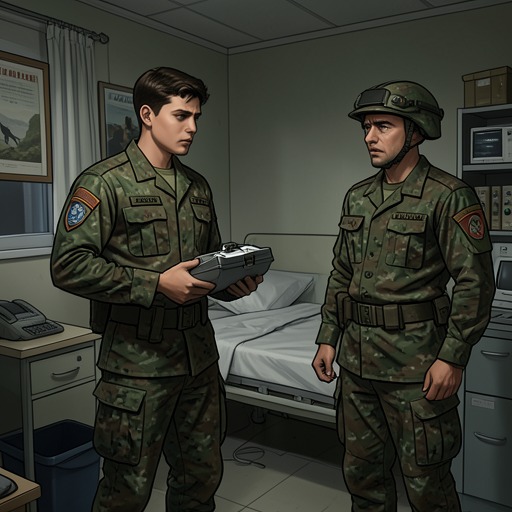
The narrator served as the third section’s aid man while the section was assigned as Quick Reaction Force 1. Its work was to reinforce any incident in the battalion’s operational area: if a patrol came under attack or made contact with the enemy, the section would respond, and if explosive-ordnance personnel were called out, it would escort them. The assignment placed the unit on standby for other soldiers’ emergencies, rather than guaranteeing direct action of its own.
That distinction became clear when mortar rounds struck the battalion tactical operations center. The attack left three people wounded, but the narrator’s section, positioned near the power station, could see nothing: buildings blocked the view even though they were only about two hundred meters from the impact site. The narrator remembers the failure to witness the event as disappointing, because the soldiers had arrived wanting to be at the center of the fighting.
The section’s readiness could also be diverted into tasks the narrator considered pointless. He objected to being sent to establish a security cordon while a sergeant from the command section flew a small Raptor remote-controlled aircraft outside the base. The contrast between the Quick Reaction Force’s stated purpose and this duty sharpened his sense that deployment did not necessarily mean meaningful engagement.
The Medic’s Failure and Its Aftermath
During a later engagement, the narrator was assigned to treat a wounded man who had been shot by the soldiers. He could find no exit wound and could only estimate where the .556 round had gone; after cutting away the man’s tracksuit, he packed gauze into the entrance wound and covered it with a plastic bag taped down on three sides. The man’s eyes repeatedly rolled upward, and his veins were too flat for an intravenous line. The narrator later recognized what he had failed to do: use far more gauze to seal the wound and place the man on his wounded side. His talk of elevating the man’s feet was, by his own account, something to say when he did not know what else to do. The passage makes the medic’s role painfully concrete: he has the tools and responsibility to care for a stranger, but cannot turn uncertainty into effective treatment.
The wounded man died. As the narrator placed his naked body in a body bag, an old woman came out of a house screaming and tried to reach it. Soldiers pushed her back; she fell to her knees, threw handfuls of dirt over her head, and struck her face against the ground. A heavily pregnant young woman began to grieve in the same way, while two boys screamed. When four soldiers carried the body away, the old woman rose and followed, trying to pull the bag from them. The narrator recalls being close to tears and thinking of shooting himself when automatic fire erupted in three long bursts and ended the scene; the soldiers scattered and took cover as the infantry returned fire.
That night the unit went back to the area, and nothing happened. Later, Sullivan told the narrator that the old woman had been killed by their own fire that morning. The narrator believed him because Sullivan would not have said it unless he was sure. The delayed confirmation sharpens the episode’s moral consequence: the grief witnessed beside the body was not separate from the firefight, and the gunfire that broke it up had also killed one of the mourners.
Elsewhere in the deployment, the narrator’s anger at command surfaced in a confrontation with a lieutenant. He accused the officer of ignoring his warning not to drive into a soft field, where the vehicles became bogged down, and claimed that four soldiers had died as a result. He immediately qualified the accusation: the lieutenant had not killed them, and they were acquaintances rather than friends. He also acknowledged the bitter reversal that, had the vehicles not bogged down, the soldiers themselves would have been killed. The outburst therefore holds accusation and correction together: the narrator voices blame in the language of grief, then admits that the outcome he condemns may have saved the unit.
Narrative Significance
The deployment’s account is shaped by repeated corrections to what the narrator first believes or says. The soldiers’ eagerness for combat gives way to the knowledge that proximity does not mean understanding; the narrator’s confidence in his treatment of the wounded man is replaced by a precise reckoning with what he omitted; and his accusation against the lieutenant is immediately qualified by the possibility that the very mistake he condemns kept the soldiers alive. Sullivan’s later report adds another belated revision, turning a witnessed act of mourning into evidence of a death caused by the unit’s own fire. The event’s significance lies in this unstable passage from action to knowledge: responsibility remains, even when certainty about cause, competence, and blame does not.