Little Shahjahan
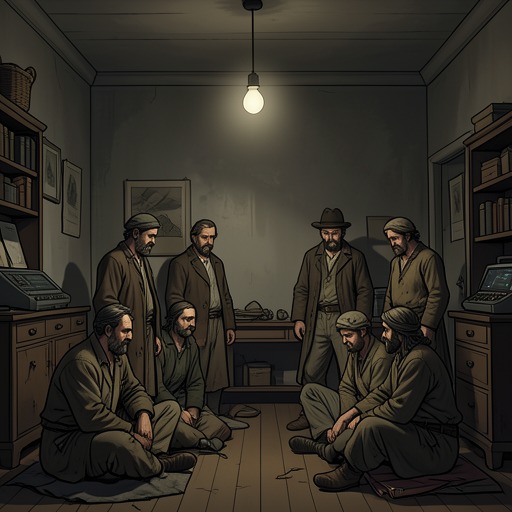
ChowringheeLittle Shahjahan is the humble gathering place for the Hotel Shahjahan staff’s farewell to Sata Bose. In its low-ceilinged hall, amid metal plates, terracotta cups, and a single sixty-watt bulb, the hotel’s workers turn a makeshift midnight meal into an expression of gratitude for a colleague who has defended them, shared tea and money, and helped them obtain medical care.
Setting and Connection to the Hotel
Little Shahjahan is presented as a separate venue used by the Hotel Shahjahan’s employees for Bose’s farewell. The hotel’s work continues without a break, so the gathering begins at midnight; the waiters there are unwilling to stay up late, and Shahjahan’s own employees take responsibility for serving. The arrangement captures the workers’ constrained leisure: even a celebration must be fitted around continuous hotel operations.
The room’s sparse furnishings give the occasion its particular scale. Its ceiling is low, and a lone sixty-watt bulb provides the light. The staff eat from enamelled metal plates and drink from terracotta cups, while Bose receives a porcelain plate, proper cutlery, and a flower-shaped napkin. The contrast marks him as the guest of honor, but the gesture is made from what the employees have managed to assemble, not from the resources of a grand hotel banquet.
The Employees’ Farewell to Sata Bose
The staff choose Little Shahjahan for the farewell because they want to repay Bose in some small way for what he has done for them. They recall that he stood up to their superiors, gave them tea without charge, and sometimes gave them money so they could see good doctors. They also credit his help with Rahim’s being able to stand again. Their affection is practical and specific: it is remembered through acts of protection, kindness, and assistance with illness.
To pay for the meal, the employees pass around a hat, each contributing four annas, the most they can afford. The modest collection and the unusualness of hotel workers being able to attend a dinner together underline how exceptional the gathering is. They are not simply arranging a formal send-off for a departing manager; they are using their limited means to honor someone they regard as having repeatedly acted on their behalf.
The ritual briefly reverses the usual division between staff and honored guest. Bose tries to put aside his fork and knife and eat with his hands, but the others stop him: if they had the utensils, they explain, they too would eat with them, since this is a banquet. Their insistence preserves the distinction of the occasion while also making it communal. Bose is honored, yet the meal belongs to the workers who have organized and served it.
Gómez’s Music and the Meaning of the Banquet
Music is the one thing the employees lack. They have not dared invite Gómez into the shabby surroundings of Little Shahjahan, despite wishing the farewell could include music. Gómez arrives unexpectedly in suitable clothes and asks why he has not been invited. He explains that, lacking the means and instruments for a violin concerto, he has spent the previous three days composing a piece for Bose, a musical farewell to the hotel’s entertainments and performances.
The room falls silent as Gómez plays. The employees have had little opportunity to learn how to appreciate the violin, but on this night, the narrator says, they need no such instruction: the words of the composition reach their hearts. The performance gives the gathering what its organizers could not provide for themselves, and turns a scrappy staff dinner into a shared act of recognition. Music bridges the distance between Gómez, the hotel workers, and the departing Bose without erasing the humble conditions in which they meet.
A Small Room Against the Hotel’s Larger Memory
Elsewhere, the Hotel Shahjahan’s past is preserved through old newspaper cuttings, framed drawings, and recollections of earlier figures and events. That kind of record gives the establishment an official history, while the farewell at Little Shahjahan makes visible a less formal one: the employees’ memories of who helped them, what they endured, and what they could give in return. The contrast is especially resonant in a novel that reflects on how hotel workers may witness dramatic events yet remain absent from the histories that are written.
Little Shahjahan’s significance lies in the intimacy of this counter-memory. Its poorly lit hall does not compete with the grand hotel’s public image; instead, it briefly becomes a place where the workers themselves set the terms of remembrance. Four annas apiece, a carefully distinguished place setting, and Gómez’s unexpected violin recital are small gestures, but together they give Bose a farewell shaped by the people whose lives his kindness touched.