Williams Lane
ChowringheeWilliams Lane is more than the setting for the Adam family’s poverty: it is a neighborhood of hardship and local solidarity, and the place where a child’s beginnings become a revelation about Father Sutherland. Its two-room dwellings, busy street entrance, and children at play form a counterpoint to the Shahjahan Hotel’s polished interiors. Through Williams Lane, the novel links intimate domestic struggle to the enduring consequences of social exclusion and racialized history.
A home after the Shahjahan
After losing his job, Robert Adam explains that his employer considered his marriage to a former barmaid damaging to the company’s prestige, sales, and business. Jane Grey asks that Robert be given work, even without a salary, and he takes a commission-only job selling fabric for a firm that makes umbrellas. His days are spent on his feet: carrying samples to Barabazar in the morning, returning for the modest meal Jane has prepared, and setting out again to find customers. The commissions are so meagre that the couple cannot afford even a servant or cook.
As Jane’s delivery approaches, they live in a dilapidated flat in Williams Lane. Its two rooms have peeling plaster that exposes the brick beneath. Jane, once accustomed to the Shahjahan’s soft carpets and the attentions of its dining-room staff, must now cook and keep the household in order despite her weakening body. The contrast is not simply between luxury and poverty: it marks how quickly the hotel’s protections disappear when a worker’s circumstances change. Jane’s former work in the bar had included offering drinks and smiles to guests; after leaving, she tries secretly to return until a new woman arrives from England. Silverton tells her that a married woman cannot work as a barmaid without being confined in the afternoons, and that no other Calcutta hotel would accept her. The alternative he names is Kidderpore.
Robert’s commission work offers little escape. He walks the districts of Barabazar, Dharmatala, and Shyambazar, but on one exhausted return to Williams Lane he has sold nothing that day and cannot collect payment for earlier sales. The month is ending, and the accounts must be sent to England. The narrator urges him to leave for work in Madras or Bombay, but the advice comes against the accumulating pressures of insecure employment, Jane’s pregnancy, and an inadequate home.
Illness and neighborhood aid
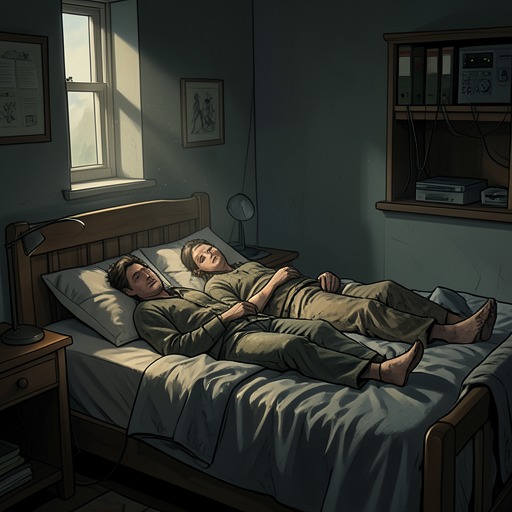
Williams Lane becomes the setting for a crisis when Robert contracts smallpox. A neighboring priest tells the narrator that Robert must be sent to an infectious-disease hospital, but raises the immediate obstacles: who will care for him, and where will the money come from? Jane refuses to leave his side and has herself fainted. The illness exposes how little support the impoverished household can call upon through formal institutions.
The boys of Williams Lane provide a different kind of support. When asked why they are helping, they explain that Saheb-dada is ill and that otherwise they would have nothing to do—perhaps they would steal guavas from the priest’s tree. Their help is presented as part of ordinary neighborhood life rather than a grand rescue. Later, when the narrator goes to see Jane, he finds the boys at the street entrance with sombre faces. They tell him that nobody is at her home and direct him to the priest. Their presence connects the household’s private emergency to a wider circle of local concern, even as the family’s circumstances remain precarious.
A street revisited
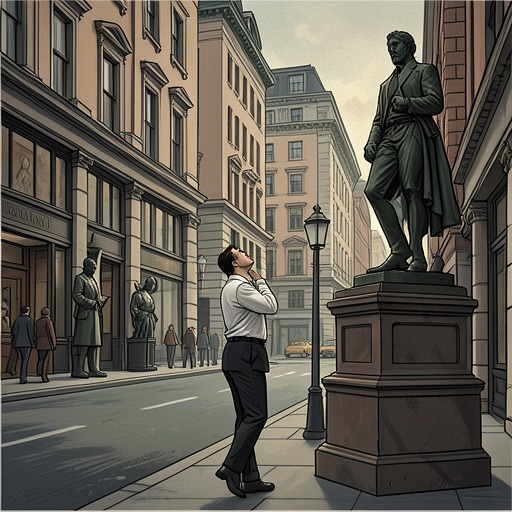
Years later, Williams Lane returns in a different key when Father Sutherland arrives in Calcutta with the narrator. They leave the taxi at the entrance to the lane; at its junction with Bowbazar Street, children are playing in the road. Sutherland points them out and asks who they are. The children’s presence recalls the neighborhood’s earlier role in Robert and Jane’s story, but the visit also leads to a more personal disclosure.
In a letter to Shankar, Sutherland admits that he was born in Williams Lane to Robert Adam and Jane Grey. He identifies himself as the child whose life was saved through the generosity of the boys of Williams Lane, and says that Father Sutherland took him back to England. He also explains that he acquired the legal right to use the clergyman’s surname. The lane is therefore not merely the poor setting from which the Adam household struggles to survive; it is the place that anchors Sutherland’s concealed birth and his connection to the people who helped him as a child.
Poverty, ancestry, and social boundaries
Williams Lane’s association with Rosie adds another history of vulnerability to the setting. William Ghosh visits the home where Rosie’s family lives and sees a dwelling of one and a half rooms, with three sick people on folding beds. Rosie’s family includes a paralysed father and two unmarried sisters without work; the household’s need shapes her choices about employment and marriage. At the Shahjahan, Rosie’s wages and meals support relatives whose lives are markedly poorer than the hotel’s provision for her.
Rosie also tells William that the family’s roots are African, not Anglo-Indian as she sometimes lets people assume. Her account traces her ancestors to people shipped from Africa in the early nineteenth century, brought ashore in chains at Chandpal Ghat, and sold for twenty-five rupees each at Murgighata. Although a law later freed the enslaved people, they remained in Calcutta; lacking their own names, many took the surnames of former owners. This history places the household’s present poverty beside a longer history of coerced movement, enslavement, and constrained belonging. Williams Lane thus gathers histories that the hotel’s public image keeps apart: the economic vulnerability of its former workers, the aid offered by its local children, and the lasting consequences of inherited social divisions.