Lower Circular Road Cemetery
ChowringheeLower Circular Road Cemetery is a recurring destination for mourning in the novel, but not a place where grief finds certainty. Robbie’s funeral procession reaches it, and a later visit by Sutherland and the narrator turns the search for a barmaid’s grave into an encounter with what the city has forgotten. The cemetery’s darkness and untraceable graves stand in sharp contrast to the Hotel Shahjahan, which remains busy and seemingly ageless.
Setting and Narrative Connections
The cemetery enters the narrative through more than one strand of memory. The narrator recalls seeing Sutherland during his early years at the hotel, when the doctor was said to be representing the World Health Organization in India and conducting research connected with a vaccine. Much later, after Sutherland’s return, the narrator accompanies him through episodes involving Williams Lane and its people. The cemetery becomes the place where those recollections converge: a destination already associated with death, and later the setting for an attempt to honor someone whose resting place cannot be identified.
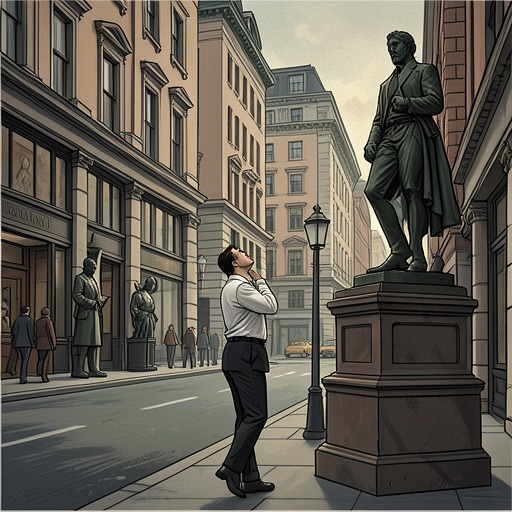
The novel also links the cemetery to an image of bodily damage. Remembering Sutherland’s striking resemblance to a Greek statue, the narrator visits an old house on Chitpore Road to look at a nude male sculpture. The figure has been neglected and vandalized: one arm is broken and part of its face is gone. Those injuries prompt the narrator to see again the agony of Sutherland’s face at the cemetery. The passage connects a damaged object elsewhere in Calcutta to the remembered expression of a living person, making the cemetery present even in a scene that takes place away from it.
Funerals and the Williams Lane Story
Hobbs’s account gives the cemetery a concrete place in a neighborhood tragedy. After Jane dies, Robbie collapses on hearing the news, develops a fever that same night, throws his glass of milk to the floor, and refuses food. The doctors try to save him but fail. At night, the boys from the neighborhood go to see Llewellyn again; the funeral procession travels from the hospital to Lower Circular Road Cemetery. The boys have little money. They had bought a large wreath for their Mem-boudi and borrow money to buy a cheaper one for Robbie, placing it on the hearse.
The procession makes the cemetery the final destination of a communal act of care, carried out with very limited means. Hobbs’s story ends without a full account of what followed: the priest returns home with the newborn baby. Sutherland thanks Hobbs, while the narrator cannot hold back tears. The narrator observes that Sutherland shows no visible sign of being upset, but does not establish what the doctor feels. The cemetery’s presence therefore belongs both to the reported funeral and to the narrator’s response to a story in which loss is followed by the uncertain continuation of life.
The Search for the Barmaid’s Grave
After asking the narrator whether he knows Williams Lane and the cemetery, Sutherland goes there with him. They first visit Williams Lane. A child points toward Sealdah Station when asked about his parents, then struggles free and runs, apparently afraid of being taken away. Sutherland is stunned; in the approaching dusk, the narrator sees him wipe his eyes with the corner of the handkerchief he had used to clean the child’s nose. From the lane, the two go directly to the cemetery.
By then darkness has spread. Flower sellers stand at the entrance, and Sutherland buys flowers when the narrator has no money. Inside, they can see almost nothing. The narrator notes that the ground might be full of snakes and scorpions, and that Sutherland’s lighter can provide little illumination. In the darkness, they cannot locate the grave of the former barmaid of the Shahjahan. The boys of Williams Lane had brought her there, but neither visitor knows where in the enormous grounds she was laid to rest; the narrator supposes that perhaps none of those boys is still alive.
They place the flowers beside a tree and Sutherland stands silently. The gesture is an act of remembrance, but not a recovery of the grave’s exact location: the flowers mark a place near them, not a confirmed headstone or identified burial plot. Hobbs’s verse about the girls of Kidderpore echoes in the narrator’s mind as he watches Sutherland, joining the cemetery visit to the story of people who have disappeared from the city’s visible life.
Memory, Obscurity, and the Living City
The cemetery’s importance rests partly on the limits of what can be recovered there. The visitors arrive with a name and a history, yet the dark, immense grounds defeat their attempt to locate the barmaid’s grave. Even the boys who carried her to burial may no longer be alive. The scene makes remembrance a practical, fragile act—buying flowers and setting them down—rather than a confident claim to know exactly where the dead rest.
Against that obscurity, the Shahjahan appears to the narrator as eternally young, continuing to attract the hungry, thirsty, and lustful. The hotel’s ongoing life does not cancel the losses associated with Williams Lane; it intensifies the contrast between a place that draws people in and a cemetery where individual traces are difficult to find. Lower Circular Road Cemetery thus gathers several forms of mourning—the funeral procession, Sutherland’s silent response, and the narrator’s recollection—while preserving the novel’s uncertainty about how much a city, or its survivors, can truly remember.