Catholic Church
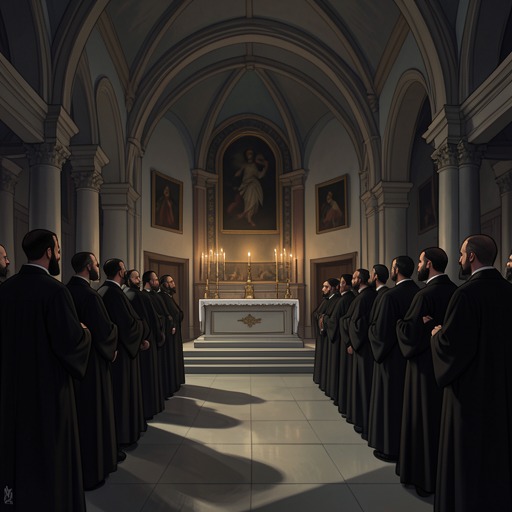
ConclaveThe Catholic Church is both the institution the cardinals must govern and the community whose future gives their election its stakes. After the Pope’s death, 118 cardinals gather behind the locked doors of the Sistine Chapel to choose a successor. Their secret ballots expose the Church to the pressures of ambition, faction, and institutional self-protection, while the election of Vincent Benítez as Pope Innocent XIV offers a different model of authority: one shaped by humility, doubt, and a refusal to answer violence with violence.
A worldwide institution under pressure
The Church appears in the novel as a global body, represented in the conclave by cardinals drawn from across the world. The gathering is not merely a contest among individuals: the candidates carry competing expectations about the institution’s direction. Aldo Bellini is regarded as the liberals’ intellectual hope; Joseph Tremblay combines his office as Camerlengo with leadership of the Congregation for the Evangelisation of Peoples; Joshua Adeyemi embodies the possibility of an African pope. Their candidacies reveal how questions of leadership, geography, and faction become entangled in a single election.
The death of the Pope makes the institution’s procedures and reputation immediately consequential. In the first hours, Tremblay gives Jacopo Baldassare Lomeli a printed timeline of the death, setting out the Pope’s final evening and the emergency treatment that preceded the declaration of death. The account is presented as a safeguard against later discrepancies and malicious rumours. The novel thus places institutional credibility alongside spiritual authority: the Church must not only choose a leader, but also sustain trust in its handling of a sensitive transition.
The election follows weeks of funeral observances and private congregations in Rome, where the cardinals have discussed the Church’s future. Although the familiar division between progressives and traditionalists surfaces, these meetings pass without controversy. Once the electors enter the Sistine Chapel, however, the private disagreements become visible in the ballots. The first count produces an unusually dispersed field: thirty-four cardinals receive at least one vote, and no candidate is close to the two-thirds threshold of seventy-nine. The figures make institutional unity a practical problem, not an abstraction.
Curial authority and the question of accountability
The novel distinguishes the Church’s worldwide membership from the Roman Curia, the bureaucracy that administers its central institutions. Lomeli recognizes among Curial officials a loss of awe: a familiarity with power that he has also detected in himself. The late Pope had warned the officials against vanity, intrigue, malice, and gossip. This criticism lends the election a second dimension: the question is not only who can command votes, but whether the institution’s administrators remain answerable to the religious purpose they serve.
The late Pope’s financial reforms are recalled as a sustained confrontation with Curial habits. From the beginning of his pontificate, he rejected the full regalia of office and chose to live in Casa Santa Marta rather than the Apostolic Palace. He demanded transparent accounts, receipts, and outside tenders for even small building projects, then brought in accountants and management consultants to examine the files. Their offices were established on the first floor of Casa Santa Marta. Bellini recalls that these measures provoked hostility within the Curia, while newspaper leaks exposed alleged misuse of funds intended for the poor.
The Pope’s private papers give that conflict material form. In his apartment, Lomeli discovers documents concealed inside a bedpost, including bank statements, transfers, addresses, and notes in the Pope’s handwriting. One list compares the area of official apartments occupied by cardinals—including 445 square metres for Lomeli, 410 for Bellini, 480 for Adeyemi, and 510 for Tremblay—with the Pope’s 50-square-metre accommodation at Casa Santa Marta. An attached report estimates the overall area of the Administration of the Patrimony of the Apostolic See at 347,532 square metres, with a potential value above €2.7 billion but a book value of €389.6 million; it says the paid occupancy rate appears to be only 56 percent and suggests that much income is not being properly declared. The contrast between the figures and the Pope’s modest residence sharpens the novel’s scrutiny of stewardship and oversight.
The reforms also help explain the Pope’s isolation. Bellini describes his pontificate as a war fought through demands for transparency, leaks, and attacks from traditionalist opponents who accused him of heresy when he spoke in favour of common-sense approaches to gay people, divorced couples, or the promotion of women. The Pope’s popularity outside the Holy See grew as his trust within it diminished. His experience suggests that institutional change may be resisted not only by a single faction but by a system whose officials have reason to protect established practices.
The conclave as collective choice
The ballots turn the Church’s divisions into a changing arithmetic of alliances. In the first ballot, Goffredo Tedesco receives 22 votes, Adeyemi 19, Bellini comes third, Tremblay is close behind him, and Benítez receives one. Lomeli records five votes for himself, enough to make him fear that he may have drawn support away from Bellini. With 38 votes going to others, the field remains fragmented, and the required majority is still far away. The rules require continued voting for a two-thirds majority, potentially through thirty ballots over twelve days before a different majority procedure could be used.
The next ballots show how quickly support can shift. Adeyemi gains sixteen votes from candidates who have fallen away, while Tedesco adds seven; Bellini and Tremblay barely move. Benítez rises from one vote to two, a small change that initially sits at the edge of the larger contest. Later, after Adeyemi loses more than half his support, thirty-two votes move among the other candidates: Tremblay gains eleven, Bellini eight, Lomeli six, Tedesco four, and Benítez three. The shift follows the spread of news from the dining hall, demonstrating how information and public events can reorder an election even within a formally secret process.
The alliance problem becomes explicit when Bellini and Lomeli consider their position. Bellini has fifteen votes and Lomeli twelve, but even a complete transfer of Bellini’s supporters would leave Lomeli behind Tremblay and Tedesco. Their adviser Giulio Sabbadin calculates that an alliance combining their twenty-seven votes with Tremblay’s forty would give Tremblay sixty-seven—twelve short of election. Bellini accepts that Tremblay has broad appeal despite his own reservations, and invokes the possibility that the Holy Spirit may be working through the conclave. The scene puts strategic coordination beside religious discernment: the electors must act through human negotiation while asking whether the result can be understood as more than political arithmetic.
Unity, violence, and the meaning of leadership
Lomeli’s address to the cardinals defines unity not as uniformity, but as the work of a body whose different members are all needed. He warns that certainty can become an enemy of unity and tolerance, and presents doubt as part of living faith. His appeal is for a pope capable of sin, repentance, and continued service rather than one who claims moral invulnerability. In this account, the Church’s strength depends not on the absence of human failure but on the willingness to acknowledge it and continue.
That ideal is tested when coordinated terrorist attacks strike at a moment when the Church has no elected pope. Lomeli urges his colleagues to think clearly and warns that the violence could be interpreted as the beginning of a religious war. Tedesco instead calls for a forceful defence of traditional values, invoking the Battle of Lepanto and presenting the crisis as confirmation that the Church has grown weak. Benítez answers from his experience as Archbishop of Baghdad: he describes a Christian community in Iraq reduced from 1.5 million before the American invasion to 150,000, and says that Christians who have suffered violence would not wish to see violence answered in kind. Their disagreement makes the Church’s response to attack a conflict over both policy and moral identity.
Benítez then asks the electors not to prolong the contest until the rules would permit election by a simple majority. He urges them to unite behind the leading candidate and asks those who voted for him to transfer their support to Lomeli. The appeal is striking because it renounces his own growing candidacy and treats the continuing election as subordinate to the Church’s need for leadership. On the eighth ballot, however, Benítez receives 92 votes, Lomeli 21, and Tedesco five. The result gives the Church a new pope by a clear majority and makes Benítez’s withdrawal from the contest a decisive act of support rather than an end to his influence.
Benítez takes the name Innocent XIV. Lomeli reads the choice as a symbol suited to a time of bloodshed: a return to a tradition of virtue-based papal names, yet also a declaration with a new force. He kneels before the newly elected pope, who asks him to remain Dean and says he will need his advice. Lomeli replies that his first advice is to make no promises of office yet. The exchange leaves the Church at the beginning of a new pontificate, with its customary offices and political questions intact, but with leadership entrusted to a man whose election has been shaped by self-renunciation, restraint, and the demand that the institution answer violence without reproducing it.