Swiss Guard
ConclaveThe Swiss Guard is the Vatican’s uniformed security force and a recurring presence at the thresholds of the papal election. In the narrative it joins ceremony to practical protection: its members salute arrivals, accompany cardinals, and stand among the personnel securing the conclave, while armed officers and helicopters make clear that the surrounding danger is not merely ceremonial. The contrast is sharpest when security forces seek entry to the chapel after explosions: Cardinal Lomeli blocks them, insists that nobody is hurt, and protects the election’s sacred space even as the Guard remains positioned outside.
Presence at Vatican thresholds
At the Casa Santa Marta, a Swiss Guard member greets Lomeli at the plate-glass entrance with a formal salute, white glove raised to a red-plumed helmet. The gesture establishes the Guard as the first visible checkpoint in a night of confusion following the Pope’s death. Its role is at once practical and emblematic: the Guard stands at the boundary between the public-facing institution and the private crisis unfolding within.
The Guard also accompanies the arriving cardinals as they come up the slope from the Palace of the Holy Office. One member, carrying a halberd, walks beside prelates in black cassocks and red skullcaps. The old-fashioned weapon and plumed helmet lend the procession a historical appearance, but the cardinals’ wheeled suitcases bring it back to the immediate logistics of a modern election. The Guard’s presence helps make that threshold crossing orderly and visible.
Security around the conclave
The election takes place under an unusually serious security warning. Lomeli has been briefed that the threat of terrorism is considered imminent; the planned precautions include surface-to-air missiles and snipers on rooftops, five thousand uniformed police and army personnel patrolling nearby streets, and hundreds of plain-clothes officers among the crowds. The Guard belongs to this wider security environment, although the account distinguishes its visible ceremonial duties from the larger deployment of police, soldiers, and other security personnel.
As the conclave closes, the Guard appears among those leaving the Sistine Chapel after the command Extra omnes. The command formally clears the chapel of people who are not entitled to remain for the election. The commandant, identifiable by his white-plumed helmet, departs with the security men, officials, clergy, and other personnel. The sequence places the Guard within the machinery that enforces the conclave’s separation from the outside world, while the doors are ultimately closed from within.
Emergency and controlled access
After explosions are heard, Lomeli goes into the vestibule and finds broken glass where two large windows have been blown in. Security men arrive with guns drawn, accompanied by O’Malley and Mandorff, who are protesting. Lomeli steps across the glass and spreads his arms to block their entry, telling them to leave and assuring them that nobody is injured. This moment shows a tension between emergency response and the conclave’s protected space: security personnel move toward the chapel, but the Dean asserts authority over who may enter.
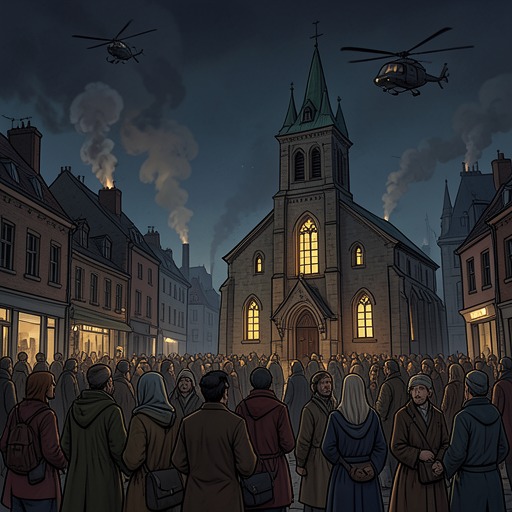
Later, when Lomeli returns to the Casa Santa Marta in a police car, a Swiss Guard member steps forward to open the door. The square is crowded with police cars and security personnel, and helicopters patrol overhead; the Guard’s familiar presence at the entrance contrasts with the extraordinary force gathered outside. Lomeli passes through the lobby, where cardinals and officials await news, and asks for privacy before addressing them. In these scenes the Guard helps secure the physical setting, but decisions about information and access remain in the hands of the conclave’s officials.
Institutional role and significance
The Swiss Guard’s appearances connect the election’s formal order with its vulnerability to events beyond the chapel. Salutes, halberd, and ceremonial dress preserve the visible traditions of Vatican life; the Guard’s place among security personnel, amid warnings of terrorism and the aftermath of explosions, gives those traditions a contemporary protective function. Yet the Guard does not determine what the cardinals may discuss or how the election proceeds. Those choices are handled through the conclave’s rules and the Dean’s authority. The organization therefore signifies both the defended boundary around the election and the limits of physical security: it can guard entrances and accompany proceedings, while the institution’s response to crisis still depends on judgment, procedure, and collective decision.