College of Cardinals
ConclaveThe College of Cardinals is the Church’s electoral body and the institutional arena in which the novel’s succession struggle unfolds. Following the Pope’s death, its members gather in Rome, weigh competing candidates, and conduct a conclave under rules that govern eligibility, deliberation, and voting. The College is not merely a backdrop for individual ambition: its decisions about procedure and access determine how the election can proceed, while its internal factions expose the tension between preserving institutional order and responding to new information.
Composition and Responsibilities
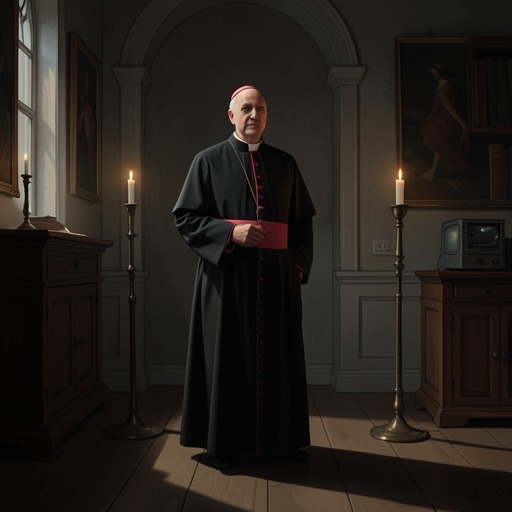
The College’s senior leadership is visible on the night of the Pope’s death. Among those present are Secretary of State Aldo Bellini, Camerlengo Joseph Tremblay, Cardinal Major Penitentiary Joshua Adeyemi, and Jacopo Baldassare Lomeli, Dean of the College. Their offices carry different responsibilities, but the scene also reveals that seniority does not mean control over every piece of information: Lomeli had imagined he was the first summoned and realizes he was actually the last. The distinction between rank, access, and practical authority will shape the election that follows.
After the death, cardinals arrive in Rome from around the world for funerary observances and almost daily congregations. These private meetings discuss the Church’s future. Familiar differences between progressives and traditionalists surface, but the preliminary gatherings pass without major controversy. The College thus begins its work through consultation before the formal election, bringing a geographically broad body into a process whose decisions must ultimately be made by a two-thirds majority.
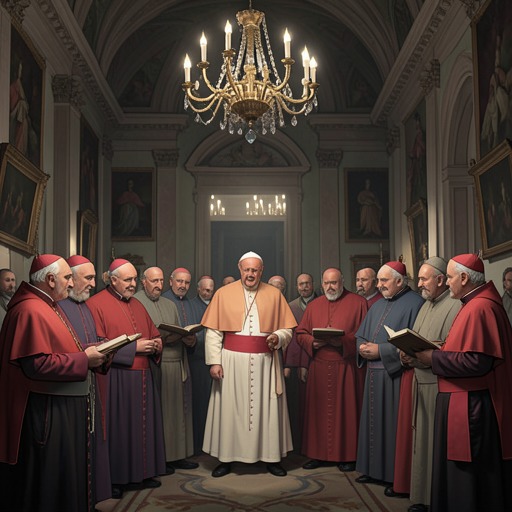
The conclave’s electorate is not identical to the wider group of people engaged in Vatican affairs. The cardinals are divided among supporters of Bellini, Tremblay, and Adeyemi, as well as electors who are undecided or harbor their own ambitions. At mealtimes, that political map becomes visible in the seating: Bellini’s liberals occupy one table, Tremblay presides over the traditionalists at another, and a third gathers those between the factions or pursuing less public aims. Yet these groupings are not fixed voting blocs; the first ballot will reveal a much less predictable distribution of support.
Factions, Candidates, and the First Ballot
The principal candidates bring distinct forms of support into the College. Bellini is the liberals’ longstanding intellectual hope, with experience as rector of the Gregorian University and Archbishop of Milan. Tremblay combines his office as Camerlengo with his leadership of the Congregation for the Evangelisation of Peoples, giving him links to the developing world; he is perceived as American without actually being one. Adeyemi carries the possibility of becoming the first Black Pope, a prospect that attracts intense media interest. These profiles make the succession a contest not only among individuals but among competing expectations of what the Church’s leadership should represent.
The first ballot frustrates attempts to read the College as a simple contest between two established camps. Thirty-four cardinals receive at least one vote, reportedly a record; electors vote for themselves, friends, and fellow countrymen. Lomeli’s own name appears several times, and his growing tally alarms him because even a handful of votes in a crowded field could make a candidate viable. After roughly eighty votes have been read, the likely contenders appear to be Tremblay, Bellini, Adeyemi, and Tremblay’s principal rivals, but the count remains unsettled until the final ballots.
The resulting figures make the scale of the deadlock concrete: Tremblay receives 22 votes, Adeyemi 19, Bellini finishes behind them, and Lomeli receives five; 38 votes go to others. Lomeli fears that his own votes may have drawn support away from Bellini, whose campaign had expected to lead. No candidate is close to the 79 votes required for election. The College’s dispersed support therefore weakens any immediate claim of inevitability and leaves coalition-building central to what follows.
The governing timetable gives that uncertainty a potentially long duration. Lomeli consults the Apostolic Constitution: the cardinals must continue balloting for a two-thirds majority, for as many as thirty ballots over twelve days, before they may use a procedure under which a simple majority suffices. The rule supplies a formal path through deadlock, but its length also makes the prospect of prolonged division a practical burden for the electors.
Rules, Eligibility, and the Dean’s Authority
As Dean, Lomeli becomes responsible for managing the election, a duty he had not expected to perform. He has previously tried to resign and had thought of himself as a temporary officeholder; his earlier prostate-cancer diagnosis had contributed to his assumption that he would die before the Pope. Instead, he must organize a conclave under difficult circumstances and makes impartiality his first stated obligation. The office gives him procedural responsibility without making him the leading candidate, a distinction that becomes important when his own name receives votes.
The rules are not only constraints; their interpretation determines who can take part. When a late-arriving cardinal, Vincent Benítez, is said to have been created in pectore, Lomeli initially shares the suspicion that he may be an impostor. He nevertheless argues that paragraph 39 of the Apostolic Constitution applies: a cardinal-elector who arrives re integra, before a new Pope has been elected, may join the election at the stage already reached. Lomeli’s reading establishes Benítez’s legal right to participate and shows the Dean using canon law to resolve an exceptional question of membership rather than treating custom or initial suspicion as decisive.
The same concern for procedure shapes the handling of information. Early in the succession crisis, Lomeli proposes amending the official account of the late Pope’s final hours to include his attendance at vespers, while preparing a fuller record of the day to keep in reserve. The other senior cardinals agree. Their response reflects the risk that discrepancies in an account of an unexpected death could fuel malicious rumors, but it also places control of the documentary record in the hands of a small group of leaders. Throughout the election, the College must balance orderly communication against the danger that withholding information will undermine confidence.
When a later crisis raises the question of whether the conclave may hear new information, Lomeli again turns to its governing rules. He asks the assembled cardinals for authority to speak under paragraphs 5 and 6, which allow discussion of certain matters in special circumstances if a majority agrees. He puts the question to a vote rather than letting a senior opponent decide it unilaterally; a large majority supports hearing the information, while Tedesco and a smaller group oppose it. No one leaves when Lomeli says dissenting cardinals are free to do so. The episode demonstrates that procedural legitimacy is actively made through debate, interpretation, and collective consent.
Crisis and Institutional Adaptation
The conclave’s rules were written for circumstances that did not anticipate the multiple terrorist attacks that occur during its proceedings. In retrospect, theologians and canon lawyers recognize that Universi Dominici Gregis, issued by Pope John Paul II in 1996, belongs to a less apprehensive age: five years before the September 11 attacks, its authors had not envisaged coordinated attacks on this scale. But at lunchtime on the third day, the cardinals at Casa Santa Marta do not yet know how to proceed. They face the paired questions of how deliberations can continue after the violence and how they can be stopped.
The crisis unsettles the College’s political balance as well as its routine. Lomeli sees Tedesco standing uncertainly among the cardinals; if three supporters abandon him, he will lose the blocking third that allows his faction to prevent a decision. Benítez raises his hand to speak. Tedesco objects that the meeting should not become a general congregation, since that phase has ended, but Lomeli permits the intervention and challenges him to identify a rule forbidding it. The contrast is institutional as much as personal: one response treats the closed procedural phase as decisive, while the other asks whether the rules actually prohibit a necessary conversation.
Lomeli’s handling of the assembly makes the College’s formal structure visible under pressure. He first asks permission to address the cardinals and secures a majority for receiving the information; later, after the election result, he follows the constitution’s prescribed steps, asking that the Junior Cardinal-Deacon summon the Master of Papal Liturgical Celebrations and the Secretary of the College. These procedures give the gathering an ordered form even as unprecedented events force its members to interpret the rules in real time.
Election and Continuity
When the required majority is achieved, the College’s deliberations become an act of institutional transfer. The announcement of the result brings applause, and Lomeli joins it more loudly than anyone. He stands, prompting the entire assembly to rise in an ovation, while Tedesco claps slowly and Benítez remains seated, head bowed in prayer. The election is not complete at the moment of applause: Lomeli goes to the altar with the Apostolic Constitution and asks Benítez whether he accepts his canonical election as Supreme Pontiff. The College’s choice must pass from a tally of votes into the elected man’s formal acceptance.
Across the novel, the College’s significance lies in this combination of authority and vulnerability. Its procedures preserve a lawful route to succession, but the route depends on people deciding how to apply the rules, what information to admit, and whether factional advantage should yield to common deliberation. The body that gathers to choose a Pope must therefore do more than count votes: it must sustain the legitimacy of its decision through disagreements, an unexpected elector, prolonged uncertainty, and a crisis for which its written framework was not designed.