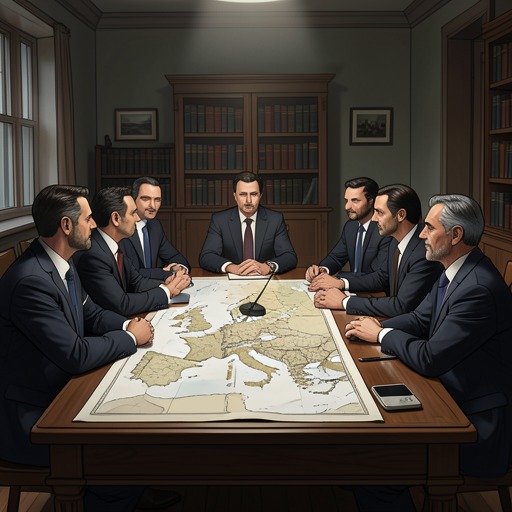
Traditionalist Cardinalist faction
ConclaveThe traditionalist faction is the conservative current in the College of Cardinals that rallies around Goffredo Tedesco during the papal succession contest. It brings organized support, a forceful defense of inherited practice, and deep hostility to the late Pope’s reforms into the election. Its influence is both electoral and institutional: the faction’s members challenge Jacopo Baldassare Lomeli’s public appeal for doubt and tolerance, while the widening divide makes his intended neutrality increasingly difficult to maintain.
Identity and Formation
The faction is one of the principal alignments among the cardinals, rather than a body with a separately described formal structure. At the start of the succession crisis, Bellini, Tedesco, and Adeyemi are each associated with supporters inside the electoral college; Tedesco’s following among traditionalists ensures that he is a prominent candidate even though he had been the late Pope’s most savage critic. Bellini’s liberal supporters and the cardinals who remain undecided or harbor ambitions of their own provide the other visible groupings around which the Italians arrange themselves.
Tedesco’s appeal is bound to a program of resisting change. In a meal-time argument, he presents the abandonment of Latin as a cautionary example: reforms intended to improve communication, he argues, have instead made it harder for cardinals of different language groups to communicate. The dining room’s separation of Italians, Spanish-speakers, and English-speakers becomes evidence in his case for restoring a common language. His argument turns a practical observation about the Conclave into a wider criticism of reform and a warning about the choice of the next Pope.
Support and Electoral Reach
The faction’s support extends beyond Tedesco’s immediate Italian circle. Paul Krasinski, the Archbishop Emeritus of Chicago, has already endorsed Tedesco, using language that condemns the late Pope’s pontificate as a period in which the Church had lost its proper path. The endorsement is especially pointed because Krasinski is presented as a traditionalist and a strong supporter of the Legionaries of Christ. His alignment also complicates assumptions that the nineteen North American votes will mostly go to Tremblay: Tremblay may expect most of them as Archbishop Emeritus of Quebec, but Krasinski is explicitly not among his supporters.
At the Italian cardinals’ meal, Tedesco presides over the traditionalist table, distinct from Bellini’s liberal gathering and a third table of undecided cardinals or men with their own ambitions. Around Tedesco are conservative archbishops from Agrigento, Florence, Palermo, and Perugia. Tutino, formerly regarded as a liberal but disgraced as Prefect of the Congregation for Bishops, is also present; Lomeli judges that he may hope a Tedesco pontificate will restore his career. The scene shows that factional alignment can draw together people with different histories and immediate interests, not only those who share a single stated argument about doctrine.
Conflict over Reform and Authority
The faction’s opposition is part of a longer conflict over the late Pope’s leadership. Bellini recalls that the pontificate began with the Pope rejecting full regalia and choosing to live at Casa Santa Marta rather than the Apostolic Palace. The Pope then demanded financial transparency from the heads of the congregations: proper books, disclosure of accounts, outside tenders for building work, and receipts. Accountants and management consultants were brought in to review files, with their offices set up on the first floor of Casa Santa Marta. Bellini describes the resulting resistance as extending beyond the old guard; leaks and embarrassing reports followed, while Tedesco and his allies attacked the Pope’s comments on gays, divorced couples, and the promotion of women as heretical.
In this account, the late Pope’s public popularity contrasts with his growing isolation inside the Holy See. The traditionalists’ campaign is not depicted only as a disagreement over liturgy or abstract theology: it is also part of the institutional resistance to financial scrutiny and to the direction of reform. Bellini’s recollection presents the Pope’s papacy as a war fought across policy, public reputation, and trust within the Curia, with Tedesco’s faction among its most persistent opponents.
Confrontation with Lomeli
Lomeli’s appeal for unity, tolerance, and humility becomes a point of conflict with the traditionalists. Although he has tried throughout his career to remain neutral, he finds that his words are welcomed mainly by the liberal faction. Archbishop Dell’Acqua of Bologna praises him aloud, while Gambino, Archbishop of Perugia and one of Tedesco’s strongest supporters, silently rebukes him by wagging a finger. Tedesco then challenges Lomeli’s interpretation of Saint Paul, arguing that uncertainty is no guide for those preparing for battle. The encounter makes the political cost of Lomeli’s speech visible: a Dean who intended to stand above the factions is increasingly identified with one side.
Tedesco’s position is stated more fully in the meditation he delivers to the cardinals. He warns against the “dictatorship of relativism,” argues that not every opinion deserves equal weight, and calls for a Church that will move the world rather than move with it. The speech opposes the recent direction of the Church and urges the electors to choose a pastor who will end what he calls its drifting. The traditionalist case is therefore presented as a demand for firm direction and continuity, set against Lomeli’s concern that inflexible certainty can damage unity.
Institutional Influence and Limits
The faction’s influence does not amount to control over every decision. During the crisis following the explosion, Lomeli proposes putting to a vote whether the Conclave should receive information about what has happened. Tedesco attempts to intervene, but Lomeli conducts the vote under the Conclave’s rules; scores of cardinals support hearing the information, while Tedesco, Krasinski, Tutino, and roughly a dozen others oppose it. The measure passes, and no one takes Lomeli’s invitation to leave rather than listen. The episode shows both the faction’s capacity to resist and the limits of that resistance when a majority accepts the Dean’s procedure.
The faction remains consequential because its arguments and supporters shape the choices facing the electors even when they do not prevail in a particular procedural contest. Its table, endorsements, and public challenges make the succession more than a contest between individual candidates: they expose a struggle over what the Church should preserve, what it should change, and how much authority the new Pope should exercise against entrenched interests.