Apostolic Camera
ConclaveThe Apostolic Camera is a Vatican office whose officials appear at crucial points in the transition from a Pope’s death to the election of a successor. Its personnel help manage practical and ceremonial matters, but the novel also situates them within disputes over official accounts, financial oversight, and the authority of conclave rules. The office’s presence gives institutional form to a period in which the Church must both record a death and decide who may participate in what follows.
Role and Personnel
At the Pope’s deathbed, at least four priests from the Apostolic Camera are among the more than a dozen people gathered in the crowded papal suite. The Camerlengo, Joseph Tremblay, arrives with two assistants from the office. After announcing that the Pope is with God, he signals to them; one carries a silver box used in the ensuing handling of the Fisherman’s Ring. The office is therefore present not only as a body of clergy but as practical support for the procedures that mark the end of a pontificate.
The Camera’s personnel also form part of the larger administrative response to the death. Tremblay takes charge after being summoned, consistent with the stated rule that the Camerlengo is the first member of the Curia officially notified. The novel shows how this chain of responsibility gives the office and its head a consequential position at the moment when facts, procedure, and institutional legitimacy are especially sensitive.
The Death and Its Official Record
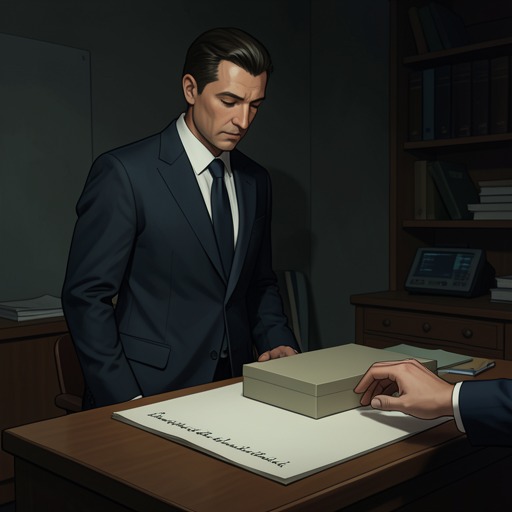
The response to the death includes a prepared timeline, printed and presented by Tremblay. It records the Pope’s evening meal with Janusz Woźniak at Casa Santa Marta, his reading and meditation, the time he went to bed, Woźniak’s discovery that he had no vital functions, the doctor’s unsuccessful emergency treatment, and the time of death. Tremblay explains the need for a consistent official account by invoking the lingering public suspicion surrounding the death of Pope John Paul I. In this scene, documentation is more than routine record-keeping: it is presented as protection against discrepancies and malicious rumours.
Tremblay also produces the Pope’s recent medical records, including an angiogram from the previous month showing a blockage. The display of the timeline and medical evidence places the Camerlengo in control of information about the death, while the Dean, Jacopo Baldassare Lomeli, negotiates how much should be included in the public document. Lomeli proposes adding the Pope’s attendance at vespers and preparing a fuller account of the day for reserve use. The other senior cardinals accept the proposal, making the official narrative a matter of collective caution as well as administrative procedure.
Ritual Duties and the Vacancy
After the death is acknowledged, the Camerlengo asks Woźniak to bring him the Pope’s ring. When it proves difficult to remove, Woźniak works it free and delivers it to Tremblay, who uses shears from the silver box to sever its seal. Tremblay then declares the Holy See vacant. The action converts the death into a formal institutional transition: a distinctive object and a brief announcement make the change in status visible and official.
The Camera’s practical role continues as the Pope’s body is prepared for removal. Tremblay makes arrangements with the Holy See’s media office; less than half an hour later, ambulance attendants take the body from the apartment. The cardinals descend ahead of the stretcher and escort it through the building and out toward the waiting ambulance. Members of the Apostolic Camera follow in procession. Their presence connects the office to the public and ceremonial handling of the Pope’s death, alongside the senior cardinals and the religious gathered in silence.
Administration, Oversight, and Authority
The office appears within a wider institutional setting marked by financial scrutiny. The Pope’s hidden papers include property and financial records prepared for him by APSA, the Administration of the Patrimony of the Apostolic See. An accompanying report estimates the total area of the APSA patrimony at 347,532 square metres, with a potential value above €2.7 billion but a stated book value of €389.6 million; it identifies paid occupancy of only 56 percent and suggests that much income is not properly declared. The novel does not equate APSA with the Apostolic Camera, but places both within the administrative structures whose records and practices are under examination.
Aldo Bellini recalls that the Pope demanded transparent accounts, receipts, outside tenders, and independent scrutiny, and that accountants and management consultants were installed at Casa Santa Marta to examine files. His account describes resistance within the Curia and a pontificate increasingly isolated by leaks and internal opposition. Against that background, the Camera’s involvement in official records carries a broader significance: institutions depend on entrusted officials to preserve and communicate information, while the novel repeatedly raises the question of whether procedure serves accountability or merely manages appearances.
Conclave Procedure and Institutional Continuity
The Camera’s administrative environment intersects with the legal rules governing the conclave. When Vincent Benítez arrives claiming to have been created cardinal in pectore, Tremblay’s position as Camerlengo forms part of the institutional context in which his status is assessed. Lomeli argues that the Apostolic Constitution permits cardinal-electors arriving re integra to join the election at the stage reached, and concludes that Benítez is legally a cardinal. The episode distinguishes the office’s immediate administrative authority from the separate question of who is entitled to vote, which must be resolved through interpretation of the governing rules.
During a later emergency, Lomeli asks the assembled cardinals for permission to address what has happened, citing the Constitution’s provisions for discussing special matters or problems when a majority agrees. He then puts the question to a vote, and the cardinals authorize the discussion. These moments show the conclave operating through formal procedures even under pressure: authority is exercised through rules, and a crisis must be admitted into deliberation before it can be addressed. The Apostolic Camera’s recurring presence at the boundary between the Pope’s death and the conclave helps make that transition administratively possible, while the novel leaves open whether procedure alone can guarantee honest stewardship.