Bhuvan Chowdhury
DevdasBhuvan Chowdhury, also identified as Bhuvanmohan Chowdhury, is the zamindar of Hatipota village and Parvati Chakravarty’s second husband. A wealthy widower who marries again after losing his wife, he enters the story through a match shaped by money and family pressure. His later tenderness toward Parvati complicates that arrangement: he can recognize that she does not belong in the household he has brought her into, even as he remains part of it.
Identity and Marriage
Bhuvan is the zamindar of Hatipota, about twenty miles from Parvati’s home in the Burdwan district. When Parvati’s father returns from arranging a match, Bhuvan is presented as well off and below forty. He had lost his wife the previous year and wanted to marry again. The account at this point makes his age and wealth part of the match’s appeal, but the marriage scene later describes him as well above forty, leaving a pointed discrepancy between the initial report and his appearance at the ceremony.
The proposed marriage is not welcomed by most people in Parvati’s household. Nevertheless, nearly two to three thousand rupees is expected from Bhuvan, one way or another, and the women fall silent. The arrangement thus places his wealth at the center of a decision whose consequences fall on Parvati. His status as a zamindar and his capacity to provide money give him substantial weight in the match, while the household’s disapproval does not stop it from proceeding.
The Wedding at the Chakravarty Home
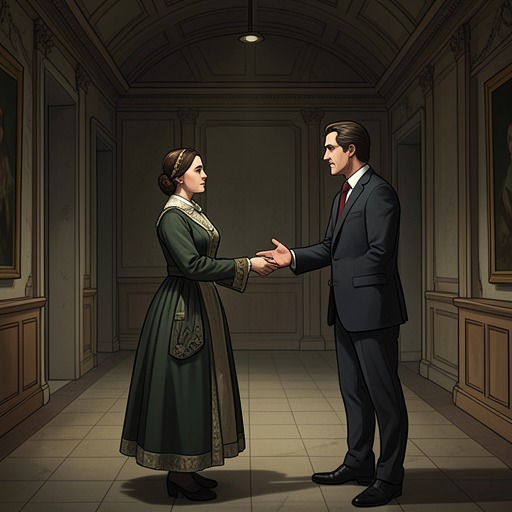
Nearly ten days after Parvati’s injury has healed, Bhuvan arrives at the Chakravarty home in the groom’s finery. The ceremony is simple; he does not want to make a spectacle of his second marriage. His physical appearance—fair, plump, and sturdily built, with a salt-and-pepper moustache and a rapidly receding hairline—contrasts with the earlier description of a man under forty.
The gathering responds to the wedding with restraint rather than celebration. Some people laugh privately, while others stay silent; Bhuvan takes his place at the wedding mandap with an apologetic air. The women forgo their customary teasing because his grave expression offers little occasion for mirth. The subdued scene makes the marriage feel socially awkward as well as consequential: it proceeds without the easy festivity that might have disguised the age difference and the household’s reservations.
Parvati and the Household
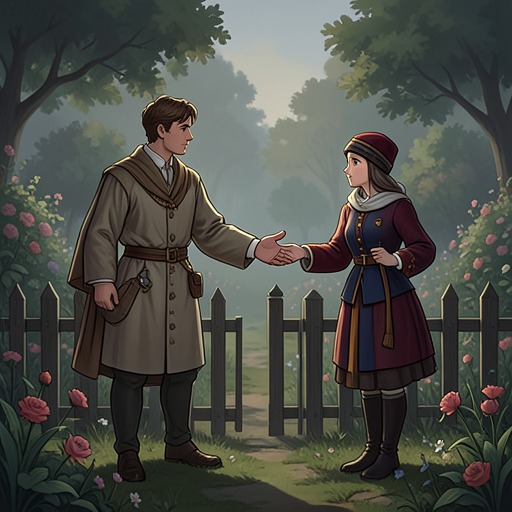
Later, Bhuvan speaks to Parvati about his son’s refusal to marry. He had hoped his son would wed, but says the house has consequently seemed empty, without a woman’s touch and with its spark gone. His explanation places Parvati within a household whose loneliness predates her arrival: she is brought into it partly as the answer to an absence, although the marriage does not mean that she has found a place where she belongs.
When Parvati responds that if he is old she will grow old quickly too, Bhuvan sits up, takes her face in his hands, and gazes at her for a long time. The narration compares his attention to a craftsman admiring a finished idol, with pride and respectful affection. He sighs that she did not deserve this, then tells her that he thinks she does not belong there. The moment reveals an intimacy grounded in tenderness and recognition, but also in the distance between Parvati and the life she has entered. Bhuvan’s care does not undo the circumstances of their marriage; instead, it allows him to acknowledge their cost.