Devdas Mukherjee
DevdasDevdas Mukherjee’s life turns on the gap between attachment and action. As a boy, he schemes to escape the schoolroom; as an adult, he cannot overcome his parents’ opposition to marrying Parvati. His later drinking, deteriorating health, and last journey to see her make that early restlessness part of a larger tragedy: he repeatedly recognizes what matters to him, but recognition arrives too late to change the course of his life.
Identity and Early Character
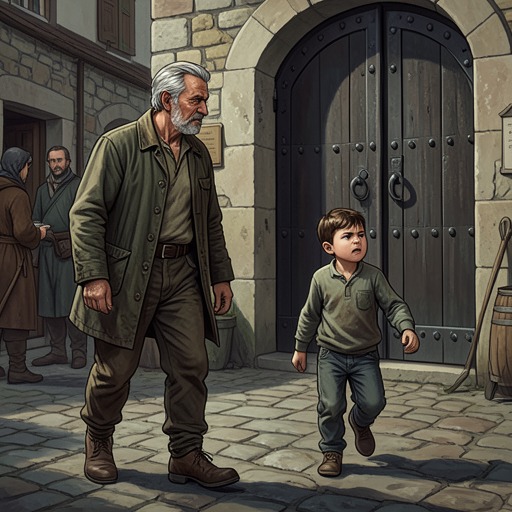
Devdas first appears on a scorching summer afternoon, bored in the schoolroom and already imagining a life outside its restrictions. Sitting on an old mat with a slate, he weighs his options, then decides that roaming the fields and flying kites would be better than losing the afternoon to lessons. His impulse is not merely to daydream: he stands up with his slate, preparing to put his plan into motion. The scene establishes a boy inclined to escape supervision rather than accept it.
That freedom is constrained by adults who know his habits. Govinda Master has noticed that Devdas may not return if allowed out for lunch, and his father has also forbidden him to leave. The lunch hour is therefore spent under the class monitor’s supervision. Nearby, boys play marbles while Parvati, newly arrived at the school, sketches the sleeping teacher in her alphabet book. Devdas’s schoolroom is thus also the setting of his early proximity to Parvati: childhood companionship begins amid lessons, boredom, and small acts of mischief, before family authority gives their relationship its more serious stakes.
Love, Family Opposition, and Refusal
After Parvati’s secret nighttime visit, she is left uncertain about what Devdas will do. She hopes that he will return and prevent her marriage to someone else, imagining him making a promise that he will not allow it while he is alive. That expectation belongs to Parvati’s hope, not to a commitment Devdas has actually made. The difference between what she longs to hear and what he chooses to do becomes central to their relationship.
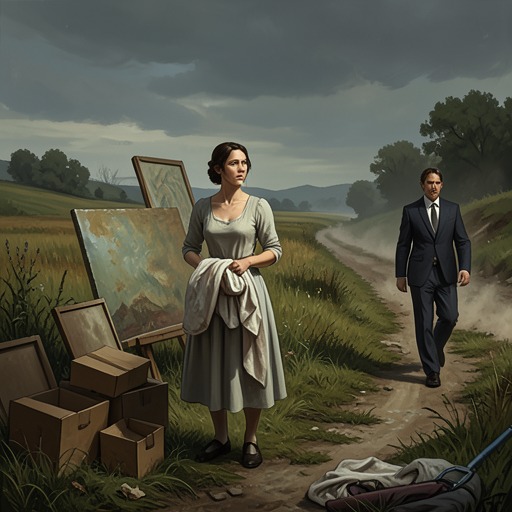
A few days later, Devdas writes that neither his father nor his mother wants them to marry. He presents himself as unable to make Parvati happy without inflicting a wound on his parents, and questions how they could marry against their wishes. He also invokes the difference in their family standing, describing Parvati’s family as not high-born. The letter turns private affection into a decision governed by parental authority and social rank. Rather than defy those limits, Devdas explains them to Parvati and leaves their future unresolved; his words cannot fulfill the intervention she had hoped for.
The consequences do not end with the letter. After Narayan Mukherjee’s death, Parvati hurries back, believing that she should be beside Devdas in a time of trouble. She sees him as wasting away while she is occupied with her own household and daily acts of charity, and reproaches herself for not having been there sooner. Determined to speak with him, she enters his room shortly before dusk, closes and bolts the door, and sits on the floor. Devdas meets her with a smile, though his face is sad and calm, then raises the possibility that he might have dragged her name through the mud. Their encounter brings affection and the threat to Parvati’s reputation into the same confined space; the seriousness of his question contrasts with the intimacy of her private visit.
Drinking, Illness, and Isolation
Devdas’s drinking becomes a pattern of absence. He usually does not drink at home unless Chunilal comes to visit; more often, he goes out, returns late, and sometimes fails to return at all. After two days without any sign of him, Dharmadas weeps and refuses food or drink. On the third day Devdas comes home with a burning fever, lies down, and becomes unable to get up. Several doctors are called to attend him. His illness is not an isolated collapse but the visible consequence of a life increasingly organized around drinking, disappearance, and dependence on others to care for him.
Even when offered the possibility of contacting his mother, Devdas refuses. Dharmadas proposes writing to Harimati Devi in Varanasi, but Devdas stops him, unable to face her in his condition. Later, after a year has passed, he leaves a hospital in Bombay leaning on Dharmadas. The prospect of going to his mother returns, yet he still says that he does not feel ready to appear before her and that the time has not come. His tears in the hospital carry a wider recognition: he has a mother, an elder brother, Parvati, and Chandramukhi, but having these connections is not the same as being held by them. His isolation is emotional as well as physical, sustained by his refusal to return to the people who might receive him.
Parvati, Chandramukhi, and Belated Recognition
As Devdas’s condition worsens, his understanding of Chandramukhi changes. For much of his life he has dismissed her because of her life as a courtesan; on the final journey, her face rises in his thoughts beside his mother’s. He weeps at the thought that he will never see Chandramukhi again and that she may not learn of his death until much later. The shift does not undo his earlier rejection or restore their lost time. Instead, it reveals a belated recognition of her place in his emotional life, arriving when he expects that no reunion is possible.
Parvati remains the person he is determined to reach. Devdas remembers the taunts he directed at her and the mischief he played as a child, but decides that he must make good on his promise to see her one last time. He calculates that the road may take a couple of days and wonders whether he will survive that long. His choice is therefore made under the pressure of approaching death: despite the thought of his mother and Chandramukhi, he continues toward Parvati because he believes the promise is one he must honor.
Final Journey and Death
The journey to Hatipota is physically arduous. The roads are damaged and pooled with rainwater; the bullock cart moves slowly, sometimes requiring people to push it while the bullocks are driven onward. The route is sixteen miles long. As dusk falls, Devdas’s fever returns, and he asks how much farther remains. His failing body turns a journey of limited distance into a race against time, while his purpose remains fixed on reaching Parvati.
The cart arrives beneath a huge peepul tree in front of the zamindar’s house in Hatipota around midnight, later than expected. The coachman calls to Devdas to get down, receives no answer, and calls again. The journey ends not in the meeting Devdas sought but in silence. At his death, the people present debate who may cremate him and who is permitted to touch his body, bringing caste restrictions into the immediate aftermath of his illness. The inspector identifies cirrhosis of the liver and notes blood at Devdas’s nose and mouth.
The evidence that establishes his identity is intimate and material. A tattoo of the first letter of his name is on his left wrist. He carries two letters: one from Dwijodas Mukherjee in Talshonapur saying that no more money can be sent, and another from Harimati Devi in Varanasi asking how he is. The inspector declares that the dead man is Devdas. A blue stone in a gold ring and an expensive but worn shawl are also recorded among his possessions. Bhuvan Chowdhury and Mahendra Chowdhury are present; when Mahendra hears the name Talshonapur, he thinks of his mother’s hometown and suggests she might identify the body, but Bhuvan dismisses the idea. Devdas’s final identification thus depends on a mark on his body and the objects in his pockets, while his family’s recognition remains obstructed by shame, distance, and the circumstances of his death. His last act of devotion brings him close to Parvati’s home, but the story closes on his inability to reach her.