Mahendra Chowdhury
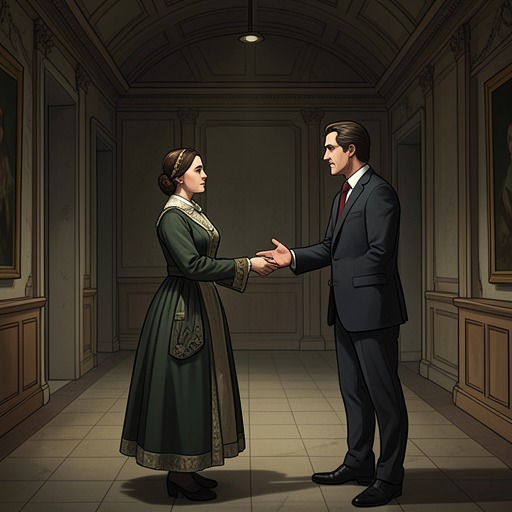
DevdasMahendra Chowdhury is Bhuvan Chowdhury’s eldest son, a young man of about twenty who approaches Parvati Chakravarty as she enters her husband’s household. His first appearance establishes the family role he is willing to give her: after his mother’s death, he asks Parvati to accept him as her son and bless the household. Later, he helps carry out her efforts to reunite the family, even when he expects those efforts to be resisted.
Identity and Place in the Household
Parvati arrives at a vast, old-money mansion where servants abound but family members are few. Just before dusk, Mahendra comes to greet her. He keeps some distance, touches her feet, and identifies himself as her eldest son. When she initially remains quiet behind her veil, he repeats his request for her blessing; she then raises the veil to her brow and calls him closer.
Mahendra tells Parvati that the family lost its mother two years earlier and that the intervening years had been difficult. His appeal is not only personal: he asks her to bless them so that the household may be happy again. Parvati, newly installed as its matriarch, responds without ceremony and asks where the other children are. Their exchange makes his welcome a first step in her relationship with the family, not merely a formal greeting.
Family Relationships and Actions
Mahendra explains that his younger sister, Yashoda, is living at her husband’s home. Although he had written to her, she could not come to welcome Parvati. When Parvati later tells him to fetch Yashoda, he hesitates because he expects his sister to refuse. He suggests that Bhuvan should go instead, but Parvati maintains her request.
The next day Mahendra sets out alone. Four days later, Yashoda arrives at the Hatipota house. The account does not reveal what persuaded her, but Mahendra’s journey succeeds where his letter did not. His part in the reunion is practical and somewhat reluctant at first: he anticipates difficulty, raises an alternative, then goes himself to carry out Parvati’s wish.
On another occasion, Parvati asks Mahendra to arrange two palanquins and thirty-two bearers so she can leave for Talshonapur immediately. He says he can readily arrange the transport, then asks why she needs two palanquins. The exchange shows him responding to her urgent plans by attending to their logistics, while the question indicates that the scale of the arrangements is not self-explanatory to him.
Marriage and Household Tension
Mahendra is married to Jaladbala. When she hears estate clerks and servants discussing the money Parvati secretly gives to poor but respectable families, she challenges him for failing to notice the household’s rising expenses. The servants’ talk includes claims that expenses have nearly doubled and that the vaults are empty; Jaladbala argues that although Bhuvan may indulge his new bride, Mahendra should protest.
Mahendra asks why she says this, but the account supplies no further response from him and does not say that he takes action against Parvati’s giving. The episode places him between competing expectations inside the household: his wife voices concern about the apparent cost, while Parvati uses her personal allowance to support families in need. His recorded reaction remains limited to asking Jaladbala to explain her accusation.
Narrative Role
Mahendra’s appearances mark the gradual incorporation of Parvati into a family whose members are not all present or reconciled. His appeal for her blessing gives her an immediate maternal place in the house; his journey to fetch Yashoda turns that welcome into a concrete family connection. He is also a witness to the household’s unsettled boundaries, where Parvati’s generosity is praised by its beneficiaries but treated by servants and Jaladbala as a possible threat to the estate’s finances. The text leaves his own position in that dispute unresolved.