Parvati Chakravarty
DevdasParvati Chakravarty is Devdas Mukherjee’s childhood companion and the woman whose active, steadfast love gives much of the novel’s emotional force. While Devdas retreats from choice and commitment, Parvati tries to make their attachment a shared future. Their separation and his eventual death leave that effort unanswered, making her both a central presence in his story and a figure whose later life remains unknown.
Identity and Childhood Bond
Parvati’s claim on Devdas begins in childhood, before either of them has considered what marriage might require. She comes to feel, gradually and with growing certainty, that she has a special claim on him. The bond is not formally promised to her; it is built from their familiarity and his childhood indulgence of her wishes. For Parvati, that history makes their closeness seem like something that should continue into adulthood.
Devdas, by contrast, has already loosened his attachment after going to Calcutta and discovering other interests. He does not understand that Parvati, in her rural life, continues to carry him in her thoughts. The difference between what each has taken their childhood bond to mean becomes decisive when the possibility of their marriage is rejected: what Parvati experiences as the loss of a future she had quietly counted on, Devdas has not recognized as a future requiring his defense.
Love, Rejection, and Initiative
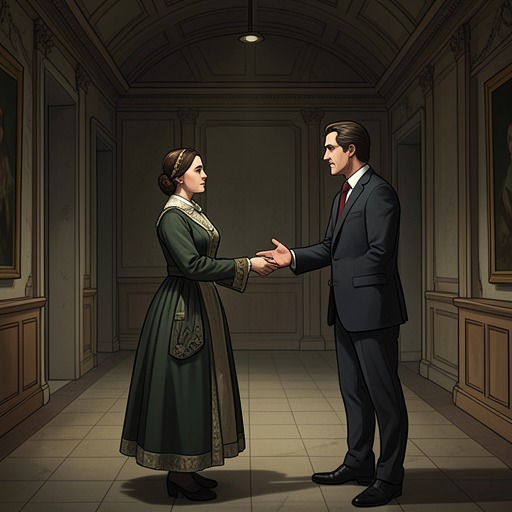
Parvati’s feelings lead her to act rather than wait for Devdas to name their relationship. She approaches him with the prospect of marriage, but he cannot withstand parental opposition and rejects her. He then writes to say that he does not wish to marry her. Only after sending the letter does he recognize that he loves her; he hurries to her and asks her to marry him, but the arrangement for her marriage elsewhere has already been made. The reversal leaves Parvati refusing the proposal that she had first tried to bring about.
Her earlier visit to Devdas is one of the novel’s defining scenes of resolve. Around one in the morning, with faint moonlight overhead, she wraps herself in bedsheets, comes quietly downstairs, checks that no one is awake, and leaves the house. She crosses the silent village road to the gate of the zamindar’s house, where the old guard, Krishan Singh, is sitting on a charpoy reading the Ramayan. The stealth of the journey reflects the risks surrounding a woman’s private meeting, but Parvati goes nonetheless, seeking a choice about her future rather than accepting separation without speaking to Devdas.
Marriage, Injury, and Devdas’s Decline
The marriage that Parvati had hoped to make with Devdas does not take place; her marriage is fixed elsewhere. The account of their relationship presents that outcome not as a change in her attachment but as the consequence of Devdas’s initial refusal and the decisions made around her before he returns to claim her. Her early conviction that their childhood closeness would endure is thus tested against the social and family arrangements that make marriage the condition for preserving it.
A later encounter with Devdas brings another rupture. While out of his senses, he strikes her brow with a fishing rod. Parvati cries out to him in shock and pain; he breaks the rod into pieces and throws them into the river, then dismisses the wound as slight. The episode places his destructive conduct beside her continuing emotional exposure to him: the man she has loved is capable of injuring her, yet the scene does not turn her into a merely passive figure in their relationship.
Devdas’s Final Journey and Parvati’s Narrative Role
Parvati’s concern for Devdas persists long after their marriage has taken separate paths. When a letter arrives, she calls for Mahendra and asks for two palanquins and thirty-two bearers so she can leave for Talshonapur at once. The concrete urgency of the order shows her again taking action to reach Devdas, rather than leaving the effort to him. Her attempt to bring him back belongs to the same pattern as her earlier proposal and nighttime visit: she repeatedly tries to bridge a distance that Devdas’s indecision and decline have helped create.
Devdas’s final journey ends without the meeting he seeks. He reaches the zamindar’s house at night, already gravely ill, and is laid on hay beneath a peepul tree. At dawn, people from the household find him there; Bhuvan Chowdhury comes, and the dying Devdas can only look at those gathered around him and weep. The scene establishes the cruel separation at the center of Parvati’s story, though the evidence does not show her among those who see him at the tree. The narrator later says that Parvati’s subsequent life is unknown and does not seek to discover it.
Parvati’s importance therefore rests not only on being the object of Devdas’s longing. She is a strong, proactive presence whose attempts to secure, revisit, and preserve their bond set events in motion, while his failures of action leave those efforts without resolution. The novel’s closing appeal asks readers to pity Devdas’s uncared-for death, but Parvati’s unanswered love helps make that appeal resonate: the story’s tragedy lies in the distance between the connection she tries to enact and the reunion that never occurs.