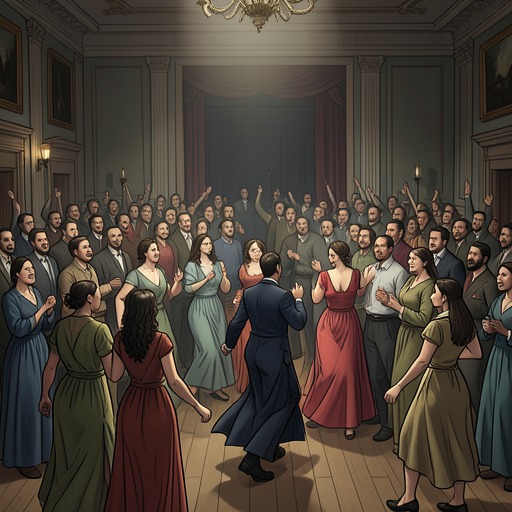
Gabriel’s speech at the Morkan dance
DublinersGabriel’s speech at the Morkan dance is the evening’s ceremonial centerpiece: a toast that celebrates the Morkan women and presents Irish hospitality as a living inheritance, while casting the younger generation as a possible break with the past. The speech gathers the company around shared customs and remembered singers, but its poised confidence is shadowed by Gabriel’s private awareness of absence and by the tensions that the ceremony cannot settle.
The Toast and Its Setting
As the meal draws toward its close, raisins, almonds, figs, apples, oranges, chocolates, and sweets pass around the table. Aunt Julia invites the guests to choose port or sherry. Bartell D’Arcy initially refuses both drinks; after a neighbour nudges him and whispers to him, he allows his glass to be filled. Conversation dwindles as the last glasses are poured. The pause is marked by the wine being poured and chairs shifting, then by a cough and the gentlemen’s gentle taps on the table calling for silence.
Gabriel pushes his chair back and rises to speak. The encouragement grows louder and then stops. He rests his ten trembling fingers on the tablecloth, smiles nervously at the upturned faces, and looks toward the chandelier. Even as he addresses the room, the scene opens briefly onto the world beyond it: a waltz plays on the piano, skirts sweep against the drawing-room door, and Gabriel imagines people standing in the snow on the quay, looking at the lighted windows and listening to the music. His inward glance fixes the party within a wintry landscape, with snow weighing on the park’s trees and the Wellington Monument gleaming above the Fifteen Acres.
Hospitality as Inheritance
Gabriel begins by describing the annual gathering as a familiar occasion beneath a hospitable roof and around a hospitable table. He calls the aunts and Mary Jane its hostesses, then plays with the possibility that the guests are not merely recipients but “victims” of their hospitality. The joke gives the room a shared pleasure: the three women blush as the company laughs or smiles, and Gabriel gains confidence from their warm response.
He then makes hospitality the central claim of his address. In his view, it is the national tradition that most honours the country and deserves to be guarded. He acknowledges that some might regard it as a failing, but recasts that failing as “princely,” a quality to be cultivated rather than corrected. His argument moves from the immediate welcome offered by the women at the table to a chain of inheritance: their hospitality carries forward what their forefathers handed down and should, in turn, be handed to their descendants. The approving murmur around the table confirms that this account of communal identity finds an audience among the guests.
Generations, Memory, and Absence
The speech’s warmth does not exclude a note of conflict. Gabriel turns from the hostesses’ familiar generosity to a new generation shaped by different ideas and principles. He grants that its enthusiasm is sincere, even when misdirected, but worries that an age of scepticism and intense thought may lack the humanity, hospitality, and kindly humour he associates with the older generation. This contrast makes the speech more than a tribute to the women: it is also a defense of values Gabriel fears may be disappearing.
Gabriel connects that concern to the names of great singers who have been remembered during the evening. Their presence in conversation makes the past feel spacious by contrast with the present; he calls their time “spacious days” and urges the company to cherish the memory of the dead whose fame endures. The passage shifts from the living women at the table to cultural memory, treating remembrance as one way an inheritance survives the passage of generations.
That confidence has a personal complication. While praising the gathering and its traditions, Gabriel thinks of Miss Ivors, who has left and whom he regards as having gone away discourteously. Her absence briefly sharpens his self-assurance: he continues with confidence after the table’s assent. The episode places a private disagreement at the edge of a speech devoted to hospitality, suggesting that a public ideal of welcome does not by itself repair an individual breach.
The Hostesses and the Closing Toast
Gabriel turns at last from general principles to the three women who have made the gathering possible. He refuses to rank them, comparing the chief hostess’s good heart, Aunt Julia’s enduring youth and singing, and Mary Jane’s talent, cheerfulness, and hard work. Calling the choice of a single honouree an invidious task beyond his powers, he makes their shared recognition the point of the passage rather than selecting a winner.
The effect is visible around the table. Gabriel sees Aunt Julia smiling broadly and tears in Aunt Kate’s eyes, and hastens toward his conclusion. He raises his glass of port; the guests finger their glasses in anticipation. His final toast wishes all three women health, wealth, long life, happiness, and prosperity, and honours both the professional standing they have earned and the affection they command. The movement from a general defense of national hospitality to this particular act of gratitude gives the speech its ceremonial shape: the abstract tradition is embodied in the people whose work and welcome sustain the party.
Rhetorical Role and Limits
The address proceeds through several forms of persuasion. Gabriel establishes his authority by speaking as a returning guest who has travelled abroad; he appeals to shared feeling through praise of the aunts and remembrance of celebrated singers; and he frames hospitality as a collective inheritance that the company should preserve. Its repeated addresses to “Ladies and Gentlemen,” carefully balanced contrasts, and final toast make it a public performance as well as an expression of conviction. The room’s laughter, assent, tears, and readiness to raise glasses register how successfully it gathers the guests into a common occasion.
Yet the speech’s polished unity is not the same as an untroubled unity among its participants. Gabriel’s nervous hands, the pause before he begins, and his thought of the absent Miss Ivors interrupt the image of effortless concord. His appeal to an older, more spacious age also depends on an opposition between inherited virtues and modern scepticism that he states rather than resolves. The toast succeeds as an act of hospitality and remembrance, while the scene leaves visible the limits of ceremonial language: it can honour a community and preserve its customs without erasing private discomfort or generational disagreement.