Kernan attends a Jesuit retreat
DublinersKernan attends a Jesuit retreat because his friends arrange a religious intervention around an injured man who has been outside the Church for twenty years. At the Gardiner Street Jesuit Church, he joins his companions among an orderly congregation of Dublin businessmen and civic figures; Father Purdon’s sermon then gives the retreat its governing image, treating spiritual self-examination as the correction of accounts. The episode’s pointed tension lies between the friends’ managed plan and the preacher’s confident promise of moral bookkeeping.
Causes and the Friends’ Plan
Kernan’s retreat begins not with a decision he makes in full knowledge, but with a plot disclosed to his wife and developed by his friends. Mr Power originates the idea and entrusts its execution to Martin Cunningham, who is joined in the plan by Mr M'Coy and Mr Power. They know Kernan as a convert from Protestant stock who has been away from Catholic practice for two decades and likes to make side-thrusts at Catholicism. The scheme therefore aims at more than a visit to church: it is an effort to bring a skeptical, lapsed man back within the Church’s orbit.
Mrs Kernan accepts the arrangement with little expectation that her husband will undergo a deep change. After twenty-five years of marriage, she has few illusions and suspects a man of his age is unlikely to alter much before death. Religion, for her, is a habit, grounded in familiar domestic devotion and approval of the sacraments; she believes steadily in the Sacred Heart and, when pressed, can also believe in the banshee and the Holy Ghost. She leaves the matter in Cunningham’s hands because she thinks the scheme may do good and can at least do no harm. Her consent is practical rather than fervent, and the episode sets that household pragmatism beside the friends’ effort to make religion an occasion for deliberate reform.
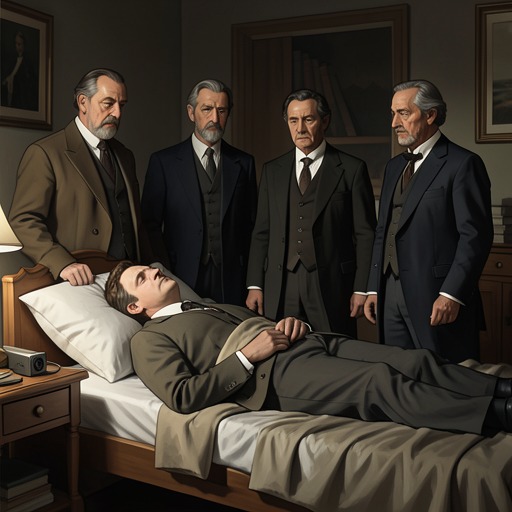
The plan is also colored by the condition in which it finds Kernan. After his accident, he stays in bed while his wife makes beef-tea, scolds him, and tends him when his habitual intemperance leaves him sick. Two nights later, his visitors find him propped among pillows, irritable from the occasional pain in his tongue but capable of apologizing for the disorder of the room and looking at his guests with a veteran’s pride. He does not know that the friends have already discussed his case with his wife. His injured, confined body becomes the setting for an intervention conceived by others, rather than a retreat he has independently sought.
From Evasion to Invitation
When the friends begin to explain their purpose, Cunningham first calls it a little spiritual matter. Power then states plainly that they are going to make a retreat. Cunningham describes the friends as going to wash the pot together, and M'Coy owns up to the plan. Their joking language makes the retreat sound at once like a group undertaking and a cleansing exercise, but Kernan is still being brought into a plan whose real aim has not yet been fully laid out to him.
Cunningham then turns the group proposal into a personal invitation. He suggests that Kernan join them for a four-handed reel, and Power endorses the idea of all four attending together. Later, Power makes the objective explicit to Mrs Kernan: the friends intend to make her husband a good, holy, pious, and God-fearing Roman Catholic. They will make the retreat together and confess their sins. The contrast matters: the men present the occasion as shared religious practice, while Power’s candid explanation shows that Kernan is also the target of a purposeful campaign of conversion and correction.
The Church and the Congregation
At the Jesuit Church in Gardiner Street, the retreat takes place amid a precisely observed public order. The transept is nearly full; gentlemen continue to enter through a side door, following a lay brother along the aisles until they find seats. Black coats and white collars dominate the congregation, punctuated by tweeds, against green-marble pillars and sombre paintings. The men sit with their hats secured and their trousers hitched slightly above their knees, facing the distant red light before the high altar. The scene locates religious instruction among the respectable routines and visible social codes of male Dublin.
Kernan sits near the pulpit with Cunningham. M'Coy is alone in the bench behind them, and Power and Fogarty sit behind M'Coy, leaving the party arranged in a quincunx. M'Coy has tried without success to join the others and to make comic remarks; once they fail to land, he stops. Even he begins to respond to the decorous atmosphere and religious stimulus. As Kernan recognizes familiar faces in the congregation, he begins to feel more at home. His wife has rehabilitated his hat, which rests on his knees; he pulls down his cuffs and holds the brim lightly but firmly. These small gestures register his adjustment to the formal setting, not a declared change of belief.
The assembly includes men whose occupations and civic connections come into view as Cunningham points them out: a moneylender, a registration agent and mayor-maker, a pawnbroker, a prospective Town Clerk’s-office employee, the chief reporter of The Freeman’s Journal, and an old friend of Kernan’s who was once a substantial commercial figure. The retreat thus gathers religion, business, local influence, and social recognition in the same space. Kernan’s growing ease comes partly through recognizing this familiar world; the church does not remove the social order outside it but assembles that order in its pews.
Father Purdon’s Sermon and the Accounts of the Soul
A large priest in a white surplice struggles into the pulpit. The congregation settles, takes out handkerchiefs, and kneels on them; Kernan follows the general example. Father Purdon first kneels toward the red light before the altar, then rises to address the formally attentive congregation. His chosen text is the biblical counsel, “For the children of this world are wiser in their generation than the children of light. Wherefore make unto yourselves friends out of the mammon of iniquity so that when you die they may receive you into everlasting dwellings.”
Purdon acknowledges that the text is difficult and may appear to conflict with the lofty morality elsewhere preached by Jesus Christ. He resolves that difficulty by calling the passage especially suited to people who must live in the world but do not wish to live as worldlings. In his account, Christ understands that most people are not called to the religious life and must, to some extent, live for the world. The sermon therefore speaks directly to the businessmen and professionals in the pews, presenting worldly conduct not as an escape from moral scrutiny but as the very field in which they must exercise it.
The sermon makes that counsel concrete through the language of accounts. One model of self-examination declares that everything has been checked and found in order. The more searching alternative admits specific discrepancies, names what is wrong, and promises, with God’s grace, to rectify it and set the accounts right. This is a practical vocabulary of confession: responsibility requires identifying fault rather than merely claiming a clean balance. Yet the metaphor also joins spiritual correction to the habits of commercial life. Purdon does not ask his hearers to abandon their worldly identities; he offers them a way to manage those identities under religious judgment.
Significance and Limits of the Retreat
The episode brings sincere religious forms into contact with social management. Kernan’s friends arrange the retreat as an intervention, his wife accepts it as a sensible possibility, and the church gathers a congregation whose recognizable members help him feel at home. Inside that setting, Purdon translates scriptural difficulty into advice tailored to worldly occupations. The retreat is therefore both a religious occasion and an organized effort to make religion legible within the routines and self-understanding of the men who attend.
Kernan’s presence at the church is a real change in circumstance: a man who has been outside the Church for twenty years has been brought to a Jesuit retreat and follows the congregation’s movements. But the evidence does not establish that he has become a good, pious, or newly committed Catholic. The friends’ stated hope and the sermon’s language of corrected accounts remain distinct from a confirmed spiritual outcome. That gap gives the episode its irony: the campaign is presented as a path to reform, while the retreat’s central image makes religious change sound at once morally demanding and as orderly as balancing a ledger.