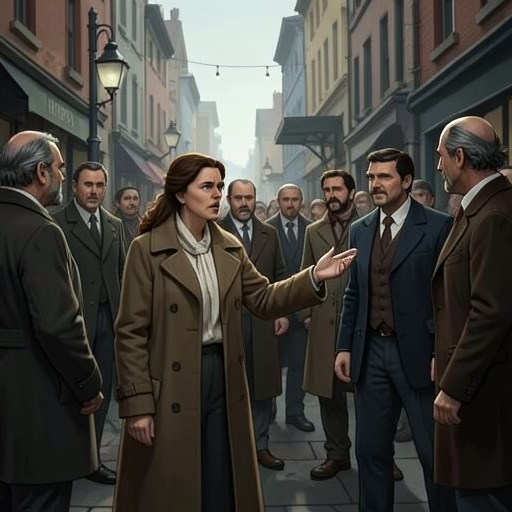
Mrs Kearney’s dispute over the concert contract
DublinersMrs Kearney’s dispute over the concert contract turns an unpaid fee into a public contest over who can define an agreement and enforce it. After securing an eight-guinea contract for Kathleen to accompany four concerts, Mrs Kearney insists that the organizers honor its terms even when they cancel one performance. Her demand wins a partial payment but not the settled outcome she seeks: the Committee conditions the remaining money on Kathleen performing, the room turns against her, and she leaves with her daughter before the second part. The episode makes the contract both a practical safeguard and the instrument around which a social conflict hardens.
The Contract and Its Circumstances
When the Irish Revival becomes noticeable, Mrs Kearney sees an opportunity in the reputation her daughter has gained as a clever musician and supporter of the language movement. Kathleen and her sister exchange Irish picture postcards with friends, while gatherings of the Kearneys’ musical and Nationalist acquaintances end in farewells in Irish. Against this background, Mr Holohan approaches Mrs Kearney about a series of four grand concerts for his Society at the Antient Concert Rooms. The proposal offers Kathleen paid work and gives her mother a role in an enterprise that draws upon both musical and nationalist associations.
Mrs Kearney does more than accept the proposal. She advises Holohan on the programme, drawing on her knowledge of how performers should be presented and ordered. She considers which items might hold the audience’s attention and understands that a first tenor would not want to follow Mr Meade’s comic turn. Holohan visits daily for her advice; their dealings are friendly, and she entertains him at home with a decanter and a silver biscuit-barrel. The arrangement culminates in a contract stipulating eight guineas for Kathleen’s work as accompanist at all four concerts. Mrs Kearney’s later insistence rests on that stated obligation, not merely on an expectation of gratitude for her help.
The Dispute Takes Shape
The first concert disappoints. The performers are poor, the audience dwindles, and the evening ends shortly before ten. Mrs Kearney says nothing at first, though she regrets having spent money on the enterprise and grows irritated by Mr Fitzpatrick’s vacant smile. Thursday’s concert draws a better crowd, but she sees that the hall is filled with paper and that the audience behaves as if it were at an informal rehearsal. She also learns that Friday’s concert will be abandoned so that the Committee can concentrate its efforts on Saturday.
Mrs Kearney immediately draws the distinction between the organizers’ revised schedule and their existing obligation: cancellation of Friday does not, in her view, cancel the contract for four concerts. Holohan directs her to Fitzpatrick, who says he will take the matter to the Committee. She grows alarmed when responsibility keeps moving away from the man who brought her the contract. Later, in a corridor, she asks Holohan when Kathleen will be paid. He again assigns responsibility to Fitzpatrick and says the matter is not his business. Mrs Kearney counters that he himself brought the contract and that, whether or not he accepts responsibility, she will pursue the payment.
The pressure becomes immediate as the Saturday performance is about to begin. In the dressing-room, Mr Bell waits with his music, while the audience’s clapping and stamping grow louder. Holohan and Mr O’Madden Burke enter and find the room hushed. Holohan speaks earnestly to Mrs Kearney, but she gives the same condition: Kathleen will not perform unless she receives the eight guineas. Holohan appeals to Mr Kearney and Kathleen, yet neither changes the position. Mr Kearney strokes his beard; Kathleen looks down and moves the point of her new shoe. The physical stillness of the two contrasts with the growing noise outside, where the waiting audience makes the dispute harder to postpone.
Payment, Performance, and Withdrawal
When the clamour in the auditorium rises, Fitzpatrick bursts into the room with banknotes. He counts four guineas into Mrs Kearney’s hand and says that she will receive the other half at the interval. She immediately points out that the amount is four shillings short. Even so, Kathleen gathers her skirt and goes out with Mr Bell; the piano begins after a short pause. The urgent demand has secured some money, but it has not resolved either the shortfall in the amount tendered or the uncertainty about the balance.
During the interval, Fitzpatrick and Holohan tell Mrs Kearney that the remaining four guineas will be paid after a Committee meeting on the following Tuesday. They add a condition: if Kathleen does not play in the second part, the Committee will consider the contract broken and pay nothing. The offer changes the practical stakes. Mrs Kearney has been pressing the organizers to fulfill a four-concert agreement, but now they make the remaining payment depend on Kathleen’s continued performance. She answers that she has not seen any Committee and demands the entire sum of four pounds eight shillings in Kathleen’s hand; otherwise, Kathleen will not return to the platform.
The Social Cost and the Ending
The Committee’s representatives treat Mrs Kearney’s insistence as misconduct. Holohan tells her he never thought she would treat them that way, and after the exchange her conduct is condemned on all hands: those present approve of what the Committee has done. Her claim is therefore displaced by a judgment about her manner and loyalty. The room’s response does not establish that the contract has been paid in full; instead, it isolates the person demanding that its terms be observed.
Mrs Kearney waits, hoping that the secretaries will approach her, but Miss Healy agrees to play one or two accompaniments. As the baritone and his accompanist pass toward the platform, Mrs Kearney stands still for an instant like an angry stone image. When the first notes of the song reach her, she takes Kathleen’s cloak and orders her husband to get a cab. She wraps the cloak around her daughter and follows him out, stopping at the doorway to tell Holohan that she is not finished with him. Holohan answers that he is finished with her. Kathleen follows her mother meekly; Holohan paces the room to cool himself. The closing exchange leaves the conflict unresolved beyond the immediate withdrawal: mother and daughter have left the concert, while the promised balance remains conditional and the working relationship has broken down.
Significance of the Conflict
The episode pits a written financial commitment against the informal authority of a committee whose members can control access to the platform and the timing of payment. Mrs Kearney’s repeated appeals to the agreed sum expose the gap between having a contract and being able to enforce it on equal terms. Once the organizers make the remaining fee depend on Kathleen’s performance, the contract becomes a point of leverage for both sides rather than a settled protection.
The dispute also turns on the way a woman’s insistence is received. Mrs Kearney argues that she is protecting her daughter’s agreed payment, but the people around her recast that insistence as bad conduct and side with the Committee. The scene’s movement—from friendly consultation in the drawing-room, to negotiation in the corridor, to confrontation in the crowded dressing-room—tracks the collapse of cooperation. The concert continues without Kathleen in the second part, while the family’s departure makes visible the cost of a conflict in which the right to claim payment does not guarantee either a full payment or social approval.