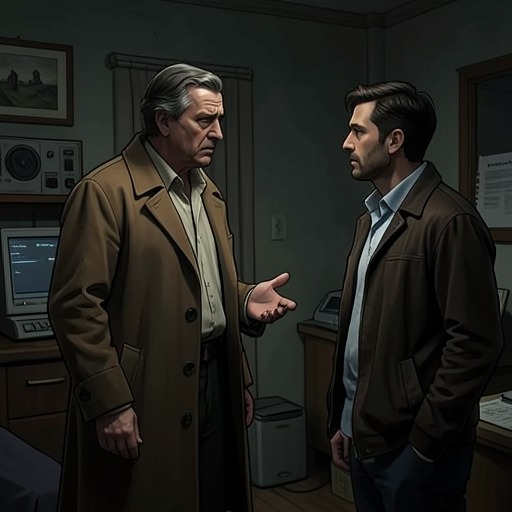
Corley’s encounter with the servant and the gold coin
DublinersCorley’s encounter with the servant and the gold coin concludes the suspenseful episode in which Lenehan waits to discover whether Corley has succeeded in obtaining money from a young woman. Its reversal is conveyed not through an explanation but through a brief, deliberate gesture: Corley opens his hand beneath a street lamp, and the coin shines in his palm. The encounter settles Lenehan’s immediate question while keeping the transaction itself opaque.
Causes and Background
Before the encounter’s result becomes visible, Lenehan has been left waiting and imagining what Corley might be doing. He wonders whether Corley has already asked the young woman for money or is delaying until the last moment. He shares, almost bodily, the “pangs and thrills” of his friend’s situation, but his confidence rises and falls with what he can see: remembering Corley’s slowly revolving head reassures him, while the possibility that Corley has slipped away by another route makes him search the street anxiously.
The waiting stretches past what Lenehan takes to be half an hour since he saw the clock of the College of Surgeons. He lights his last cigarette and watches each tram as it stops at the far corner of the square, looking for Corley and the young woman. When the cigarette paper breaks, he curses and flings it into the road. These small signs of impatience establish how much of the episode is filtered through Lenehan’s uncertainty: Corley’s purpose is being tested, but the reader experiences the test through the companion who cannot see its outcome.
The Encounter and Its Result
Corley and the young woman eventually come towards Lenehan. They walk quickly and do not seem to be speaking; the woman takes short, quick steps while Corley keeps beside her with his long stride. Lenehan reads their bearing as evidence before he knows what has happened. An intimation of failure strikes him, and he decides that Corley has failed, that it is “no go.” His premature certainty creates the scene’s first reversal: the visible signs that Lenehan interprets as defeat do not settle the matter.
The pair turn down Baggot Street, with Lenehan following on the opposite footpath. When they stop, he stops too. After they talk briefly, the young woman goes down the steps into the area of a house, and Corley waits some distance from its front steps. The hall door then opens slowly and cautiously. A woman runs down the steps and coughs; Corley turns and goes towards her. His broad figure hides her for a few seconds before she reappears, running back up the steps. Once the door closes, Corley walks swiftly towards Stephen’s Green. The sequence gives the exchange a furtive, carefully observed shape, but supplies no account of what passes between the two.
Lenehan hurries after Corley. A few drops of light rain fall; glancing back towards the house to make sure he has not been observed, Lenehan runs across the road, panting from anxiety and exertion. He calls to Corley, first from behind and then again as he catches up. Corley turns his head at the first call but continues walking. At Ely Place, he swerves left without answering, his features composed in stern calm. Lenehan stays beside him, breathing uneasily, and asks whether the attempt came off and whether Corley tried her. His questions sharpen into a note of menace as Corley keeps silent.
The Coin and the Reversal
At the first lamp, Corley halts and stares grimly ahead. Then, with a grave gesture, he extends his hand towards the light and slowly opens it for Lenehan to see. He smiles; a small gold coin shines in his palm. The coin answers the questions that Corley has refused to answer aloud. Lenehan’s expectation of failure gives way to proof of success, and the carefully timed reveal turns an ordinary object into the scene’s final piece of evidence.
The result is deliberately narrower than an explanation. The scene shows that Corley has obtained a gold coin from the woman, but does not identify the precise bargain or spell out what she was promised. That withholding keeps the event tied to Lenehan’s limited vantage: he can follow the figures, watch the woman return through the door, and finally see the coin, but the crucial exchange remains outside his knowledge. The silence that first frustrates him is answered by a gesture rather than a confession.
Narrative Significance
The encounter is built around a gap between expectation and result. Lenehan’s reading of the couple’s quick, silent walk makes him believe Corley has failed; the hidden meeting at the house and the coin under the lamp overturn that judgment. The change is visible and compact: a tense watcher, a silent companion, and finally a hand opened to reveal money. The scene’s suspense depends less on the details of the transaction than on the delay before its outcome can be read.
Lenehan’s presence also shapes the episode’s moral and social texture. He is at once Corley’s anxious ally and a watcher who follows the woman’s movements and checks that no one sees him running back towards the house. Corley, by contrast, gives nothing away until he chooses to display the coin. His composed walk and grave presentation make the money both an answer and a small performance of success. The ending confirms the practical result while preserving the uncertainty surrounding the means, leaving the shining coin to carry the scene’s mixture of triumph, secrecy, and unease.