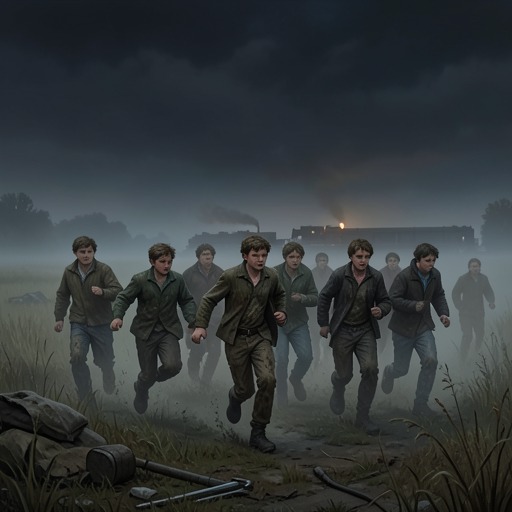
The boys’ truant outing and encounter with the strange man
DublinersThe boys’ truant outing and encounter with the strange man is an attempted escape from school routine that ends in fear rather than adventure. The narrator and Mahony set out with Leo Dillon for a day away from lessons, but after Leo fails to appear, the two boys continue alone; in a field, an elderly stranger first presents himself as a genial reader and then dwells on whipping boys, especially boys who have sweethearts. The narrator leaves under the cover of a false name and calls Mahony back to him, ashamed of his own stratagem but relieved by his friend’s return. The outing’s decisive turn is from chosen transgression to sudden vulnerability: the boys seek the unknown, only to find that it can make their bravado collapse.
The plan to escape school
The expedition grows out of the narrator’s appetite for a life beyond school discipline. A rebuke over boys’ reading of adventure stories has diminished their glamour, but the narrator’s desire for “wild sensations” returns whenever school is out of sight. He concludes that real adventures do not happen to people who stay at home, and that they must be sought abroad. The planned day of truancy is therefore not merely a break from lessons: it is an attempt to turn the imagined exploits of books into personal experience.
The narrator, Leo Dillon, and Mahony arrange to meet at ten in the morning on the Canal Bridge, each having saved sixpence. Their plan includes cover stories as well as a route: Mahony’s older sister is to write an excuse for him, while Leo will have his brother say that he is sick. They intend to follow Wharf Road to the ships, cross by ferry, and walk out to see the Pigeon House. Leo worries that they might meet Father Butler or someone from the college; Mahony dismisses the concern by asking what Father Butler would be doing at the Pigeon House. The narrator collects the others’ sixpences and displays his own, giving the scheme a small, practical formality before the boys part with excited handshakes on the eve of the outing.
A morning of anticipation, then disappointment
The narrator sleeps badly and reaches the bridge first because he lives nearest. He hides his schoolbooks in the long grass near the garden ashpit, a concrete gesture that separates the day’s chosen adventure from the obligations he has left behind. On a mild, sunny morning in the first week of June, he waits on the bridge, admiring the canvas shoes he has pipeclayed overnight and watching business people ride past in a tram pulled by docile horses. Leaves, water, and warming granite make the wait seem idyllic; he taps the bridge in time to an air in his head and feels happy.
Mahony arrives in a grey suit, carrying a catapult and explaining its improvements. He says he intends to use it to have some sport with birds, and speaks of Father Butler by the slang nickname Old Bunser. But Leo does not come. After waiting another quarter of an hour, Mahony jumps down and concludes that Leo has lost his nerve. His absence changes the planned three-boy expedition into an outing for two, though the narrator and Mahony still proceed beyond the bridge and eventually lie on a field bank. The narrator’s readiness to go on shows that the wish for adventure survives its first setback; the stranger’s arrival will expose how little control the boys have over what kind of adventure they find.
The stranger’s friendly approach
A man appears at the far end of the field while the boys are lying on the bank. He is shabbily dressed in a greenish-black suit, wears a high-crowned hat, and has an ashen-grey moustache. He passes them, glances quickly at them, then turns back after some fifty paces and retraces his path, tapping the turf with a stick. The narrator watches him lazily at first, chewing a green fortune-telling stem; the stranger’s slow return makes his approach part of the scene’s growing uncertainty.
The man greets the boys and sits beside them carefully. He begins with the weather, predicts a hot summer, and says that the seasons have changed since his own boyhood. He then praises schooldays as the happiest time of life and says he would give anything to be young again. The boys find this talk dull, but the stranger moves on to books, asking whether they have read Thomas Moore, Sir Walter Scott, and Lord Lytton. The narrator claims to have read all the authors, anxious to appear knowledgeable. The man calls him a bookworm and contrasts him with Mahony, whom he characterizes as interested in games. The conversation initially seems to confirm the stranger’s professed kinship with a reader, even as his questions place the boys under scrutiny.
From books to punishment
The stranger says that he owns the works of Scott and Lytton and never tires of reading them, but adds that some of Lytton’s books are not suitable for boys. Mahony asks why boys could not read them. The narrator is pained by the question, fearing that the stranger will mistake his companion’s ignorance for his own. The stranger only smiles; the narrator notices the gaps between his yellow teeth. He then asks which boy has more sweethearts. Mahony lightly claims to have three, while the narrator says he has none. The stranger refuses to believe the narrator, insisting that he must have one, and the narrator falls silent.
After briefly leaving and returning, the man resumes speaking while Mahony chases a cat across the field. He calls Mahony a rough boy and asks whether he is often whipped at school. The narrator considers objecting that they are not National School boys to be whipped, but keeps quiet. The stranger’s attention settles on corporal punishment: he says that unruly boys need a sound whipping, not a slap on the hand or a box on the ear, but a “nice warm whipping.” The narrator looks up involuntarily and meets the man’s bottle-green gaze beneath a twitching forehead. The earlier language of books and youthful happiness has given way to an insistence on violence, and the narrator registers the change before he can put it into words.
The man carries the subject further, declaring that he would whip a boy for talking to girls or having a sweetheart. A boy who lied about having one, he says, would deserve an even worse beating. He describes the punishment at length, as though disclosing an elaborate mystery, and says that he would love doing it more than anything in the world. His voice grows almost affectionate and seems to plead for the narrator’s understanding. That intimate, persistent manner makes the speech more disturbing than an ordinary threat: a stranger who had posed as a fellow reader now reveals a fixation on punishing boys, while the narrator is left alone beside him as Mahony wanders away.
The retreat and its consequence
When the monologue pauses, the narrator stands abruptly. He delays to fix his shoe, pretending to be calm, and tells the stranger that he must go. He walks up the slope composedly, but his heart beats quickly with fear that the man will seize him by the ankles. The contrast between his controlled departure and his physical alarm marks the failure of the role he had imagined for himself as a seeker of adventure: the experience has become something to escape.
At the top of the slope he calls out “Murphy!”, using the false name he and Mahony had earlier chosen in case the stranger asked who they were. His loud call carries a forced bravery, and he is ashamed of the “paltry stratagem.” He has to call a second time before Mahony notices him and answers. As Mahony runs across the field, apparently as if coming to help, the narrator’s fear gives way to penitence. He acknowledges that he had always despised Mahony a little, yet in the moment of danger depends on him and welcomes his return. The outing closes not with the freedom or heroic exploits the narrator expected, but with relief, embarrassment, and a changed awareness of the companion he had undervalued.
Narrative significance
The episode is shaped by a reversal between expectation and result. The boys’ route, saved coins, hidden books, and cover stories turn truancy into a deliberate quest; the June morning initially seems to reward the narrator with open air and happiness. Yet Leo’s failure to appear and the stranger’s unsettling speech steadily narrow the promise of the day. The narrator’s imagined adventure depends on his ability to choose its terms, while the encounter makes clear that a child’s curiosity can expose him to experiences he cannot control.
The stranger’s shift from nostalgia and literary conversation to fantasies of whipping also gives the scene its disturbing structure. His talk first appears to bridge the distance between adult and boys, then becomes a vehicle for probing their knowledge and sexuality before concentrating on punishment. The narrator’s silence, departure, and call for Mahony form a compact sequence of recognition and retreat: he does not confront the stranger, but acts to get away and summons the friend whose roughness he had judged. In that reversal, the day’s supposed lesson in independence becomes an unplanned lesson in fear, dependence, and the limits of youthful bravado.