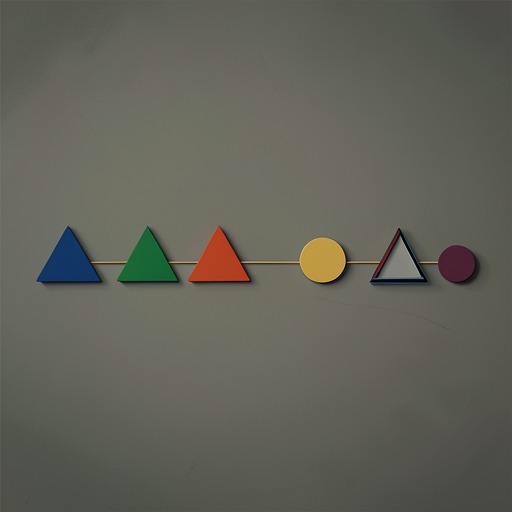
Coloured geometry
ElementsColoured geometry is a visual system for teaching geometrical demonstration by assigning distinct colours to the lines, angles, and other parts of a figure. Its decisive significance lies in changing how a learner locates and remembers the objects of a proof: instead of making letters carry the entire burden of reference, it allows the visible forms and colours of the parts to guide the reasoning directly. The method is presented not as decoration or entertainment, but as an instrument for instruction, inquiry, and the production of permanent knowledge.
Purpose and Educational Premise
The system begins from the claim that the arts and sciences have become so extensive that improving the means of acquiring them is nearly as important as extending their boundaries. Illustration may not always shorten study, but it can make study more agreeable; coloured geometry is assigned a stronger task, assisting the mind in its search for truth and increasing the facilities of instruction. Geometry receives particular emphasis because it is described as a powerful exercise of the mind, cultivating inquiry, elevation of thought, and the reasoning faculties.
The method also responds to a pedagogical failure. Students may encounter propositions at the threshold of the subject surrounded by formalities, rigid procedures, and repetitions that obscure rather than strengthen the sequence of evidence. When demonstrations are reduced to a dry exercise of memory, a discipline intended to develop close thinking becomes uninteresting. Coloured geometry therefore seeks to awaken curiosity and the dormant powers of younger minds by making the structure of a proof immediately available to sight.
Its larger educational claim is extensive. Since arithmetic, land-surveying, mensuration, engineering, navigation, mechanics, hydrostatics, pneumatics, optics, and physical astronomy depend on geometrical propositions, improving the first communication of geometry could affect many practical vocations. The method is also recommended for female education, which the introduction describes as an increasingly important part of sound education, and for broad public instruction. Its final ambition is not merely that learners should retain propositions, but that education should teach people how to think rather than what to think.
Colour as a Mathematical Reference System
The method distinguishes between ordinary language and geometrical diagrams. Words and letters function as representative signs, while the diagram is described as the material through which the relative quantities of the parts are shown by reasoning. Coloured symbols, signs, and diagrams are introduced because they can make that reasoning more precise and its attainment more expeditious.
In the ordinary system, letters attached to points, lines, or other parts are arbitrary names used in a demonstration. In coloured geometry, differently coloured parts are made, in the work's phrase, to “name themselves,” because corresponding colours represent them throughout the demonstration. A line, angle, or region is therefore identified not only by a verbal label but by a visible mark that remains present in the figure. This converts reference from a sequence of remembered letters into an immediate act of recognition.
The method nevertheless insists on a strict conceptual limitation. Colour does not belong to the mathematical magnitude itself. A mathematical line, defined as length without breadth, cannot literally possess colour. The meeting of two colours on the same plane can provide an idea of what a mathematical line means, but when a demonstration speaks of a black, red, or other coloured line, the learner is to understand the junction or represented part rather than treat colour as an intrinsic geometrical property. Colour names the object; it does not alter the object.
This distinction protects the visual system from confusing representation with mathematical definition. The coloured surface is a practical aid, while the geometrical relation remains the object of proof. The diagram does not replace demonstration: it supplies a more direct and stable field in which the demonstration can be followed.
Operation in Demonstration and Classroom Instruction
The introduction illustrates the system by expressing the same geometrical relationships through colours. A relation among three angles can be stated as the red angle added to the yellow angle added to the blue angle, equal to twice the yellow angle and equal to two right angles; another formulation identifies the red angle added to the blue angle as equal to the yellow angle. A corresponding relation among squares states that the square of the yellow line is equal to the sum of the squares of the blue and red lines. The colour names thus function as stable verbal handles for visible parts of the figure.
The chief classroom advantage appears when oral and visual instruction occur together. During an oral demonstration, the eye and the ear can be addressed at the same moment. If an instructor says “the red angle” or “the blue line,” every learner can identify the relevant part at once. By contrast, a reference such as an angle named by three letters requires students to trace those letters individually and then reconstruct the position and magnitude of the intended object in their minds. That extra operation can produce confusion, error, and loss of time.
The system also preserves the data of a proof. When equal parts in a diagram are given the same colours, the learner receives an ocular demonstration of the equality that is to be proved and can retain the given conditions throughout the reasoning. The visual arrangement keeps the mind from wandering away from the object under examination. The text can refer to forms and colours, or to parts and their colours, with greater speed and certainty than it can refer only to letters on the diagram.
Coloured geometry is not represented as an exclusive replacement for older methods. Even where it is not substituted for words, letters, and uncoloured diagrams, it can serve as an auxiliary for introducing a proposition, recalling it rapidly, or preserving it more permanently in memory. For schools and other public places, dyed chalks are proposed for drawing diagrams; for private use, coloured pencils are described as convenient. The method is therefore designed both for printed visual material and for direct classroom practice.
Speed, Memory, and Accessibility
The work attributes substantial practical effects to the coloured system. According to experiments conducted by its inventor and by others who adopted the plan, the Elements of Euclid can be acquired in less than one third of the time usually employed, while retention in memory is more permanent. The explanation offered is structural rather than ornamental: colour reduces the delay involved in identifying arbitrary lettered parts and keeps the relevant forms continuously before the learner.
The argument is reinforced by a broader comparison between hearing and sight. The introduction invokes the familiar claim that impressions received through the ear are weaker than those conveyed by the faithful eye, and later observes that coloured representations, pictures, cuts, and diagrams are more easily fixed in the mind than sentences lacking distinctive marks. The visual system consequently treats memory as something shaped by the form in which knowledge is presented, not merely by the logical content of the proposition.
Its accessibility claim extends beyond ordinary classroom efficiency. Tangible diagrams are described as the only medium through which geometry and other linear arts and sciences can be taught to blind learners, while the visible system is also presented as adapted to the needs of deaf and mute learners. The introduction further imagines that the same force can address one thousand learners as easily as one, making the method suitable to mass education. These statements make coloured geometry part of an argument about the social reach of mathematical knowledge, not simply a technique for improving individual study.
Place in Geometrical Knowledge
The system is situated between classical authority and educational reform. The Elements of Euclid are presented as the foundation of mathematical science across the civilized world, and geometry as a basis for numerous intellectual and practical disciplines. At the same time, coloured geometry is described as a notable improvement to plain geometry since the days of Euclid: an innovation that leaves the geometrical propositions intact while revising their mode of communication.
Its method also clarifies the relation between representation and proof. Geometry concerns the properties of figures, and figure is defined through the relation between boundaries. The first six books treat plane figures; the perimeter is the entire length enclosing a figure, the lines enclosing it are its sides, and the lines considered in those books are assumed to lie in the same plane. Within this formal setting, colour has a limited but powerful role: it directs attention to the boundaries and parts through which geometrical relations are stated, without becoming an additional geometrical magnitude.
The method's ambition is thus double. It makes a proof more rapidly readable by organizing the page as a field of visible correspondences, and it resists the substitution of memorized verbal formulas for reasoning itself. Its most important consequence is not simply that a learner can say which coloured part equals which other part. It is that the learner is encouraged to keep reason, fact, and proof before the understanding, allowing the diagram to support thought without pretending to be thought itself.