Geometric point
ElementsGeometric point is the most elementary object in the book’s account of geometry, defined not as a visible mark with measurable size but as position abstracted from length, breadth, and thickness. Its decisive importance lies in the tension between this ideal status and the need to make it comprehensible: the text uses the meeting of three colours on a plane to give the learner a perceptible model of something that occupies no area and nevertheless has a definite position.
Definition and Ideal Status
A Geometric point is introduced within the formal definitions of The Elements of Euclid. The concise definition states that it is that which has no parts. The introduction expands this into a more explicit account: a point has position but not magnitude, and is considered independently of length, breadth, and thickness. It is therefore not a small object, a dot of ink, or a coloured patch. A drawn mark may indicate a point, but the mathematical entity itself has no extension that could be measured.
This distinction places Geometric point at the beginning of the book’s movement from ordinary perception toward ideal mathematical reasoning. The first six books treat plane figures, whose sides, angles, circles, and other elements are represented on a surface, yet the objects considered in the reasoning are not identical with the physical traces used to display them. The point is the clearest instance of that separation: the diagram offers a material aid, while the definition directs thought beyond the material aid to position alone.
The Three-Colour Illustration
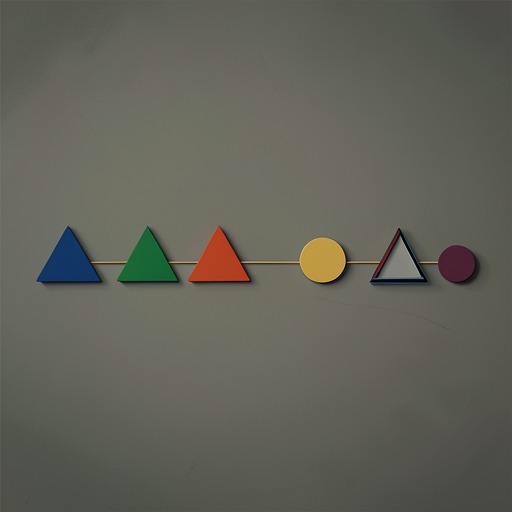
The introduction seeks a better explanation than a purely abstract formula for learners who have not yet acquired the idea of a mathematical point. It proposes that three colours meet and cover part of the paper. At the place where they meet, the point is not the blue region, nor the yellow, nor the red. It occupies no portion of the plane, because if it did, that portion would belong to one of the adjoining coloured parts. Nevertheless, the meeting exists at a determinate location.
The illustration thus converts absence of magnitude into a relation among visible regions. The point is identified by the convergence of the colours rather than by a fourth coloured area of its own. The text presents this junction as giving a good idea of a mathematical point: it supplies position without pretending that the ideal entity possesses physical breadth or thickness. The example is not offered as a literal claim that colour constitutes a point; it is a perceptual analogy that lets the learner approach an abstraction through the arrangement of material marks.
Colour, Naming, and Representation
The coloured diagram belongs to the book’s broader method of visual instruction. The work argues that geometrical diagrams are the materials of geometrical science, while demonstration shows the relative quantities of their parts by reasoning. Traditionally, that reasoning had been carried by words, letters, and black or uncoloured diagrams; the proposed system adds coloured symbols and diagrams to make reference more precise and rapid.
Within this system, colour functions chiefly as a means of naming and distinguishing parts. The introduction insists that colour has nothing to do with the lines, angles, or magnitudes themselves. A mathematical line, being length without breadth, cannot literally possess colour, and the same caution applies to the point. When the book speaks familiarly of a black line or a red line, the intended object is the junction or boundary represented through colour, not colour treated as a mathematical property. This limitation protects the formal concept from being confused with its visual vehicle.
The contrast with arbitrary letters is central to the method. Letters attached to points, lines, or other portions of a diagram are names assigned by convention; differently coloured parts, the book claims, can be made to name themselves through their visible forms and contrasts. A coloured reference can direct the learner immediately to the relevant part, whereas a verbal designation such as an angle named by several letters requires the letters to be traced and arranged mentally. Applied to a point, the same principle makes its location available as a visible relation among adjoining colours rather than as a symbol that must be decoded separately.
Place in Geometrical Reasoning
Geometric point is not itself a theorem, problem, or demonstration, but it is one of the definitions from which geometrical propositions proceed. The book distinguishes axioms as general propositions taken to be self-evident and incapable of being established by demonstration; propositions as results obtained through reasoning; problems as instructions to construct something under given conditions; and theorems as assertions of principles deduced from definitions, postulates, axioms, or previously established truths. Geometric point belongs to the definitional foundation on which these later operations depend.
That foundation is paired with permitted constructional instruments. The book states that the Straightedge and Compass are the only instruments allowed in Euclid’s plane geometry, a restriction expressed through the postulates. A postulate permits a straight line to be drawn from one point to another and a circle to be described with any centre at any distance from that centre. Such operations begin from points as positions and connect or organize them into lines and circles. The physical construction may leave a visible mark, but the proof concerns the ideal relations established by the definitions and permitted operations.
The concept also participates in the book’s account of superposition, defined as conceiving one magnitude placed upon another so that every part exactly coincides. Although a point has no magnitude and is not itself a magnitude to be superposed, its position provides the fixed reference by which lines, figures, and coincident parts can be located and compared. In this way, the point is quiet but structurally indispensable: it is less an object among objects than the positional condition that allows geometrical objects to be specified.
Educational and Epistemological Significance
The treatment of Geometric point exemplifies the book’s attempt to join sensory clarity with deductive discipline. The introduction argues that visual explanation is intended not merely to entertain but to assist the mind in its search for truth, facilitate instruction, and diffuse permanent knowledge. Since geometry is presented as a foundation for mathematical science and as a basis for activities including land surveying, mensuration, engineering, navigation, mechanics, and optics, making its first abstractions accessible is treated as an educational priority.
The point reveals why visual teaching cannot simply replace definition and proof. The three-colour junction makes position imaginable, but the formal statement determines what the object is: something without parts, position without magnitude. Colour supplies an entry into the idea; definition limits the idea; and demonstration would establish consequences from it. The method therefore does not dissolve geometry into perception. Instead, it uses perception to hold the learner’s attention while directing reasoning toward entities that no physical diagram can display without remainder.
This combination supports the book’s larger educational ambition. By addressing sight and hearing together, and by making equal or related parts remain visually present throughout a demonstration, the proposed system seeks to prevent learners from merely committing proofs to memory. The Geometric point is a particularly exact test of that ambition, because understanding it requires recognizing both what the diagram shows and what it cannot literally show. Its educational value lies in training the learner to move from a coloured meeting on paper to an abstract positional concept, and from that concept into the ordered reasoning of plane geometry.