Straight line
ElementsStraight line is one of the foundational objects of the geometry presented in The Elements of Euclid. It is defined negatively, as length without breadth, and positively, as that which lies evenly between its extremities. The book therefore treats it neither as a coloured mark nor as a merely drawn stroke, but as an ideal relation that diagrams, instruments, and demonstrations make perceptible and usable.
Definition and Ideal Form
A straight line is introduced through the distinction between a mathematical object and its material representation. The formal definition states that a line is length without breadth, while the definition of a straight or right line adds that it lies evenly between its extremities. Its endpoints are points, so the line occupies a position between determinate limits without acquiring the breadth of a surface. The language separates the exact object of geometry from the paper on which it is represented: the drawn trace is an aid to thought, whereas the geometrical line is the dimension and relation abstracted from that trace.
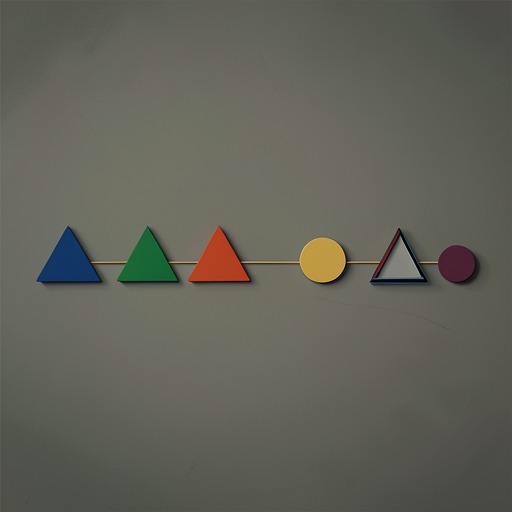
The book's coloured explanation makes this abstraction visible by placing two colours against one another on a plane. Where the colours meet is neither the red region nor the blue region; the junction is treated as occupying no portion of the plane and therefore as possessing no breadth, but only length. A single colour differing from the paper would have been sufficient for illustration, yet the meeting of two colours gives the learner a sharper sense of a boundary without thickness. When the text later speaks of a red line or a blue line, it explains that the junction with the plane is what should be understood, not the colour as a physical property of the mathematical line.
Representation Through Colour
The coloured system changes how a straight line is named during demonstration. Ordinary geometrical reasoning had commonly used words, letters, and black or uncoloured diagrams, but the book adopts coloured symbols because they make the relevant forms and relations more precise and more rapidly apprehensible. Letters attached to points, lines, or other parts of a diagram are described as arbitrary names. Colour instead allows the parts to appear to name themselves, because their forms, distinguished by corresponding colours, identify them within the demonstration.
This visual naming is especially important when several lines or other parts must be followed at once. A lecturer can refer to the blue line or the red line and have the class see the indicated object immediately. By contrast, a reference such as a lettered line requires students to trace the letters one by one and then reconstruct the particular magnitude in their minds, a process the book associates with confusion, error, and wasted time. The straight line thus becomes more than an abstract definition: within the pedagogical system, it is also a visually indexed component of an argument.
The colours do not alter the line's mathematical nature. The book expressly warns that colour has no connection with the line, angle, or magnitude except as a means of naming them. A mathematical line, being length without breadth, cannot literally possess colour. The coloured junction is a familiar representation, and the learner is expected to understand the represented line rather than mistake the pigment for the object. This limitation gives the method its discipline: visual immediacy is welcomed, but it remains subordinate to geometrical abstraction.
Instrument and Construction
Straight lines are the principal paths of the constructions that organize plain geometry. The book restricts Euclidean geometry to the use of the Straightedge and Compass, identifying these as the only instruments permitted in the subject and explaining that the declaration of this restriction belongs to the postulates. The Straightedge supplies the practical means for drawing or extending the ideal line, while the proof determines what the construction establishes; neither the instrument nor the visible stroke replaces the reasoning.
The sequence of propositions repeatedly turns the straight line into an operation. Book I opens with a problem concerned with a given finite straight line, then proceeds to constructions involving perpendiculars and other relations between lines. A later proposition asks for a straight line perpendicular to a given indefinite straight line from a given point. These formulations show the line in two complementary conditions: it may be finite, with specified extremities, or indefinite, continuing beyond the portion displayed. In each case, the line is not merely described but placed within a rule-governed construction whose success is confirmed by demonstration.
The same object also appears in theorem form. One proposition begins from a straight line standing in relation to another figure, while subsequent Euclidean arguments use lines as the boundaries, divisions, or connecting paths through which equality and other properties are established. The distinction between problem and theorem is significant here: a problem requires something to be constructed, whereas a theorem states a result obtained by reasoning. The straight line passes between these modes, serving first as a thing the instruments produce and then as an ideal element whose relations the proof explains.
Proof, Memory, and Educational Use
The book presents coloured diagrams as a corrective to teaching that turns demonstration into a dry exercise of memory. Repetitions that add no greater exactitude can hide the sequence of evidence from a student, while the coloured line keeps the relevant object before the mind throughout the reasoning. If parts given as equal receive the same colours, the arrangement offers an ocular demonstration of the equality to be proved and helps the learner retain the data while the argument proceeds.
This method is claimed to accelerate the acquisition of The Elements of Euclid, reducing the required time to less than one third of that usually employed and making retention more permanent, according to experiments attributed to the inventor and to others who adopted the plan. The claim depends on a particular division of labour between sight and language. Words and letters remain available, but colour supplies a faster reference to the actual parts of the figure. In oral demonstrations, the eye and ear can be addressed simultaneously, allowing the verbal statement and the visible line to reinforce one another.
The straight line is consequently central to the book's broader theory of geometrical learning. Geometry is presented as a science that calls forth inquiry, elevates the mind, and strengthens reasoning, while also supporting arithmetic, land surveying, mensuration, engineering, navigation, mechanics, hydrostatics, pneumatics, and optics. A line that can be seen, named, constructed, and proved becomes an entry point into that larger discipline. Its apparent simplicity conceals the book's central educational ambition: to make rigorous reasoning visible without confusing visibility with proof.
Significance in the Geometry of the Book
Straight line joins the book's three governing levels: definition, representation, and demonstration. At the level of definition, it is length without breadth and a path even between its extremities. At the level of representation, it appears as the junction of coloured regions on a plane, a visible sign whose colour identifies rather than changes it. At the level of practice, it is produced with the Straightedge, extended, placed perpendicular to another line, and incorporated into propositions that transform construction into proved geometrical knowledge.
Its importance also lies in the tension it manages between sensory instruction and ideal form. The coloured diagram makes the line easier to locate and remember, yet the book insists that the learner must understand the junction, not the colour; the visual aid is powerful precisely because it points beyond its material surface. Straight line therefore exemplifies the book's coloured geometry as a whole: an apparently concrete mark is used to disclose an abstract relation, and a familiar act of drawing is disciplined by definitions, restricted instruments, and reasoned proof.