Plane surface
ElementsPlane surface is the ideal two-dimensional field in which Euclidean geometry takes place. It has length and breadth but no thickness, is bounded by lines, and is defined by an evenness that distinguishes it from an irregular or merely physical surface. In the colored pedagogy of The Elements of Euclid, it is also the visible ground against which lines and solid divisions become intelligible: geometry moves from the material page to abstract relations without abandoning the page as its first means of access.
Definition and Boundaries
A plane surface is defined as that which has length and breadth only. Its extremities are lines, so the plane is not an isolated expanse but a surface understood through the boundaries that determine it. The definition of a surface supplies the two-dimensional condition, while the definition of a plane surface adds the requirement that it lies evenly between its extremities. This evenness makes the plane suitable for exact comparison and construction: figures placed upon it can be treated as relations of position, length, inclination, and enclosure rather than as accidental irregularities of a physical object.
The text distinguishes the plane from both the line and the solid. A line has length without breadth; a surface has length and breadth without thickness; a solid body has length, breadth, and depth. These distinctions are not merely verbal classifications. They establish the dimensional order through which geometry can pass from the indivisible point, to the extended line, to the bounded plane figure, and finally to bodies whose parts are separated by surfaces. In the explanation of a solid, differently colored portions are divided by a colored surface, making the plane surface perceptible as the separator between regions of matter.
The Plane as Geometrical Medium
The plane is the common setting of the first six books of The Elements of Euclid. The lines considered in those books are assumed to lie in the same plane, a restriction that keeps the demonstrations within plain geometry and permits figures to be examined through their visible boundaries. Angles are formed when two lines meet in a plane without lying in the same straight line, and figures are enclosed by lines whose entire length is called the perimeter. The plane therefore gathers the book's principal objects into one coherent field: points mark positions, lines delimit extension, angles express inclination, and polygons and circles occupy bounded portions of the surface.
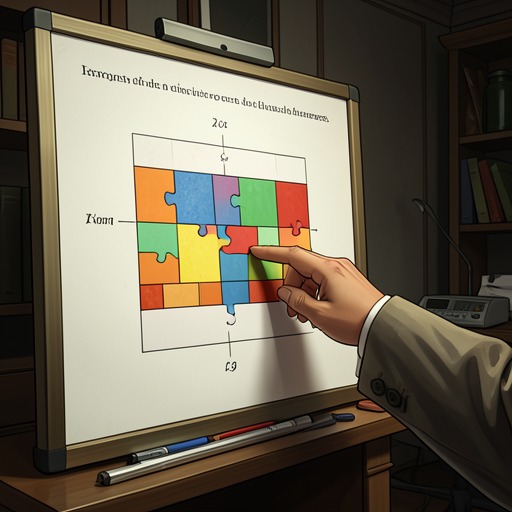
The colored system makes this medium unusually explicit. When two colors meet on paper, their junction is neither the red region nor the blue region; the junction occupies no portion of the plane and therefore has length but no breadth. The visible meeting of color and paper thus provides an illustration of the mathematical line, while the paper itself supplies the plane upon which that line is traced. A single color different from the paper would have been enough for the illustration, but contrasting colors allow adjoining parts to distinguish themselves and to name themselves through their forms and relations.
Construction and Proof
The plane is not only where geometrical objects are displayed; it is where permitted operations become constructions. The straightedge and compass are identified as the only instruments allowed in Euclid, or plain geometry, and the postulates define the scope of their use. One postulate grants that a straight line may be drawn from any point to any other point; another grants that a circle may be described with any center and at any distance from that center. These operations presuppose a plane in which the drawn line and described circle can be compared, intersected, and used to form new figures.
The opening propositions demonstrate how the plane converts instrument use into mathematical knowledge. Book I, Proposition I begins with the problem of constructing an equilateral triangle on a given finite straight line. Later propositions use the same planar discipline to draw a perpendicular to an indefinite straight line from a given point, and to establish further relations among planar lines and angles. In each case, the construction is only the beginning. The solution shows how the required figure may be made with the straightedge and compass; the demonstration proves that the process actually reaches the stated end. The plane is consequently the controlled space where practical drawing, ideal definition, postulate, and deductive proof meet.
Superposition provides another operation through which planar magnitudes are understood. It is the process by which one magnitude is conceived as placed upon another so that every part exactly coincides. Such imagined coincidence allows figures and portions of figures on the plane to be tested for equality without treating the page as a passive illustration. The visible surface supports the act of comparison, while the proof converts that act into a general geometrical principle.
Epistemological and Pedagogical Significance
The plane has a double status in the book. It is an abstract object defined by dimensional properties and evenness, yet it is also the material field on which colored symbols make geometrical reasoning visible. The book argues that diagrams are not merely signs standing for an absent science: geometrical diagrams are the materials of geometrical science, whose purpose is to show the relative quantities of their parts through reasoning called demonstration. Color therefore does not replace proof. It makes the relevant parts more precise and more quickly apprehensible so that proof can operate on clearly differentiated forms.
This visual emphasis is linked to a broader educational claim. The colored method is presented as capable of reducing the time required to acquire The Elements of Euclid to less than one third of the time usually employed, while making retention more permanent, according to experiments attributed to the inventor and others who adopted the method. Letters attached to points and lines are described as arbitrary names; differently colored parts instead appear to name themselves because corresponding colors represent them in the demonstration. The plane becomes the meeting place of these two systems: it is the physical page that carries the colors and the ideal surface that organizes their geometrical relations.
The plane also supports the book's distinction between perception and language. Audible words, whether heard directly or encountered through letters addressed to the eye, communicate through representative signs. The visual diagram offers a different economy, because the relative quantities of its parts can be apprehended together rather than assembled only through verbal sequence. By directing sight toward one planar arrangement, the colored figure makes comparison immediate while leaving the logical demonstration responsible for establishing necessity.
Place in the Euclidean System
As the defined two-dimensional setting of Euclidean geometry, plane surface connects the book's foundational vocabulary to its later constructions and theorems. Definitions establish what a surface and a plane surface are; postulates authorize the drawing of lines and circles; axioms provide self-evident general propositions; problems propose constructions; and demonstrations prove that the constructions or asserted principles succeed. The plane is the stable domain that allows these forms of knowledge to remain distinct while functioning together.
Its importance is therefore structural rather than ornamental. Without a plane, the line could not be treated as the boundary of a surface, angles could not be defined through the inclination of planar lines, and the first propositions could not turn straightedge-and-compass actions into exact relations. The plane surface is at once boundary, background, instrumentally produced field, and condition of proof: the apparently blank extent on which geometry reveals that its abstractions depend upon carefully regulated visibility.