Geometrical demonstration
ElementsGeometrical demonstration is the central reasoning practice of the book’s presentation of geometry. It converts figures and operations into justified mathematical knowledge: a construction proposes what can be done, while a demonstration establishes that the proposed operation really achieves its required end. The method therefore joins visual form to deductive necessity, preserving the classical structure of Euclidean geometry while recasting its evidence for quicker and clearer apprehension.
Definition and Function
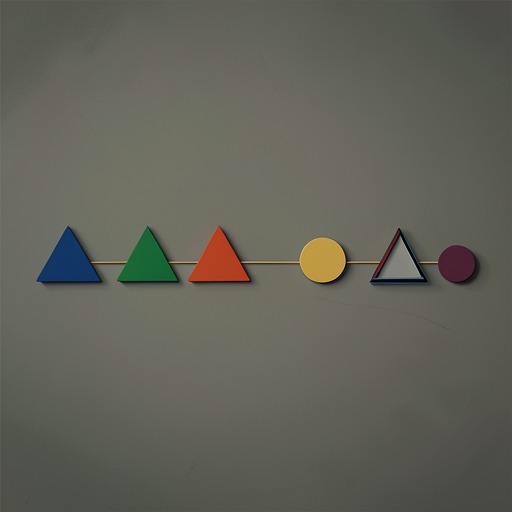
A geometrical diagram is treated as more than a merely illustrative sign. The diagrams are described as the materials of geometrical science, whose purpose is to show the relative quantities of their parts through reasoning called demonstration. Earlier instruction had commonly relied on words, letters, and black or uncoloured diagrams; this book instead adopts coloured symbols, signs, and diagrams because they make the reasoning more precise and its attainment more expeditious. Colour does not replace proof. It identifies the corresponding parts of a figure so that their forms participate directly in the argument rather than remaining dependent on arbitrary letter names.
The distinction between construction and demonstration is explicit. A construction changes the original figure by drawing lines, making angles, or describing circles so that the figure is adapted to the argument or to the solution of a problem. The conditions introduced by these changes are considered as indisputable as those contained in the hypothesis: if an angle is made equal to a given angle, the two angles are equal by construction. Demonstration then proves that the completed process reaches the required conclusion. Its authority lies not in the appearance of the altered figure alone, but in the chain that connects each permitted operation with an established principle.
Foundations of the Argument
The book places demonstration within a hierarchy of mathematical foundations. Its definitions begin with elementary entities and relations, including the point, and its postulates state the operations that may be assumed. One postulate grants that a straight line may be drawn from any one point to any other point; another grants that a circle may be described with any centre at any distance from that centre. The axioms, by contrast, are general propositions whose truth is taken to be self-evident and incapable of being established by demonstration. Demonstration thus does not begin from nothing: it proceeds from definitions, granted constructions, and accepted general truths.
The restriction of instruments gives this system a practical boundary. The straightedge and compass are the only instruments permitted in Euclid, or in plain geometry, and the purpose of the postulates is to declare that restriction. The ideal figure is therefore not produced by any convenient mechanical device. It must arise through the operations that the geometric system authorizes, after which the resulting relations can be reasoned about. This distinction between permitted action and proved consequence keeps construction from being confused with verification.
Problems, Theorems, and Supporting Steps
The book divides propositions into two species: problems and theorems. A problem proposes that something be done, such as drawing a line under given conditions, describing a circle, or constructing a figure. Its solution shows how the requested object may be produced with the straightedge and compass. The demonstration that follows proves that the indicated process actually attains the required end. A problem is therefore analogous to a postulate, while a postulate is a problem whose solution has been assumed.
A theorem asserts the truth of a principle. That principle must be deduced from the axioms and definitions, or from other truths previously and independently established; demonstrating this deduction is the theorem’s purpose. A theorem consequently resembles an axiom in form but differs in status: an axiom is granted without demonstration, whereas a theorem earns its authority through the proof that connects it to the foundations.
The system also recognizes intermediate forms of reasoning. A corollary is an inference deduced immediately from a proposition, allowing a consequence to be drawn without rebuilding the entire argument. A scholium is a note or observation on a proposition that does not contain an inference important enough to be called a corollary. A lemma is a proposition introduced merely to establish a more important proposition. These distinctions show that geometrical demonstration is not a single undifferentiated act; it has supporting steps, immediate consequences, explanatory remarks, and subordinate results, each with a defined place in the architecture of proof.
Visual Evidence and Instruction
The book’s educational reform addresses the difficulty of presenting this architecture to learners. It criticizes instruction in which formalities and the apparatus of rigour are displayed so ostentatiously that they nearly conceal the reality of the subject. Endless repetitions that add no greater exactitude can make demonstrations involved and obscure, hide the succession of evidence, and reduce a discipline intended to strengthen reasoning to an uninteresting exercise of memory. Against that failure, the book proposes a method that appeals forcefully to sight, described as the most sensitive and comprehensive of the external organs.
This visual emphasis gives demonstration a double channel. Words and letters remain part of the reasoning, but coloured parts of the diagram can identify themselves through their forms and corresponding colours. The stated advantage is not merely decorative clarity: the Elements of Euclid are said to be learnable in less than one third of the time usually employed, with more permanent retention, on the basis of experiments conducted by the inventor and others who adopted the plan. The claim presents coloured geometry as a change in the transmission of proof, allowing perception to support the sequence that language must otherwise carry alone.
Closure and Significance
The conventional closing formula, Q. E. D., is expanded as Quod erat demonstrandum, meaning “Which was to be demonstrated.” Its position at the end of an argument marks the point at which the proposed conclusion has been connected to the authorized premises and operations. In the book’s larger educational vision, that closure is not an empty ritual. It represents the difference between seeing that a figure has been made and knowing why the figure satisfies the stated conditions.
Geometrical demonstration consequently unites the book’s classical inheritance with its visual pedagogy. Definitions, postulates, axioms, constructions, and propositions supply the logical order; straightedge and compass define the legitimate means of operation; colour and diagrammatic form make the relations more immediately perceptible. The result is a conception of geometry in which proof is both rigorous and teachable: it disciplines the mind by requiring a succession of reasons, while the visible figure keeps that succession exposed rather than burying it beneath verbal formality.