Axiomatic method
ElementsThe Axiomatic method is the organizing principle that turns geometry from a collection of diagrams into a demonstrative science. Its distinctive significance lies in the division of mathematical knowledge into definitions, postulates, axioms, constructions, and deductions: each has a different authority, and together they create a chain by which a proposition can be established rather than merely observed. The method therefore joins the visual power of figures to a strict account of what may be assumed, constructed, and proved.
Foundations and First Principles
The system begins with definitions. Among the opening definitions is the statement that a point is that which has no parts, while later definitions distinguish such entities as lines, angles, planes, and parallel straight lines. These formulations do not prove properties; they identify the objects about which geometry will reason. They establish the vocabulary and limits of the subject before any proposition is attempted.
Postulates then authorize particular geometrical operations. The first permits a straight line to be drawn from any one point to any other point. Another permits a circle to be described with any centre and at any distance from that centre. These are not presented as conclusions derived from earlier demonstrations. They are admitted starting conditions, expressed as operations that make construction possible. The restriction to the straight-edge and compasses gives the method a practical boundary: in Euclid's plain Geometry, these are the only permitted instruments, and the postulates state the basic acts those instruments may perform.
Axioms have a different scope. They are described as general propositions whose truth is self-evident and incapable of being established by demonstration. An axiom is therefore defined as a theorem whose truth is granted without demonstration, whereas a postulate is a problem whose solution is assumed. The contrast is precise: the postulate concerns an authorized construction, while the axiom concerns an accepted relation or truth. Both stand before the demonstrations, but they do not perform the same logical work.
From Construction to Demonstration
The method distinguishes propositions into problems and theorems. A problem proposes that something be done, such as drawing a line under given conditions, describing a circle, or constructing a figure. Its solution must show how the required object can be made with the straight-edge and compasses. The construction changes the original figure by drawing lines, making angles, or describing circles in order to adapt it to the argument or to the solution of the problem.
Demonstration begins where construction alone would be insufficient. Its task is to prove that the process indicated in the solution really attains the required end. A theorem, by contrast, asserts the truth of a principle; that principle must be deduced from definitions, axioms, postulates, or other truths previously and independently established. The distinction prevents a diagram from carrying more authority than it deserves. A figure may display the intended relation, and a construction may produce the relevant configuration, but only the reasoning shows why the result follows.
The method also accommodates several subordinate forms of reasoning. A corollary is an inference deduced immediately from a proposition. A lemma is introduced to establish a more important proposition, while a scholium is a note or observation that does not contain an inference important enough to be called a corollary. These categories map the stages of mathematical argument, separating foundational assumptions from direct consequences, preparatory results, and explanatory remarks.
The formula Q. E. D., expanded as Quod erat demonstrandum and translated as "Which was to be demonftrated," marks the completion of this process. It is not an additional premise or a new mathematical operation. It signals that the asserted conclusion has been carried through the established chain of reasoning and that the demonstration has reached its appointed end.
Visual Evidence and Logical Authority
The Axiomatic method does not reject visual instruction. The book presents Geometry as concerned with the exposition and explanation of the properties of figure, and it treats visual communication as a means of assisting inquiry and instruction. Superposition, for example, is defined as conceiving one magnitude placed upon another so that every part exactly covers or coincides with the corresponding part of the other. This supplies an intelligible model for geometrical equality and coincidence, connecting what the eye can compare with what the argument must establish.
Yet visual coincidence is not simply allowed to replace proof. The figure is a controlled field in which definitions and constructions become perceptible. A line may be produced by extending it; the perimeter is the entire length of the line or lines enclosing a figure; a radius runs from the centre of a circle to its circumference; and the sides of a figure are the lines that include it. Such terms make the drawing readable, but their mathematical force comes from the definitions that govern their use and from the demonstrations that derive consequences from them.
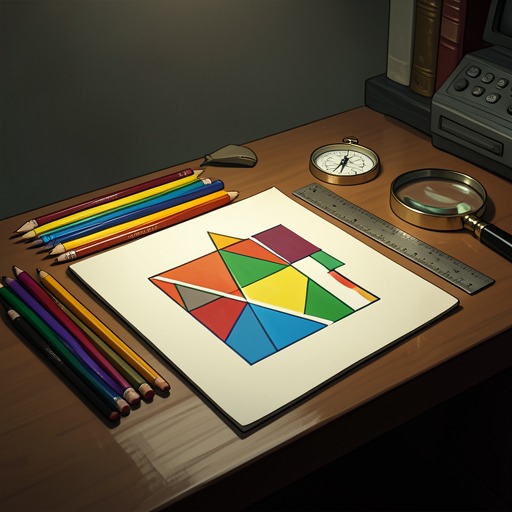
This separation between appearance and warrant is especially important because the book also advocates coloured diagrams as a reform in teaching. Its larger educational program aims to use the eye to assist the mind in its search for truth, not merely to entertain it. The colour and form of a diagram can make the sequence of evidence easier to follow, but the axiomatic structure ensures that greater visibility does not become an unsupported assertion. Visual immediacy and logical necessity cooperate without becoming identical.
Geometry as an Educational and Practical System
The method supports the book's claim that Geometry is more than an abstract exercise. The propositions of geometry are presented as foundations for arithmetic, land-surveying, mensuration, engineering, navigation, mechanics, hydrostatics, pneumatics, optics, and physical astronomy. In that context, the axiomatic system gives practical knowledge a disciplined origin: useful procedures and measurements can be connected to propositions whose conditions and consequences are made explicit.
The educational ambition is equally broad. The book argues that the first communication of a science strongly affects a learner, and it criticizes instruction in which formalities and repeated explanations obscure the sequence of evidence. The Axiomatic method offers a corrective by making the architecture of reasoning visible. Definitions tell the learner what is being discussed; postulates and axioms identify what may be taken as given; constructions show what can be done; and demonstrations show why the result follows.
This structure also supports the book's social ideal of mathematical instruction. It calls attention to the place of the Elements of Mathematics in sound female education and imagines that, because sight and hearing can be addressed with one thousand learners as readily as with one, geometry and other branches of mathematics could be taught to the million. The stated educational purpose is to teach people how to think rather than what to think. In that formulation, the axiomatic system is not only a technical arrangement of propositions but also a training in intellectual independence: learners encounter reasons that can be followed, tested against premises, and extended to new conclusions.
Significance and Limits of the Method
The Axiomatic method establishes a hierarchy of certainty without pretending that every part of geometry has the same status. Definitions stipulate meanings, postulates assume constructions, axioms grant general truths, problems prescribe acts, and theorems demand deduction. Their relationships prevent confusion between making a figure and proving a fact. The system's rigor lies less in any single statement than in the ordered passage from accepted foundations to demonstrated consequence.
At the same time, the method remains presented through concrete operations and visible forms. Straight lines, circles, angles, radii, perimeters, and superposed magnitudes give abstract relations a physical and perceptual language. The straight-edge and compasses define what counts as an admissible construction, while proof determines whether that construction fulfills its purpose. The resulting synthesis explains why this geometry can be both intellectually exact and pedagogically accessible: its objects can be shown, its operations can be performed, and its conclusions can be justified.
Its decisive legacy within the book is therefore methodological. Geometry becomes a model of ordered inquiry, one that cultivates the spirit of investigation, elevates the mind, and strengthens the reasoning faculties. The axiomatic method makes those aims concrete by requiring every demonstrated principle to stand in relation to definitions, postulates, axioms, or truths already secured. What begins as a point, a line, or a permitted circle thus becomes a complete discipline of evidence, culminating in the quiet declaration that the proposition has been demonstrated.