Geometry
ElementsGeometry is defined in this work as the exposition and explanation of the properties of figure, where figure itself is understood as the relation subsisting between boundaries. Its decisive importance lies in the union of two purposes: it disciplines inquiry and reasoning, while also supplying principles on which many practical occupations and sciences depend. The book treats geometry not as an isolated school exercise but as a foundation for mathematical knowledge, technical work, and the general education of the mind.
Scope and Intellectual Importance
Geometry is associated with the training of the mind from ancient Greece through the educational practice of Johann Heinrich Pestalozzi and others. The book presents The Elements of Euclid as having become, by common agreement, the basis of mathematical science throughout the civilized world. This authority is explained not merely by tradition: geometry is said to call forth the spirit of inquiry, elevate the mind, and strengthen the reasoning faculties, while also serving as an introduction to arithmetic, land-surveying, mensuration, engineering, navigation, mechanics, hydrostatics, pneumatics, optics, and physical astronomy.
The work therefore gives geometry a double social identity. It is a rigorous science of relations among figures, but it is also preparation for useful and important vocations. Its value extends from abstract reasoning to the measurement of land, the design of machines, the study of fluids and air, navigation, and the interpretation of physical phenomena. Geometry becomes, in this account, a common intellectual infrastructure connecting school learning with practical life.
Visual Teaching and Coloured Representation
The book argues that the first communication of a science strongly influences a learner's future relation to it. Conventional instruction can place formalities, repeated demonstrations, and rigid procedures so prominently before the student that the evidence becomes obscure and the subject is reduced to an uninteresting exercise of memory. Geometry is consequently in danger of being experienced as dry discipline rather than as a subject capable of awakening curiosity and cultivating close thought.
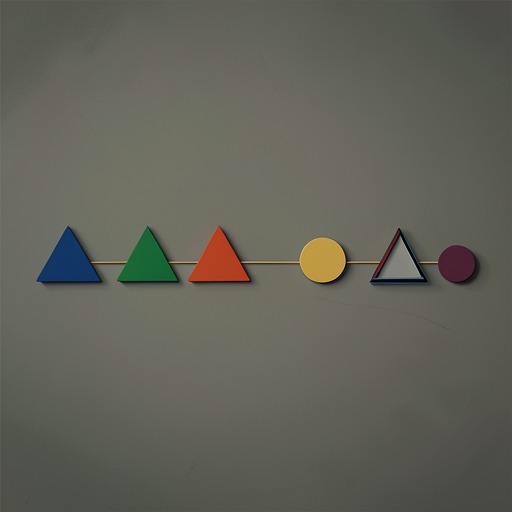
The proposed remedy is a coloured system of instruction. Colour is not introduced merely for entertainment or decorative combination; it is intended to assist the mind in searching after truth, facilitate instruction, and diffuse knowledge that will remain. The method appeals to sight, described as the most sensitive and comprehensive of the external organs, and treats visual arrangement as a means of fixing relationships in the understanding rather than as an ornament added after the reasoning is complete.
In a lecture, naming a red angle or a blue line allows the relevant part to be recognized at once by the whole class. Naming the same object only through letters requires students to trace those letters individually and arrange the corresponding magnitude in their minds, a process that can cause confusion, error, and loss of time. When equal parts in a diagram share the same colours, the arrangement provides an ocular demonstration of their equality and helps the learner retain the given data throughout the reasoning. The coloured method can replace other methods in some contexts, but it can also serve as an introduction, a rapid aid to recollection, or a means of making knowledge more permanent.
The book generalizes this claim beyond geometry. Coloured representations, including pictures, cuts, and diagrams, are said to be more easily fixed in the mind than unmarked sentences. The contrast is between sounds that quickly disappear and forms that remain impressed upon memory: visual structure is treated as a durable carrier of knowledge. Geometry thus becomes an especially clear example of a broader theory of visual learning, in which colour, shape, and spatial arrangement reduce the burden of verbal identification and make relations immediately available to perception.
Formal Structure and Basic Objects
The formal system begins with definitions. A point is defined as that which has no parts, while parallel straight lines are those in the same plane which, if continually produced in both directions, would never meet. The first six books concern plane figures, and the lines considered in them are assumed to lie in the same plane. The vocabulary also includes the perimeter as the entire length enclosing a figure, the radius as a line from the centre of a circle to its circumference, the sides as the lines including a figure, and the hypotenuse as the side opposite the right angle in a right-angled triangle.
The book distinguishes the parts and operations through which figures are understood. An angle is formed by two lines meeting at a vertex; the lines are its legs, and the vertex is the point at which they meet. When the legs are prolonged beyond the vertex, the angles on opposite sides are vertically opposite angles. Superposition is the process of conceiving one magnitude as placed upon another so that corresponding parts exactly coincide. A line is produced when it is extended or prolonged, and the added length is its produced part or production.
These definitions establish an ideal vocabulary for describing visible figures without reducing geometry to the appearance of a particular diagram. Colour may make a part instantly recognizable, but the formal system identifies the same part through concepts such as vertex, leg, side, radius, perimeter, and superposition. Visual immediacy and abstract definition therefore operate together: the diagram supplies a perceptible arrangement, while the definitions specify what kind of relation the arrangement expresses.
Instruments, Foundations, and Proof
The permitted instruments of plain geometry are the straightedge and compass. The postulates declare the accepted operations: a straight line may be drawn from any one point to any other point, and a circle may be described with any centre and at any distance from that centre. These permissions define the practical limits within which constructions are made. The instruments are simple, but their restricted use gives Euclidean construction its distinctive character, converting drawing into a controlled mathematical operation.
The axioms are described as general propositions whose truth is taken to be self-evident and incapable of being established by demonstration. Definitions specify the objects and relations under discussion; postulates authorize certain constructions; axioms provide general truths from which further reasoning may proceed. The resulting system combines perceptible figures with propositions whose authority is not derived from the particular marks on a page.
A proposition is a result obtained by reasoning and has two forms, the problem and the theorem. A problem proposes that something be done, such as drawing a line under given conditions, describing a circle, or constructing a figure. Its solution shows how the required action may be performed with the straightedge and compass; its demonstration proves that the indicated process actually achieves the required end. A theorem, by contrast, asserts the truth of a principle, which must be deduced from definitions, axioms, or other truths already established independently. Demonstration is the means by which that deduction is shown.
This structure clarifies the epistemic division between construction and proof. A figure can be produced by an authorized operation, but the visible success of the operation is not by itself the full mathematical justification. The demonstration must establish that the construction satisfies the stated conditions. Conversely, a theorem is not merely a diagram accompanied by words: its force comes from a chain of reasoning grounded in the system's prior commitments. Geometry is consequently represented as both a practice of making and a discipline of proving.
Education, Memory, and Public Use
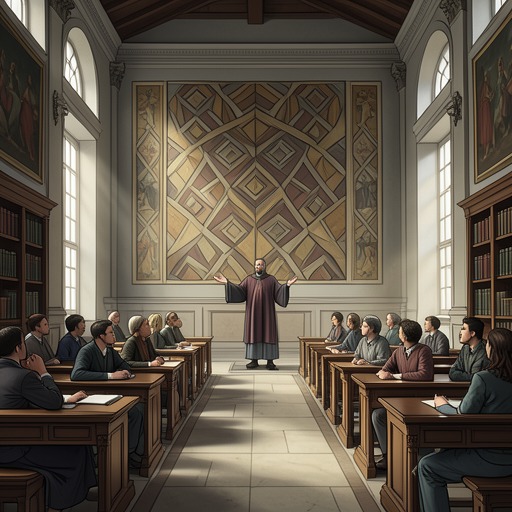
The educational ambition of geometry extends beyond specialist instruction. The work calls attention to the place of the Elements of Mathematics in sound female education and recommends the attractive visual method to those concerned with educating women. It also imagines geometry and other branches of mathematics being taught to very large populations, arguing that sight and hearing can be addressed with equal force whether the audience numbers one person or a million.
For public schools and other places of instruction, dyed chalks are proposed for drawing diagrams; for private use, coloured pencils are described as convenient. These practical details show that the visual system is intended to function in classrooms and ordinary study, not only in an ideal printed figure. The method links the material means of marking a diagram with the social aim of making mathematical understanding broadly accessible.
The final educational claim is philosophical as well as institutional: instruction should teach people how to think, rather than what to think. Geometry is valuable because it forms habits of inquiry, sustained attention, and reasoning from stated foundations. Its coloured presentation seeks to preserve those intellectual demands while removing avoidable obstacles of notation, confusion, and mechanical memorization. In that combination, geometry appears as both a classical science inherited from Euclidean tradition and a modern instrument for the wider distribution of disciplined thought.