Visual learning
ElementsVisual learning is presented as a method for turning geometry from a dry exercise of memory into an active practice of perception and reasoning. In Oliver Byrne’s introduction to The Elements of Euclid, colour is not decorative entertainment but a disciplined system for identifying geometrical parts, making demonstrations more immediate, shortening study, and extending access to mathematical knowledge. Its decisive claim is that the eye can grasp relationships among lines, angles, and figures at the moment they are explained, allowing learners to retain the structure of a proof rather than merely memorize its wording.
Purpose and Educational Background
Visual learning arises from a critique of conventional instruction. The introduction argues that although geometry is exceptionally suited to cultivating inquiry, elevating the mind, and strengthening the reasoning faculties, students are often confronted at the threshold of the subject with excessive formalities, rigid procedures, and perplexing repetition. Such teaching can conceal the sequence of evidence and turn a discipline intended to develop close thinking into an uninteresting exercise of memory. The proposed remedy is to awaken curiosity and the “dormant powers” of younger minds by presenting geometrical relations in a form that can be apprehended before they are laboriously reconstructed from verbal notation.
The method is placed within a broad account of the importance of geometry. The Elements of Euclid is described as the foundation of mathematical science throughout the civilized world, while arithmetic, land-surveying, mensuration, engineering, navigation, mechanics, hydrostatics, pneumatics, optics, and physical astronomy are all said to depend on geometrical propositions. Visual learning therefore has a practical as well as a philosophical ambition: it is meant to improve the first communication of a foundational science and to prepare learners for many useful occupations.
Colour as a Geometrical Language
The system distinguishes between arbitrary verbal labels and visible identities. Letters attached to points, lines, angles, or other diagrammatic parts function as names in a demonstration; differently coloured parts, by contrast, are said to “name themselves,” because their forms and corresponding colours identify them whenever the proof refers to them. Colour consequently operates as a visual grammar. It does not alter the line, angle, magnitude, or mathematical relation; it merely provides a rapid means of recognition. The introduction explicitly cautions that a mathematical line, being length without breadth, cannot literally possess colour. When a “black line” or “red line” is mentioned, the learner is to understand the geometrical junction or part indicated, not to mistake pigment for mathematical substance.
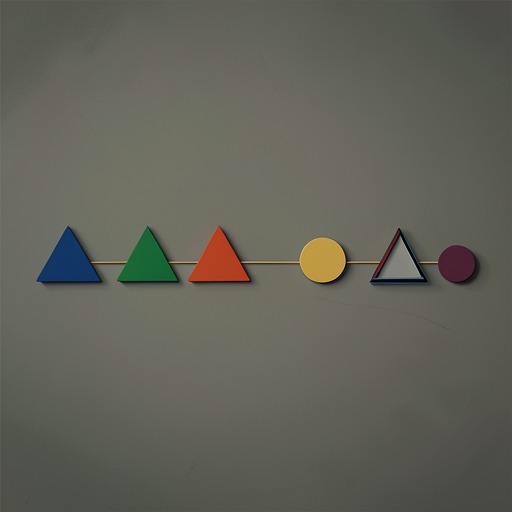
The method is demonstrated through relations among coloured components. A red angle, a yellow angle, and a blue angle can be combined so that the diagram visibly expresses their equality with twice the yellow angle and with two right angles; the same arrangement can also make the red angle plus the blue angle equal to the yellow angle. In another example, the yellow line is shown as equal to the sum of the squares on the blue and red lines. These are not presented as illustrations added after the reasoning. The coloured forms are treated as the material through which the geometrical relationships become available to thought.
This visual coding also preserves the data of a proof. When parts given as equal receive the same colour, the learner continues to see the initial conditions throughout the reasoning. The diagram thus supplies an “ocular demonstration” of the parts that are to be proved equal, preventing attention from wandering away from the objects under examination. Colour makes equality recurrent and visible rather than leaving it to be recalled from an earlier sentence.
Eye, Ear, and the Speed of Demonstration
Visual learning is most powerful in the book when it works together with speech. In oral demonstrations, the eye and the ear can be addressed simultaneously: the teacher names a coloured angle or line while the class sees the corresponding part at once. This is presented as a special advantage for teaching geometry and other linear arts and sciences in classes. The method does not abolish verbal explanation; it synchronizes verbal explanation with visible reference.
The contrast with letter-based diagrams is practical and cognitive. If a lecturer says “the angle ABC,” “the triangle PFQ,” or “the figure EGK,” students must trace the letters one by one before arranging the relevant magnitude in their minds. That delay can produce confusion, error, and loss of time. A colour name, such as the red angle or the blue line, directs attention immediately to the visible object. Reference from text to diagram is therefore described as more rapid and more certain when it uses the form and colour of a part, or names the part together with its colour, rather than relying on letters alone.
The introduction supports this argument with a maxim attributed to Horace, contrasting what enters through the ear with what is placed before the faithful eye. It also cites a poetic formulation in which sounds addressed to the ear are said to be lost while what strikes the eye lives upon the mind. These verbal authorities reinforce the book’s central paradox: a system designed to make mathematical language clearer relies on the priority of nonverbal visibility. The written explanation remains necessary, but the diagram carries relations that words and arbitrary labels make slower to assemble.
Memory, Access, and Wider Instruction
The book claims that the coloured method allows The Elements of Euclid to be acquired in less than one third of the time usually employed and that retention is more permanent. These claims are attributed to numerous experiments by the inventor and by others who adopted the plans. Whether treated as an empirical educational claim or as part of the book’s advocacy, the point is precise: visual learning is intended to change both the speed of acquisition and the durability of memory.
The method also resists rote learning. Its concentration and simplicity are said to exclude the injurious practice of committing a demonstration to memory while leaving reason and proof unattended. The learner retains the visible premises, follows their transformations, and encounters the conclusion as the outcome of relations that have remained present throughout the argument. In this sense, visual learning does not merely make a proof easier to remember; it attempts to redirect memory toward evidence rather than formula.
The proposed benefits extend beyond ordinary classroom instruction. Coloured diagrams are described as suitable for public schools, where dyed chalks can be used, and for private study, where coloured pencils are convenient. The introduction specifically calls the attention of those engaged in the education of ladies to this attractive mode of communicating knowledge, linking the system to the expanding place of mathematics in female education. It further suggests that tangible diagrams provide the only medium through which geometry and other linear arts and sciences can be taught to blind learners, while the visual system is also said to be adapted to the needs of deaf and dumb learners. The book thus presents visual learning as a means of widening participation, even though its account remains grounded in a period-specific understanding of sensory access.
Knowledge, Perception, and Educational Reform
Visual learning belongs to a larger educational program. The introduction argues that the senses of sight and hearing can be addressed with equal force whether the audience numbers one person or one million, and that geometry and other branches of mathematics could thereby be taught widely and easily. Its ultimate educational ideal is expressed in the distinction between teaching people how to think and teaching them what to think. Geometry matters because it trains judgment through demonstrable relations; coloured diagrams are meant to make that training more accessible without reducing it to memorization.
The method also marks a claimed improvement in plain geometry since the time of Euclid. The book treats Euclid’s Elements as the enduring classical foundation, yet proposes that coloured representation can renew the way that foundation is encountered. The result is a synthesis of ancient authority and modern pedagogy: Euclid supplies the propositions and the reasoning tradition, while visual learning reorganizes their presentation through colour, spatial relation, synchronized speech, and material diagrams. Its significance lies not in replacing geometrical demonstration, but in making the structure of demonstration visible enough to be followed, shared, and retained.