Berlin Morgue
FatherlandThe Berlin city morgue is both a working site of investigation and a place where official procedure meets private loss. Xavier March reaches it after crossing a deserted stretch of the city, descends to its basement among metal drawers arranged like filing cabinets, and later returns to guide a dead man’s sister through formal identification. The morgue’s clinical order gives death a place in the paperwork of the state, but its waiting relatives make clear what that paperwork cannot contain.
Setting and Access
After parting from Max Jaeger outside the Kripo building, March walks beside the Spree and crosses Spittel-Markt to Seydel-Strasse. The damp, quiet streets give way to the Berlin city morgue, where an attendant checks March’s identification, records his arrival, and leads him through swing doors and down in an elevator. At the basement entrance, a heavy door opens onto a cold room lit by harsh neon. White tiled floors slope toward a narrow central gutter, and heavy metal drawers line the walls. The attendant consults a clipboard to find the right drawer, making the dead legible through numbers and registers before March sees the body.
The entrance and basement establish the institution’s double character: it is part of an ordinary bureaucratic city, with an attendant distracted by television and a reception area where a radio drama plays, yet its deepest rooms are set apart for the dead. March’s approach through near-empty streets and the controlled descent into the basement place the work of investigation within an enclosed, procedural space.
Identification and Official Procedure
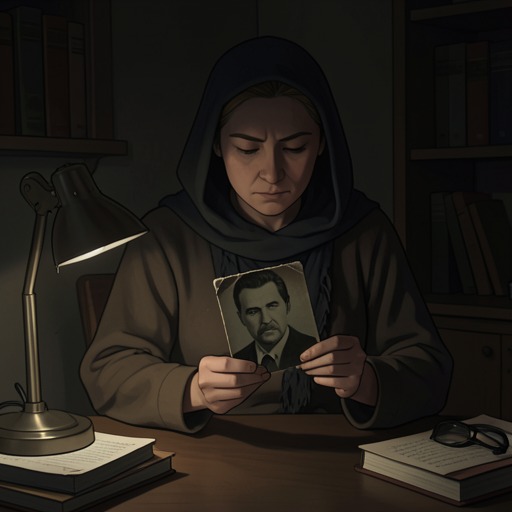
The morgue also receives relatives required to identify bodies. In the Seydel-Strasse mortuary, an old woman sits upright on a hard wooden bench, dressed in brown tweed, a brown hat with a drooping feather, sturdy shoes, and gray wool stockings. She holds her handbag in her lap and stares ahead, apart from the movement of orderlies, police officers, and grieving visitors in the corridor. Jaeger, seated beside her, tells March that she has barely spoken during the ten minutes he has been there.
March sits beside her and explains that the police need her to identify her brother’s body and complete a report on his death; afterward, they will take her home. Her response is not supplied in this moment, but the scene gives the formal request its human scale. The identification is a necessary step in the investigation, while the woman’s stillness and silence show the burden the procedure places on the person asked to perform it.
Narrative Significance
The morgue’s numbered drawers and records echo the larger machinery through which the state classifies people and manages public knowledge. Elsewhere in the novel, the monumental Roll of the Fallen publicly commemorates soldiers’ deaths, while propaganda organizes the reception of political news and students revive the memory of the executed White Rose resistance. Against those public forms of remembrance, the morgue offers a smaller, more immediate encounter: a body must be identified, a report completed, and a relative confronted with a death that cannot be made communal or abstract.
This contrast gives the morgue its narrative force. It is not simply a backdrop for forensic work; it is where March’s official duties repeatedly bring him into contact with mortality and with the limits of administrative language. The institution can locate a body and record a death, but the quiet walk to its doors and the old woman waiting on the bench preserve what the forms cannot resolve: the lived weight of loss.