Berlin
FatherlandBerlin is both the setting of Xavier March’s investigation and an instrument of the history it exposes: a capital rebuilt on a monumental scale, where the routines of police work and tourism unfold beside places tied to wartime persecution. The city’s grand avenues, official buildings, railway infrastructure, and neglected outskirts make visible the contrast between the regime’s self-image and the histories it has tried to contain.
Setting and Urban Landscape
The novel first presents Berlin through a rainbound morning on the western outskirts. At Lake Havel, rain crosses the water and sky and leaves their boundaries indistinct. March, a homicide investigator with the Kripo, recognizes the weather from his years in the U-boat service, so the present city is linked from the outset to his wartime past. The lake is not only a landscape: it is where a body is found, bringing an apparently familiar environment into the investigation.
The journey from the lake toward police headquarters passes through a capital rendered both functional and intimidating. In rush-hour traffic, wet streets and pedestrians pressed close to buildings suggest the ordinary rhythms of a workday. Along Unter den Linden, however, the avenue’s lost lime trees have been replaced by tall stone columns topped with Party eagles. The monumental substitution makes the city’s transformation legible in its streetscape: even a celebrated boulevard has been reshaped to serve official spectacle.
Police Headquarters and Everyday Routine
The Kripo building on Werderscher Markt is a six-story, soot-streaked remnant of an earlier architectural order, but it stands within a security apparatus that sets the terms of daily work. March has come there nearly every day for ten years; the building has become more familiar to him than home. At its entrance, SS sentries, identity checks, and a sign displaying the terrorist-alert scale—green, blue, black, and red—make surveillance part of the ordinary threshold. The alert is red, as it always is.
The headquarters is also shaped by the calendar of the regime. In the week before Führertag, its workload triples, files move across the marble lobby, and officers gather beneath busts of Adolf Hitler and Reinhard Heydrich. Police procedure and political ritual occupy the same space. The building’s atmosphere is not merely that of a workplace: it shows how routine administration operates within a system where the state’s symbols and security controls are omnipresent.
Family Life and the Monumental Capital
Berlin’s geography also organizes March’s strained family life. He collects his son, Paul, known as Pili, from Klara’s home in Lichtenrade, a postwar housing estate in the southern suburbs. Since the divorce, their meetings have settled into an unspoken routine: March parks in the street, sounds the horn twice, and waits for a twitch in the parlor curtain. Their contact is constrained by distance, work, and the provisions of the Reich Marriages Act; the city’s suburbs are part of the emotional as well as physical separation between father, mother, and child.
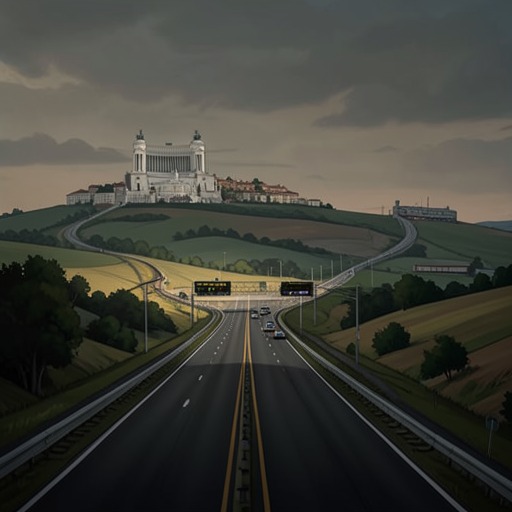
The visit to the capital’s monumental center offers a sharp contrast. On the avenue, new ministries, offices, shops, cinemas, and apartment blocks line the route toward the Great Hall. March observes settlers admiring the vast building, while their imagined journey from distant Minsk or Kiev connects the spectacle to the regime’s enlarged dominion. In this urban landscape, the capital presents itself as a destination and a source of pride, even as its scale and the settlers’ distance from home point toward the political order underpinning that display.
Railway Memory and Suppressed History
The railway setting at Gotenland station gives the city’s infrastructure a more troubling historical charge. March arrives at a body under arc lights in the station’s marshaling yards. The station had previously been the Anhalter Bahnhof, the Reich’s principal eastern terminus: Adolf Hitler had departed from it in his armored train for his wartime headquarters in East Prussia, while Berlin’s Jewish residents, including the Weisses, had been sent east from the same place. The renaming does not erase what the station was used for. Its tracks retain the connection between the capital’s public transport system and the deportations the regime’s present-day appearance obscures.
This juxtaposition makes urban memory central to the novel’s use of Berlin. The same city that contains offices, commuter routes, and tourist attractions also holds the sites and infrastructure through which violence was organized. The past does not appear in a separate historical landscape; it remains embedded in places that continue to function under new names and ordinary routines.
Ceremonial Center and Urban Ruins
At Adolf Hitler Square, March circles the principal monumental buildings while checking that he is not being followed. The Reich Chancellery, Great Hall, and Wehrmacht High Command seem unchanged: guards march, masonry gleams, and the complex remains deliberately disproportionate in scale. Tour buses unload visitors, children file toward the Great Hall, and crush barriers are being assembled for the Führertag ceremony. A television tower and broadcast vans are ready for the leader’s appearance. The ceremonial center turns the city into a stage, where political authority is designed to be watched by crowds and cameras.
Elsewhere, the capital’s promised transformation is visibly incomplete. Around Columbia House, three kilometers south of Prinz-Albrecht-Strasse, dark government buildings give way to shabby offices and boarded warehouses. Redevelopment had begun in the 1950s, but the money ran out before replacement buildings could be completed. Derelict land remains where construction was halted, while East European Gastarbeiter live in the surrounding side streets. The contrast between the gleaming monumental center and the unfinished district reveals a Berlin shaped not just by what the regime built, but by what it abandoned.
Narrative Significance
Berlin connects March’s present investigation to several layers of his past and the country’s history. The rain at Lake Havel recalls his wartime service; the familiar Kripo building places his professional routine inside a tightly controlled state; Lichtenrade marks the everyday distance within his family; and the old railway terminus preserves a concrete link to the deportation of Berlin’s Jews. In each case, the city’s physical setting carries more than one time at once.
The novel’s most consequential contrast is between the capital’s grand public image and the evidence that its streets and institutions retain. Ceremonies, tourist routes, offices, and transport continue to give Berlin the appearance of order. Yet the renamed station, the security-conscious police headquarters, and the stalled redevelopment around Columbia House disclose different histories beneath that surface. Berlin is therefore not simply the backdrop to March’s work: its architecture and geography repeatedly bring the regime’s claims of permanence into contact with what those claims conceal.