Shengli Da Dao
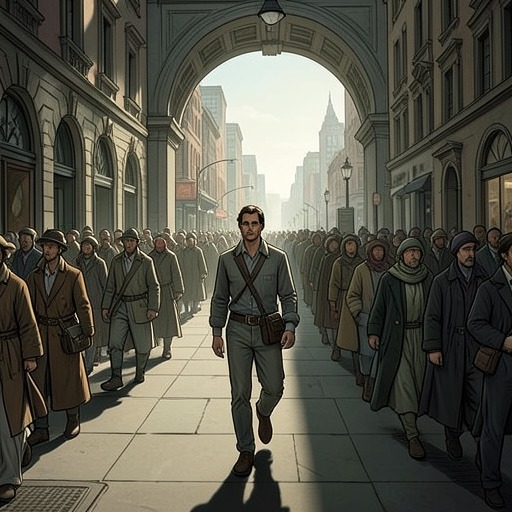
FatherlandThe Avenue of Victory is the vast ceremonial boulevard at the heart of the reimagined Berlin: a carefully staged vista of monumental buildings, traffic and military trophies leading toward the Great Hall of the Reich. Designed by Albert Speer and completed in 1957, it is presented as a triumph of national display. Through Xavier March’s perspective, however, its grandeur also exposes the regime’s habit of measuring itself against foreign landmarks and reveals how spectacle occupies the same city as police power and suppressed history.
Design and Monumental Scale
The boulevard forms the central section of an avenue that begins at the colossal arch. A Reich Tourist Ministry guide tells passengers that the avenue is 123 meters wide and 5.6 kilometers long, wider and two and a half times longer than the Champs Elysées in Paris. The comparisons make scale part of the official attraction: the capital’s architecture is introduced as a deliberate answer to famous foreign monuments, rather than as a place meant to stand on its own.
From the avenue, the view north is advertised as one of the wonders of the world. Even in rain, it is compelling: traffic fills the broad roadway, while glass-and-granite buildings housing ministries, offices, shops, cinemas and apartments line either side. At the far end, the Great Hall rises through the low cloud. The boulevard’s composition turns the city into a formal procession of state institutions, commercial life and monumental architecture, gathered beneath the regime’s dominant symbol.
Tourism and March’s Perspective
March sees the avenue from a tour bus with his ten-year-old son, Pili. The passengers include Japanese visitors with cameras, an American family and German settlers from Ostland or the Ukraine who have come to Berlin for Führertag. The guide recites dimensions and comparisons as the coach moves through the capital’s landmarks; Pili quietly repeats her claim that the view is one of the world’s wonders. For the visitors, the route makes the city’s scale legible as an attraction.
March reads the same presentation with skepticism. The repeated emphasis on being higher, longer, bigger and wider strikes him as an inferiority complex expressed through comparison. The boulevard is therefore more than a setting for tourism: it embodies a state image that seeks admiration through size, while March’s private response registers the insecurity beneath that display. The contrast between the guide’s confident statistics and his wary judgment makes the avenue an early measure of how official spectacle and individual perception diverge.
The boulevard’s public life is not confined to daytime coach tours. On an evening drive, March takes Charlotte Maguire north along it in a Volkswagen. Captured artillery from the Barbarossa campaign stands beside the road, its barrels angled upward, while floodlit buildings and guns draw crowds of people who stroll, gather and window-shop. Maguire wonders why anyone would go out to look at guns; March answers that they are tourists and anticipates more than three million by the twentieth. The avenue turns military trophies into civic scenery, making the celebration of conquest part of an ordinary urban outing.
The Boulevard Within the City of Power
The Avenue of Victory is also a point of reference for the city’s political geography. The Gestapo complex on Prinz-Albrecht-Strasse is described as another of Berlin’s famous sites, alongside the avenue and the Great Hall, though without tourist coaches. There, the Gestapo, Reinhard Heydrich’s headquarters and the SD headquarters are joined by underground passages. The contrast is sharp: the avenue displays power in open space, while the nearby security apparatus operates through guarded rooms and concealed connections.
Elsewhere, the state’s grip reaches far below the city’s monumental surface. In a later archival investigation, March and Rudolf Halder descend sixty meters to a cool, dimly lit underground level said to be built to withstand a direct hit from an American missile. The scene does not place the archive on the avenue; rather, it deepens the boulevard’s significance within a capital whose grand public image coexists with hidden, protected spaces of authority and evidence.
Narrative Significance
The avenue’s recurring function is to make the scale and ideology of the regime visible. Its official measurements, foreign comparisons, monumental vista and captured artillery convert national power into a landscape that visitors can tour. But the route’s splendor is not the novel’s final measure of Berlin. The story’s movement between public spectacle, the security complex and concealed records exposes a gap between the city presented to tourists and the history its institutions seek to control.
That tension persists at the end of March’s account. As Charlie escapes across the bridge toward Switzerland, his attention turns east toward him, while the morning light catches the Rhine and the white cross beyond. This is not a scene on the Avenue of Victory, but it completes the spatial contrast the boulevard helps establish: the regime’s monumental routes gather people into a display of power, whereas the border offers a narrow, contingent passage out of its reach.