Teikoku Daishocho
FatherlandThe Great Hall of the Reich is the colossal centerpiece of the Nazi regime’s remade capital, presented to visitors as both an architectural wonder and a stage for national ceremony. In the novel, its public grandeur is set against the documentary evidence of genocide: the Hall’s carefully rehearsed spectacle belongs to the same state whose records expose the machinery of mass killing.
Setting and Design
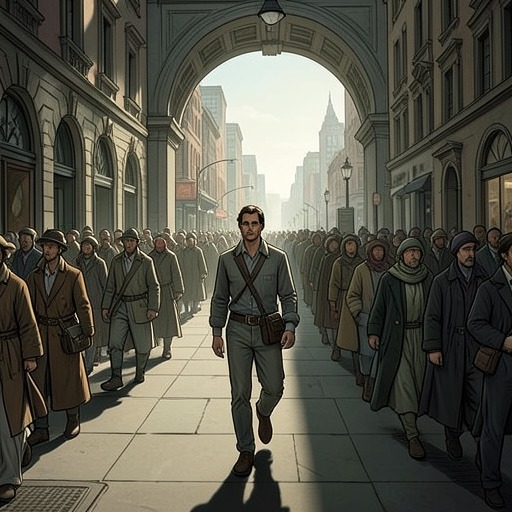
From the Avenue of Victory, the Great Hall rises at the far end of a traffic-filled avenue lined with ministries, offices, stores, cinemas, and apartment blocks. Its dome, often hidden by low clouds, gives the building the distant appearance of a gray battleship emerging through spray. As a tour bus approaches, that indistinct mass resolves into a white façade with red granite pillars, a dull-green copper dome, and golden statues of Atlas and Tellus bearing spheres of the heavens and earth. The guide describes a structure more than a quarter of a kilometer high, with a dome 140 meters in diameter. She tells the passengers that St. Peter’s in Rome could fit inside it sixteen times. These measurements turn the building into a lesson in scale: its authority is communicated not through intimacy or civic use, but through a size intended to overwhelm the individual.
Ceremonial Function and Public Spectacle
The Hall is reserved for the German Reich’s most solemn ceremonies and can hold 180,000 people. The guide’s account includes an extraordinary feature: the breath of such a crowd gathers beneath the cupola, forms clouds, and condenses into rain, giving the building a climate of its own. The claim makes the architecture seem almost self-sufficient, as if the mass assembled within it could create its own weather. The tour presents this spectacle as part of a broader civic panorama. The bus passes through an immense stone arch and proceeds along the Avenue of Victory toward the Hall; visitors crane their necks, settlers admire its scale, and young Pili repeats the guide’s language of wonder. For Xavier March, however, the familiar presentation does not hold his attention. While the guide recites the Hall’s dimensions and uses, he is preoccupied with the body found in the mud, an abrupt interruption of the tour’s polished account of the capital.
Political Geography and Counterpoint
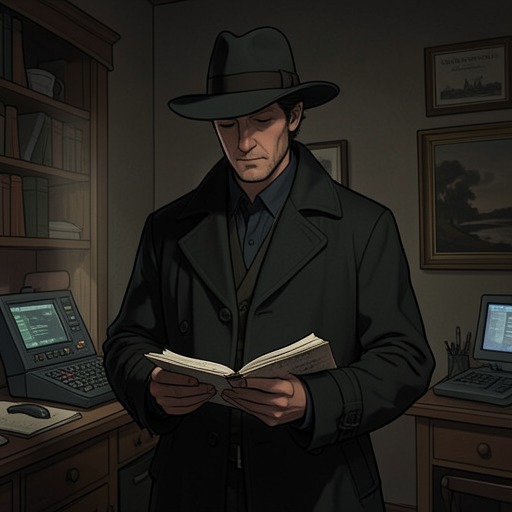
The Hall stands at the end of a monumental axis, facing Adolf-Hitler-Platz and framed by the headquarters of the Wehrmacht High Command on one side and the new Reich Chancellery and Palace of the Führer on the other. Its location makes the capital’s institutions appear gathered around a single ceremonial center. The avenue, the square, and the Hall transform movement through the city into a staged approach to power. That public geography has a darker counterpart in the novel’s records. The Wannsee Conference minutes identify a meeting held in Berlin on January 20, 1942, to discuss the so-called “final solution of the Jewish question.” In draft minutes examined by March, a passage on methods of mass killing describes shootings, gas trucks, and experiments with Zyklon B at Auschwitz; Reinhard Heydrich’s handwritten objection is followed by the passage’s reduction in the final version to a single phrase. The Hall is not the site of those events, but its ceremonial image belongs to the same state whose administrative language obscures the violence documented elsewhere.
Narrative Significance
The Great Hall’s scale and spectacle make it a potent emblem of the regime’s effort to give political power a permanent, visible form. The contrast between its public presentation and March’s investigation is sharpened by the difference between kinds of evidence: a guide offers dimensions, materials, and ceremony, while the documents reveal how euphemism and revision conceal policy and its implementation. The novel places these registers side by side without making the Hall itself a murder site; its significance lies in the way monumental architecture helps stage an official image of national grandeur while the state’s records disclose what that image leaves out.