Kaihansho
FatherlandThe Arch of Triumph dominates the redesigned Berlin not merely by its scale but by the history it monumentalizes: a regime-authored story of national sacrifice, presented as stone, ceremony, and civic infrastructure. As March passes through it on a tour with his son, the official account of the dead intersects with his own family’s losses, exposing the distance between public commemoration and private memory.
Design and construction
According to the Reich Tourist Ministry guide, construction began in 1946 and the arch was completed in 1950 for the Day of National Reawakening. Its design was credited to Adolf Hitler, based on drawings he had made during the Years of Struggle. The account makes the monument an extension of the Führer cult: even a vast piece of urban infrastructure is presented as the realization of Hitler’s personal artistic vision.
The guide’s measurements render the building almost difficult to comprehend. It stands 118 meters high, is 168 meters wide, and extends 119 meters in depth; its granite contains 2,365,685 cubic meters. The guide claims that the Arc de Triomphe in Paris would fit inside it forty-nine times. The comparison turns a familiar landmark into a unit of measurement for Nazi gigantism, with the foreign monument reduced to a fraction of Berlin’s achievement.
A road through the monument
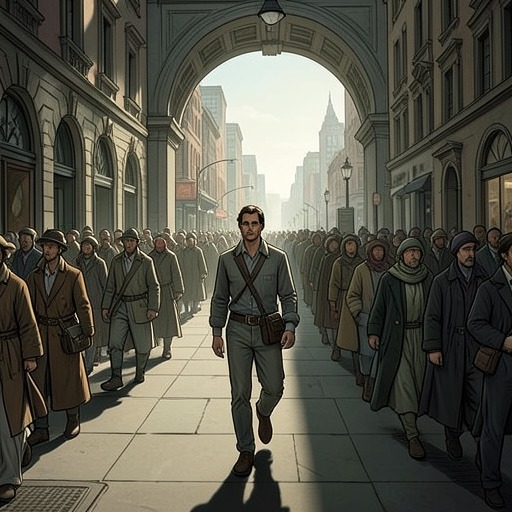
The arch is not a detached ceremonial object: eight lanes of traffic pass through its immense, stone-ribbed interior. March and the other passengers experience it first looming above the bus, then as a tunnel longer than a football pitch and higher than a fifteen-story building. Its shadowed, vaulted roof resembles a cathedral, while headlights and taillights move through the afternoon gloom. Monumentality is thus made part of ordinary circulation, joining spectacle to the daily movement of the city.
The tour continues from the arch into the Avenue of Victory, designed by Albert Speer and completed in 1957. At 123 meters wide and 5.6 kilometers long, the avenue is described as wider and two and a half times longer than the Champs-Élysées. The sequence places the arch within an urban plan that repeatedly measures Berlin’s power against other cities, making comparison itself a tool of official persuasion.
The Roll of the Fallen and March’s memory
Inside, the names of three million soldiers who died defending the Fatherland in the wars of 1914–1918 and 1939–1946 are carved on the walls. The tour guide calls attention to the Roll of the Fallen, and the passengers dutifully crane their necks to read it. The group includes Japanese visitors with cameras, an American family, and German settlers from Ostland or Ukraine visiting for Führertag; the monument’s memorial language is thus encountered by an international and imperial-era audience.
March looks away. His father and both grandfathers are among the names, but he keeps his eyes on the guide instead. That small refusal interrupts the ceremony’s demand for collective attention: the carved list may claim to gather the dead into a single national sacrifice, yet for March it contains particular relatives and a personal history he cannot turn into pageantry. The guide, meanwhile, sneezes and, when she thinks nobody is looking, wipes her nose on her sleeve. The grand memorial and its meticulously delivered statistics coexist with this unceremonious human gesture.
Monument and controlled memory
The arch’s official account presents its dates, authorship, materials, dimensions, and casualties as settled facts, delivered through a state-sponsored tour. In the wider novel, state power likewise shapes public experience through compulsory communal announcements and propaganda designed to forestall private skepticism. Against that managed language, March’s attention to the names of his own dead restores an individual scale to a monument intended to subsume individual loss within national legend.
The building’s scale makes its political claim visible, but does not make that claim complete. Its traffic tunnel carries the present through a memorial to past wars; its Roll of the Fallen gives the state’s narrative a carved permanence; and March’s response reveals what that permanence cannot settle. The arch stands as a spectacle of victory and authority, while its encounter with personal grief exposes the human memory that official commemoration attempts to organize.