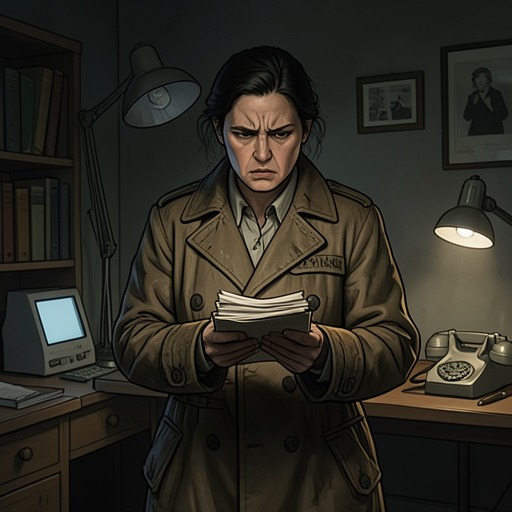
Key and authorization letter for Zaugg account 2402
FatherlandThe key and authorization letter for Zaugg account 2402 are a compact but consequential piece of evidence: they expose Wilhelm Stuckart’s concealed Swiss banking connection and give Xavier March a route into a numbered account whose contents lead toward the suppressed record of the Wannsee meeting. The packet’s power lies in the contrast between its luxurious, discreet material form and the bureaucratic documents it helps uncover—papers that reveal how the state managed both its crimes and their traces.
Appearance and Contents
The object first enters March’s hands as an unmarked blue envelope among the remaining papers he is searching through. It feels heavy, and its open flap lets him glimpse the copperplate letterhead of Zaugg & Cie., Bankiers, before he pockets it as armed SS troops arrive outside. The envelope is not yet merely a bank document: at this point it is a clue extracted under immediate pressure, carried away as the investigation and its evidence are about to be seized.
When the packet is later produced, the envelope is described as long and slim, made of thick, creamy-blue paper flecked with brown specks of age. It has no name or address. Its luxurious, handmade quality suggests another age, at odds with the secret and illegal purpose it serves. The letter inside is on matching blue paper, thick as cardboard, and bears the firm’s printed address: Bahnhof-Strasse 44, Zürich. Beneath it, a single typed sentence identifies the bearer as a joint holder of account number 2402. The letter is dated July 8, 1942, and signed by Hermann Zaugg, Director.
The small brass key is the packet’s operative counterpart to the letter’s written authority. Together they provide both a claim to the account and a means to reach its contents. Their separation is consequential: when March presents the letter to Artur Nebe, Nebe immediately notices that the key is missing, making clear that the letter alone does not complete the chain of access.
Stuckart’s Secret and the Stakes of Possession
The documents establish that the account belongs to a concealed financial arrangement involving Stuckart. March recognizes why Stuckart had kept the packet locked in his safe: German citizens were prohibited from holding foreign bank accounts without Reichsbank permission, and the stated penalty for breaking that rule was death. The letter is therefore more than a convenient authorization. It is evidence of a legally dangerous secret, preserved in a form that could implicate its holder.
The packet’s route out of the apartment is bound to the danger surrounding March’s search. He takes it from Stuckart’s papers while SS forces gather outside and the urgent buzzer sounds below. Its removal preserves a lead that might otherwise have been lost to the men pursuing the investigation. Later, March places it before Nebe as evidence that Martin Luther may have had access to a numbered account after flying to Zürich and returning to Berlin. Nebe examines the letter through a magnifying glass and treats the missing key as a bargaining point: March’s possession of it gives Nebe a reason to consider allowing him to pursue the account rather than handing him over to the Gestapo, where Globus and Heydrich might learn what the safe-deposit box contains.
Authorization, Access, and the Account
In Zürich, the letter functions as the credential that brings March and Charlotte Maguire past the initial refusal to see the bank director. March instructs the receptionist to tell him that they have authorization for account number 2402. When Hermann Zaugg examines the document, he holds it to the light and recognizes the signature as his own from his younger years, noting that his handwriting has deteriorated since then. The old, carefully preserved paper thus supplies a form of authentication that the bank can recognize.
At the safe-deposit cage, Zaugg waits outside the bars while March gives the key to Maguire and asks her to use it. Her hands are shaking. The moment makes the packet’s two components distinct in function: the letter has secured their standing with the bank, while the key is what they must physically turn to open the box. The access it affords is not an abstract promise but a threshold crossed together, under the emotional strain of what they may find.
From Bank Evidence to Suppressed History
The account investigation opens onto documentary evidence of a different order. In the Reichsarchiv, March and Rudi Halder find a letter from Reinhard Heydrich dated January 6, 1942, confirming that an interagency discussion and luncheon postponed from December 9 was to take place on January 20 at the International Criminal Police Commission offices at Am Großen Wannsee 56–58. When they search for the meeting’s minutes, they find a typed notice stating that they have been removed at the request of the Reichsführer-SS. The notice is dated April 6, 1964: Heydrich had extracted the minutes eleven days earlier.
The connection is thematic as well as procedural. The account packet is a material trace of private concealment; the missing minutes are a trace of state-directed erasure. March’s handling of the letter and key leads from a secret held in a personal safe to an institutional record that has been deliberately withdrawn. The contrast sharpens the object’s significance: a small, carefully preserved authorization can open a route toward evidence, while the regime’s power over its archives can close another. The packet does not itself contain the history March seeks, but it helps set in motion the search through which the absence of that history becomes visible.