Buhler’s stolen art collection
FatherlandBuhler’s stolen art collection is the concealed material record of a larger system: artworks removed from occupied Poland, routed through government offices, and diverted into private hands. Hidden behind a false panel in the cellar of Josef Buhler’s house on Schwanenwerder, the cache makes the distance between official administration and private plunder impossible to maintain. Its works are valuable objects, but also evidence: their origins, the records that describe them, and the discrepancies between those records expose how occupation enabled both state seizure and personal enrichment.
Discovery and the hidden room
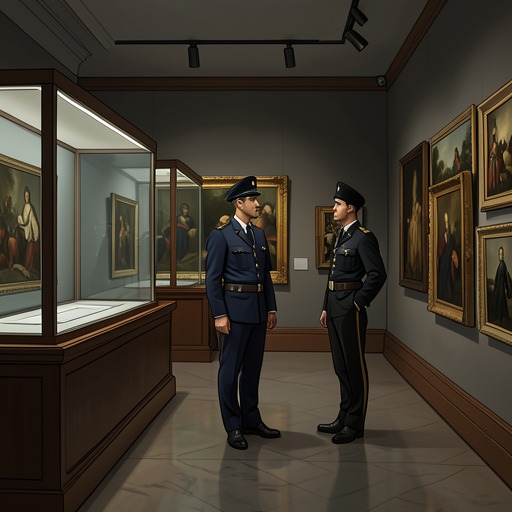
The collection is found in a cellar, beyond household rubbish and behind a false section of wood paneling. The chamber beyond is small, about four meters square, with spotlights directed at paintings covering every wall. An old swivel chair stands in the center. The concealed arrangement turns the cellar into a private viewing room, set apart from the ordinary appearance of the house and from public accounting of the objects it contains.
The room’s concealment is not merely a dramatic hiding place. It is the final point in a chain of transfers that had passed through official offices and appeared, on paper, to be legitimate. The artworks’ presence there gives investigators a physical counterpart to the missing entries in the wartime inventories: the collection is not simply wealth accumulated in private, but a cache whose contents can be compared with what the occupying authorities recorded as lost, destroyed, or transferred elsewhere.
What the collection contains
A preliminary assessment identifies works attributed to Raphael and Rembrandt, Rubens’s Christ Carrying the Cross, a Venetian palace by Francesco Guardi, a view of Krakau’s suburbs by Bellotto, eight paintings by Canaletto, at least thirty-five engravings by Albrecht Dürer and Hans Kulmbach, and a Gobelin tapestry. The assessment is explicitly incomplete; the expert from the Führermuseum in Linz has not yet arrived, and the local specialist can only identify part of what fills the chamber.
Among the works is the great altarpiece by Veit Stoss, commissioned by the King of Poland in 1477 and completed over ten years. Its triptych depicts the sleeping Virgin surrounded by angels at the center, scenes from the lives of Jesus and Mary on the side panels, and Christ’s genealogy on the predella. The story gives the altarpiece a specific provenance: it was removed from the Church of Our Lady in Krakau in November 1939. Its identification turns a celebrated work of religious art into evidence of a particular seizure, rather than an anonymous treasure in a private room.
The paintings also retain traces of their removal. One canvas bears the image of Saint Sebastian bound to a pillar; powdery masonry remains attached to the edges of some panels, remnants of the monastery and castle walls from which they were wrenched. The objects therefore carry physical indications of displacement alongside the written record. Their beauty and cultural importance do not erase the violence of their transfer; instead, the damaged edges and documented origins make that transfer legible.
From occupation to private possession
The collection’s larger context is the administration of the General Government of occupied Poland. Halder describes its official contrasts: newspaper and television appeals promise German settlers free farms and guaranteed income, while reports from the territory describe poor soil, exhausting work, and danger from local partisans. He also recounts the luxury surrounding Hans Frank’s administration at Wawel Castle in Krakau, including paintings, tapestries, church treasures, jewelry, and bribery. In this setting, the house and collection on Schwanenwerder suggest how wealth taken from an occupied population could coexist with the public language of settlement and government.
The investigation supplies figures against which the hidden cache can be understood. A secret inventory compiled by Polish museum authorities in 1940 listed artworks removed from Warsaw alone: 2,700 paintings by European artists, 10,700 paintings by Polish artists, and 1,400 sculptures. Investigators say sculptures are being dug up in Buhler’s garden. Much of the material went to intended destinations, including the Führermuseum, Hermann Göring’s museum at Carinhall, and galleries in Vienna and Berlin; the difference between Polish records of what was taken and German records of what was received points to another destination for part of the plunder: private diversion.
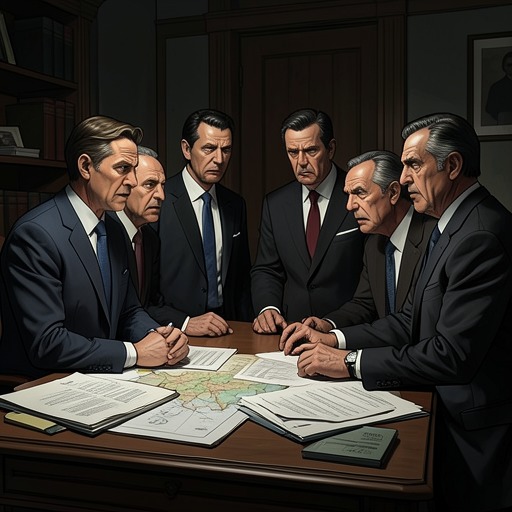
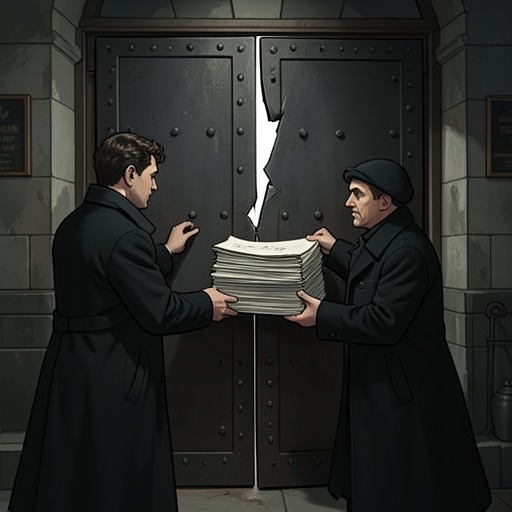
As state secretary, Buhler had access to the seized property and could have it shipped under escort to Stuckart at the Interior Ministry. The transfers could be made to look lawful. Stuckart then arranged for works to be stored or smuggled out of the Reich in exchange for cash, jewels, gold, or other portable assets that were difficult to trace. The hidden collection is thus one visible result of a broader scheme: official custody provided cover for the movement of stolen art, while concealment and conversion into portable wealth helped keep the proceeds beyond ordinary scrutiny.
Evidence, concealment, and the wider crime
The collection is discovered as investigators pursue the activities of Buhler and Stuckart. Globus says the authorities had known of Buhler’s conduct in the General Government and of his associates, but that Buhler learned they were closing in the previous week. The cache helps explain why the investigation concerns more than missing artworks: it links the officials’ access, their methods of transfer, and the wealth concentrated in Buhler’s private property. The discovery also directs attention to the discrepancy between the Polish inventory and the official German account of what reached state collections.
The story’s treatment of other hidden property broadens the picture without making every concealed asset part of this particular collection. After 1939, banks such as Zaugg devised numbered deposit arrangements: for a fee of 200 francs, a customer received a box and number, a key, and a letter of authorization, with additional keys and letters available. The system offered a means of transferring control of savings without requiring the bank to mediate each later withdrawal. This is a separate mechanism from the art scheme, but it echoes its central problem of tracing ownership once wealth has been moved, concealed, or converted.
The cache also stands against the vast quantities of property extracted from prisoners at Auschwitz. Luther’s inspection notes record a storehouse called Canada containing belongings and clothing, with listed quantities that include 132,000 men’s shirts, 155,000 women’s coats, and 3,000 kilograms of women’s hair. Those records concern a different machinery of theft and exploitation, not the provenance of Buhler’s artworks. Their relevance is the larger pattern they disclose: under the regime, the seizure and accounting of property were bound to systems of power, and administrative records could both document extraction and obscure the human realities behind it.
The novel later invokes the Lady with an Ermine, a Leonardo painting associated with the Polish collection of Prince Adam Czartoryski and photographed in Krakau in 1932, whose whereabouts became unknown after the war began. That painting is not identified among the works in Buhler’s chamber, and its fate is presented as unresolved. Its disappearance nevertheless sharpens the collection’s significance: an artwork’s absence can be as politically charged as its discovery, particularly when the records of ownership and transfer have been fractured by war.
Buhler’s stolen art collection therefore joins objects, documents, and official responsibility in a single evidentiary chain. The room shows what the paperwork alone cannot: works that were supposedly lost or destroyed survived in a private cache. The records explain how they could have arrived there. Together, the concealed chamber and the administrative trail expose plunder not as an isolated act of collecting, but as a process made possible by occupation, bureaucratic access, and deliberate concealment.