Luther’s doctor’s case
FatherlandMartin Luther’s doctor’s case is the container through which Xavier March recovers a substantial body of documentary evidence connected to Luther’s disappearance and the investigation into the persecution and murder of Jews. Its worn, locked exterior first presents itself as an ordinary piece of luggage; once opened, it yields papers that March can sort, date, and compare. The case’s importance lies not only in what it contains, but in how its contents make a suppressed history materially accessible.
Recovery and Identification
At an airport, March asks Friedman to locate a case or bag left either on the last flight from Zürich on Monday night, the thirteenth, or in the baggage-claim area. Friedman sends an elderly worker to search. When the man returns with a case, Friedman hands it to March as a personal favor, stressing that March will remember the debt between comrades. The exchange gives the recovery a practical cost: the case reaches March through a favor from a man who expects reciprocal help, rather than through an official evidence process.
Friedman jokes about possible contents, but does not open the case. He explains that it has been X-rayed and contains no guns or explosives; unclaimed luggage is otherwise left for a year before being opened. March touches the gun in his pocket while asking whether Friedman intends to inspect it, a sign that the handover is not a routine matter for him. Friedman instead gives him the case and describes it as a favor. March carries it back to the Volkswagen by a route that avoids the border guards, another concession from Friedman.
Physical Appearance and Locked Interior
The case is the kind doctors carry, with brass-reinforced corners and a stout brass lock. Its brown leather is scratched and faded; the heavy stitching has darkened, and years of use have worn the handle smooth. March reads the object as prewar, perhaps older, and built to last. Its worn solidity suggests professional reliability, in sharp contrast to the uncertain and dangerous circumstances in which he retrieves it.
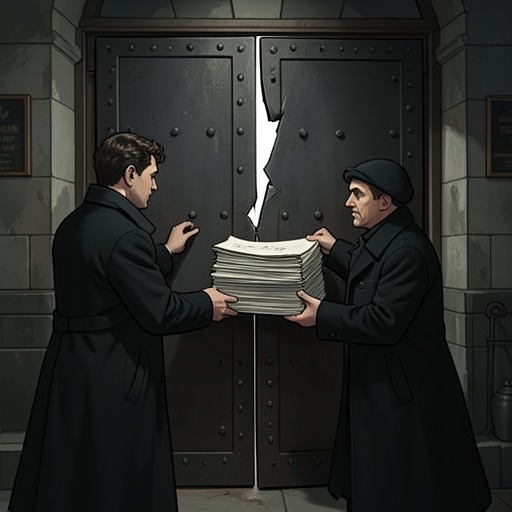
The case does not yield immediately. At the room where March and Charlie are staying, he lays it on the hard wooden bed and attacks the lock with his pocketknife. It takes five minutes of hacking and twisting; one short blade snaps before the fastener breaks. That resistance makes the case more than a transparent container: its contents remain physically withheld until March forces the lock, and the broken knife blade marks the effort required to bring the papers into view.
Contents and Documentary Evidence
When March finally opens the case, he finds it full. He turns it upside down and shakes the contents onto the bedspread. The papers include a map, envelopes, minutes and memoranda, reports, and statistical material typed with unusually large letters. Their age is visible in the way some sheets crackle. March and Charlie examine the evidence together, passing it back and forth; their initial excitement gives way to disbelief and then silence as they understand its implications.
Among the documents is an affidavit sworn by Wilhelm Stuckart, then a State Secretary in the Interior Ministry. In it, Stuckart recounts a report brought to him in December 1941: an official had heard that Jews deported from Berlin had been massacred in Rumbuli Forest in Poland. The affidavit therefore places a specific report of mass murder inside the case’s documentary record. It is one element in a larger group of materials, rather than an isolated paper whose meaning can be detached from the surrounding files.
The case’s significance is reinforced by other records in March’s investigation. An invitation from Reinhard Heydrich describes preparations for a complete solution of the Jewish question in Europe and refers to Jews being transported east. A separate notice says the minutes of the January 20, 1942 interagency meeting have been removed at the request of the Reichsführer-SS; March discovers that the minutes were extracted in April 1964. These records establish a broader pattern of documentation and suppression. The doctor’s case provides a counterweight to the missing official minutes: it preserves materials through which March can investigate what the state has removed or concealed.
From Container to Working Archive
After the contents have been spread out, March closes himself in the bedroom and braces a chair against the door. He gathers the papers on the dressing table and decides to work systematically. In an exercise book, he prepares thirty pages, each headed with a year and month, running from July 1941 through January 1944, and begins making notes from the heap. The case has thus changed function: once a private container carried through the airport, it becomes the source of an archive March is actively reconstructing.
The records’ physical forms matter to that work. The file contains originals and copies, official letterheads, memoranda, reports, and statistical sheets; elsewhere in the investigation, March also handles poor-quality photocopies made by Rudi Halder, who is frightened by the discovery and wants to end their contact. A wiretap transcript appears on flimsy brown paper, while the case’s own contents include papers whose age and typewriting remain visible. In this world, evidence travels through fragile media and can be copied, hidden, removed, or intercepted. The doctor’s case matters because it brings multiple documents together where March can compare them, order them, and pursue the history they record.
The object therefore joins material endurance to political vulnerability. Its brass lock and worn leather have survived years of use, but the documents inside remain subject to state seizure, deliberate removal, and dangerous circulation. March’s forced opening and subsequent cataloguing make the case a turning point in the investigation: not simply a lost bag recovered at an airport, but the physical threshold through which scattered testimony and official paperwork become a body of evidence.