Wannsee Conference minutes
FatherlandThe Wannsee Conference minutes are a documentary object at the center of Xavier March’s investigation: their official language presents the deportation and exploitation of Europe’s Jews as administrative policy, while draft revisions and related records reveal the systematic killing that the polished account suppresses. Their significance lies both in what they record and in what was removed from the record.
Identity and Documentary Context
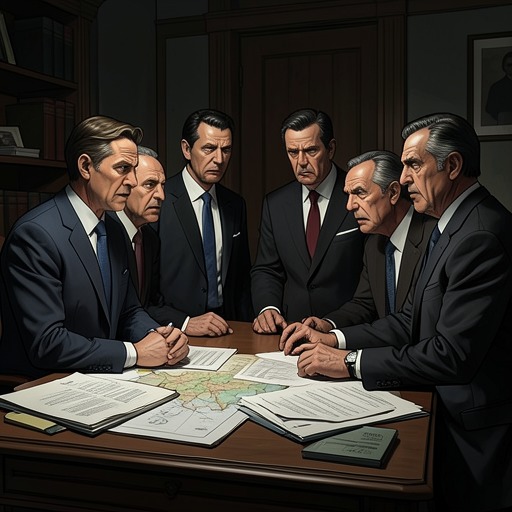
The minutes identify a conference held on January 20, 1942, at Am grossen Wannsee 56-58 in Berlin, concerning the “final solution of the Jewish question.” The document’s heading marks it as a secret Reich matter and specifies thirty copies, though the copy number has been scratched out. March reads the minutes repeatedly, confronting a plan that explicitly encompasses roughly eleven million Jews across Europe, not only German Jews. Its enumeration ranges across more than thirty nationalities and includes figures for French, Dutch, Polish, and Ukrainian Jews, as well as smaller populations such as the 200 Albanian Jews.
The formal account describes bringing Jews eastward for labor. Those considered capable of work would be separated by sex and driven in large labor columns to build roads; the text states that many would die through “natural reduction.” Euphemism does not make the outcome absent: it makes the outcome legible as policy while withholding its human meaning. March’s attention to the repeated words “appropriate” and “appropriately” exposes how bureaucratic phrasing supplies a cover for violence and avoids naming its mechanisms.
Draft, Revision, and Suppression
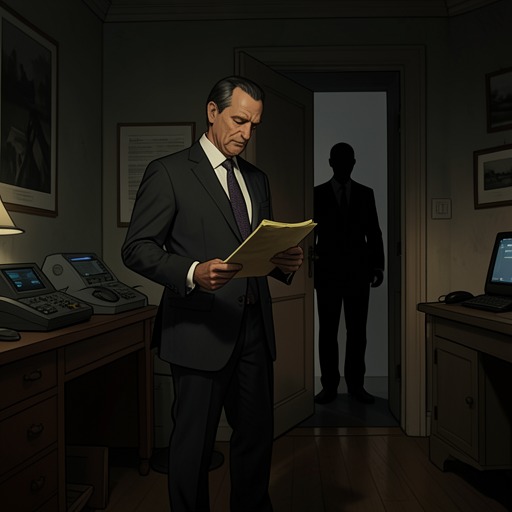
March also examines rough photostats of what appear to be Eichmann’s original draft minutes. The typewritten pages carry amendments and forceful crossings-out in a hand March recognizes as Reinhard Heydrich’s. The draft preserves material that does not appear in the final version, including discussion of the practical difficulties of killing large numbers of people by shooting: the method was slow, security was inadequate, and the shootings affected the men carrying them out.
The draft records Rudolf Lange’s comparison of several methods. It refers to the shooting of one thousand Berlin Jews near Riga on November 30, the use of gas trucks at Kulmhof on December 8, and experiments beginning in October at Auschwitz with Zyklon B on Russian prisoners and Polish Jews. Lange’s report describes the results at Auschwitz as promising in capacity and security. Heydrich writes “No!” in the margin; when March checks the final minutes, the detailed discussion has been reduced to a single phrase. The contrast between the surviving draft and the edited text turns revision itself into evidence: the final record does not merely use evasive language but removes explicit discussion of killing methods.
Corroboration in the Novel
The minutes are part of a wider documentary trail rather than an isolated proof. March’s materials include records of deportation and camp operations that give concrete form to the conference’s administrative abstractions. A memorandum on the use of prisoners’ hair, dated August 6, 1942, orders hair cut in concentration camps to be processed into industrial felt and thread. It specifies uses for women’s hair, including socks for U-boat crews and felt stockings for railways, and requires monthly reports separating female and male hair. Such paperwork extends the logic of the minutes into the organized exploitation of what remains after deportation and killing.
The novel also presents March’s inspection account of Auschwitz as an eyewitness-style record of the machinery behind the euphemisms: rail arrivals, the sorting of deportees, a chamber deceptively marked as a bathing and disinfection room, and a cremation process that includes the collection of hair and valuables. These scenes are not themselves the conference minutes, but they clarify what the minutes’ language conceals and connect policy, transport, killing, and the recovery of property into one administrative system.
Authenticity and Historical Framing
The novel identifies the extracts from the Wannsee Conference minutes among the authentic documents quoted in the text, alongside Heydrich’s invitation and Göring’s July 31, 1941 order to Heydrich. It distinguishes these authentic materials from documents created for the narrative, while explaining that the fictional reconstruction draws on reported historical circumstances: the conference was postponed, Eichmann prepared a fuller version of the minutes, and Heydrich subsequently edited it. The novel also presents Hitler as avoiding a written order for the Final Solution while almost certainly issuing a verbal instruction in the summer of 1941.
The minutes’ narrative force comes from the collision between document and evidence. On the page, mass murder is rendered through population totals, work assignments, procedural wording, and edits; in the surviving draft and corroborating records, the suppressed actions become harder to deny. The record thus exposes bureaucratic paperwork as both an instrument of policy and a site where the regime tried to control what could be said about its crimes.