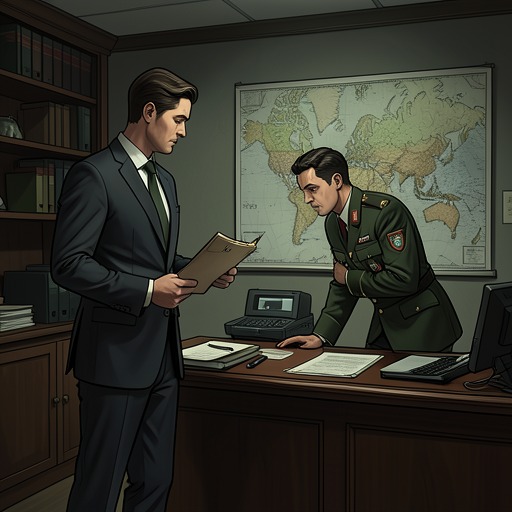
March’s Gestapo file
FatherlandMarch’s Gestapo file is a dossier compiled over ten years about Xavier March, transforming details of his military service, family life, and everyday conduct into a basis for state pressure. Revealed to March by Artur Nebe, the file shows surveillance working incrementally: individual reports accumulate in secret until a powerful adversary can use them. Its importance also resonates with the novel’s wider investigation, where invitations, missing minutes, photocopies, and affidavits expose how official records can preserve evidence and suppress it.
A biography converted into surveillance
Nebe tells March that the file arrived at his home by courier that morning. A few centimeters thick, it begins with the outline of March’s life: born in Hamburg in 1922, bereaved of his father in 1929 and his mother in a British air raid in 1942, he joined the navy in 1939 and transferred to the U-boat service in 1940. Decorated and promoted in 1943, he received command of his own boat in 1946, among the youngest such commanders in the Reich. The dossier frames this record of service as a promising career followed by a fall from favor.
That fall is documented not as one decisive offense but as a sequence of recorded deviations. The file notes that March has received no police promotion for ten years and was divorced in 1957. It collects reports that he persistently refused to contribute to Winter Relief and to join the NSDAP, and that he made disparaging remarks about Himmler in canteens, bars, restaurants, and corridors. By placing political nonconformity alongside employment and personal history, the dossier makes routine life legible as a continuous record of suspicion.
Family life made incriminating
The file reaches into March’s family. It records that in Christmas 1963 he began asking about Jews who had once lived in his apartment. It also contains a complaint from his former wife and one from his son, Paul, known as Pili. Nebe explains that the boy’s report concerns March’s supposed lack of enthusiasm for Pili’s Party activities. March objects that his son is only ten; Nebe replies that he is old enough to form a judgment and have it heard.
This entry acquires weight from the family arrangements it intrudes upon. After the divorce, March’s visits followed an unspoken routine: he collected Pili from Klara’s home in Lichtenrade, sounding the horn twice and avoiding an encounter with his former wife. Their contact was governed by the Reich Marriages Act, and Pili’s Pimpf activities supplied another channel through which family life could be judged politically. The file turns a strained father-son relationship into material for the state’s appraisal of March.
From accumulated record to immediate threat
Nebe describes the dossier as having matured in the Gestapo Registry, with small additions made year after year. Its accumulated reports become dangerous when March makes a powerful enemy. Nebe identifies that enemy as Globus, who has sought to transfer March to Columbia House, the SS’s private prison in General-Pape-Strasse, pending a court-martial. Nebe warns that the file contains enough to send March to a concentration camp, beyond the protection he or anyone else could offer.
The proposed proceedings have not begun because Globus needed Heydrich’s permission to court-martial a serving Kripo officer. Heydrich referred the request to Nebe. Nebe told him that Globus appeared afraid March had discovered something about him and wanted March removed; Heydrich then gave March four days, until Führertag, to prove his case against Globus. The reprieve is conditional, not exoneration: if March fails to produce evidence, Globus can proceed against him. Nebe therefore urges March to investigate and report back, warning him to trust no one.
The file within the novel’s archive of power
The dossier’s threat belongs to a larger pattern in which records and their absences shape the investigation. March and Rudi Halder locate Heydrich’s invitation to an interagency discussion scheduled for January 20, 1942, at the Wannsee villa. A separate sheet says the meeting minutes were removed at the Reichsführer-SS’s request; it is dated April 6, 1964, eleven days before March finds it. The file on March and the missing minutes work in opposite directions: one preserves a mass of compromising detail about an individual, while the other records the deliberate withdrawal of evidence about a state crime.
Even the surviving evidence is precarious. Halder makes three poor-quality photocopies of documents from the Reichsarchiv, frightened by the invitation and unwilling to remain with March afterward. March later carries the copies concealed inside his tunic. Among the papers is Stuckart’s affidavit, whose account records an official’s knowledge of reports that deported Jews had been massacred. The dossier thus gains significance beyond the mechanism of March’s persecution: in a world where the state accumulates records against its opponents while removing records that might expose its own actions, what is kept, copied, or taken away becomes part of the struggle over truth.