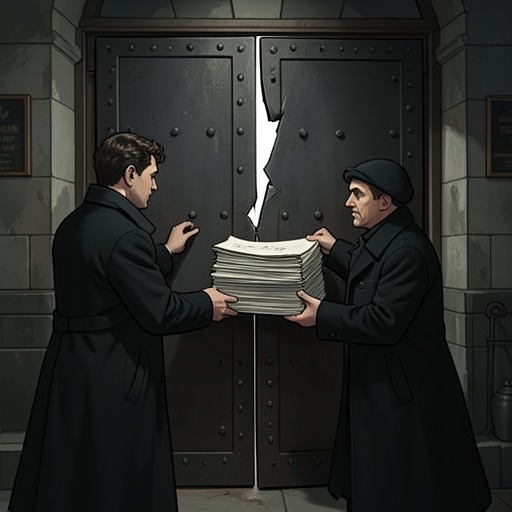
Stuckart’s affidavit
FatherlandStuckart’s affidavit is a four-page, typewritten declaration dated June 4, 1942, and signed by Wilhelm Stuckart as an attorney, with Josef Buhler witnessing it. In it, Stuckart recounts being told by Reinhard Heydrich that Adolf Hitler had decided to destroy Europe’s Jews and that Heydrich had been given the authority to implement that policy. Its decisive revelation is also a revelation about concealment: Stuckart says he raised the legal case for putting the order in writing, and Heydrich refused. Years later, the affidavit is among the papers that expose the policy and the officials who knew of it.
The document and its provenance
The affidavit is presented as a discrete item in Martin Luther’s doctor’s case: four typewritten pages, numbered as document four. Its form matters. The declaration is not a contemporaneous government order but a sworn account, composed after the conversation it describes and explicitly based on notes Stuckart says he made that evening. He swears it is a true record, signs as an attorney, and dates it in Berlin on June 4, 1942. Josef Buhler, also identified as an attorney, witnesses it. Those details give the document a chain of authorship and attestation, while leaving the reader to distinguish Stuckart’s record of a conversation from a surviving written command by Hitler.
The affidavit is uncovered when Xavier March examines the contents of Luther’s case. Its presence among Luther’s papers connects Stuckart’s account to the investigation of Martin Luther’s disappearance and to the search for records capable of explaining what senior officials had arranged. The affidavit is therefore both a testimony about an earlier meeting and a material object in the later struggle over whether the evidence will be found and understood.
What Stuckart says he learned
Stuckart dates the beginning of the account to Sunday, December 21, 1941. The Interior Ministry’s Adviser on Jewish Affairs, Dr. Bernhard Losener, came to Stuckart’s home in an agitated state. Losener said that his subordinate, Dr. Werner Feldscher, had heard from what Feldscher described as a reliable source that one thousand Jews recently evacuated from Berlin had been massacred in the Rumbuli Forest in Poland. Losener said the report had left him unable to continue in his post and asked to be transferred. Stuckart’s affidavit says he replied that he would seek clarification.
The next day, according to the declaration, Stuckart went to see Heydrich at his office in Prinz-Albrecht-Strasse. Heydrich confirmed that Feldscher’s information was correct and asked Stuckart to identify its source, framing the leak as a security breach. After dismissing his adjutant, Heydrich spoke to Stuckart privately. The affidavit thus traces a path from a report of a specific massacre, through the Ministry’s officials, to a senior security chief who confirms the report while turning attention toward the person who disclosed it.
Stuckart records Heydrich’s account of an earlier summons to Adolf Hitler’s headquarters in East Prussia. Hitler, as Heydrich reportedly recounted him, had decided to resolve the Jewish Question once and for all. The rationale described in the affidavit is not a written statute or public policy statement but an appeal to wartime power and historical impunity: Hitler believed that victory would prevent later scrutiny, and that even defeat should leave National Socialism’s opponents unable to benefit. The account’s chilling administrative significance lies in the contrast between this sweeping purpose and the bureaucratic language used to report it.
Heydrich also told Stuckart that Hermann Göring had granted him the necessary powers on July 31, 1941, and that the matter would be discussed at an interdepartmental conference. The affidavit’s account aligns with the surviving directive March later finds: Göring’s July 31 order charges Heydrich with preparations for a complete solution of the Jewish question within Germany’s European sphere of influence, and directs other government agencies to cooperate. Read together, the order and the affidavit connect a formal delegation of authority with Stuckart’s account of the policy Heydrich said that authority served.
The unwritten order and the legal contradiction
Stuckart says that he proposed putting Hitler’s order in writing because of the gravity of the matter and the legal issues it raised. Heydrich replied that political considerations made a written order impossible. The refusal is a central fact in the affidavit: it describes an asserted command at the highest level, but also records why that command was not to take the form that might make responsibility easier to establish. The absence of a written Führer Order is not presented as proof that no policy existed; it is part of the alleged method by which the policy could be carried out while remaining deniable.
Heydrich’s reported response sharpened the contradiction. He joked that legalistic concerns should not trouble Stuckart, the Reich’s chief legal draftsman, or himself, the Reich’s chief policeman. The exchange puts the state’s legal and police powers side by side, not as checks upon one another but as offices whose leaders could treat legality as an obstacle to be set aside. In this account, the written affidavit preserves the very discussion that Heydrich said could not be committed to an official written order.
The document’s sworn language gives Stuckart’s account a formal claim to truth, but its evidentiary force remains specific: it is his retrospective record of what Losener told him and what Heydrich allegedly told him, based on notes he says he made that evening. Its value comes not from disguising that chain of reporting but from making the chain explicit, naming the speakers, setting out dates, and identifying the connection to Göring’s authorization. The affidavit therefore documents both knowledge and the structure through which knowledge was transmitted.
Discovery and significance
The affidavit appears in a novel in which records are vulnerable to removal and witnesses are disappearing. March finds that the minutes of the January 20, 1942, interagency meeting have been extracted from the archive at Heydrich’s request only days before the investigation reaches them. Of the fourteen men invited to the conference, thirteen are dead and Luther is missing. Against that pattern of missing records and silenced participants, Stuckart’s four pages preserve a named account of the policy’s authorization, its secrecy, and the official discussion that preceded it.
The affidavit also gains force from the other documentary traces March uncovers. Heydrich’s January 6, 1942, letter confirms that the interagency meeting, postponed from December 9, was to take place on January 20 at the office of the International Criminal Police Commission in Berlin, Am grossen Wannsee, No. 56-58. The surviving Göring directive establishes Heydrich’s authority; the affidavit reports what Heydrich said that authority meant; and the missing meeting minutes mark the deliberate vulnerability of the archive. No one document performs all three functions. Their relationship makes the historical claim harder to dismiss even as the destruction of records and witnesses threatens to make proof difficult.
That threat is stated starkly elsewhere in the novel through a quotation attributed to an SS officer: the perpetrators expect to destroy evidence, eliminate witnesses, and dictate the history of the camps. The affidavit counters that anticipated erasure not by offering a complete archive, but by preserving a trace with a date, signature, witness, and specific account of an unwritten order. Its significance is consequently twofold: it records Stuckart’s alleged knowledge of the intended mass murder, and it shows why a sworn document might matter in a state that avoids written commands, removes minutes, and relies on future denial.