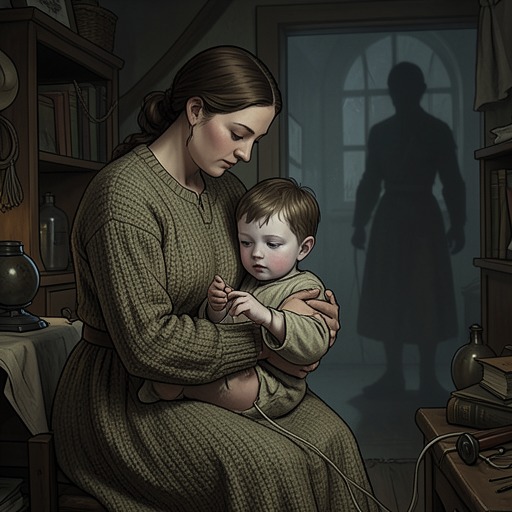
Agnes and Hamnet: a mother–son bond shaped by care, loss, and searching
HamnetAgnes and Hamnet: a mother–son bond shaped by care, loss, and searching is defined by the intimacy of repeated care and by the rupture of Hamnet’s death. Agnes first knows him as a strong, determined newborn; later, her hands identify him when illness has made the twins’ positions and appearances dangerously confusing. After his death, the same hands that fed and tended him wash his body and sew his shroud. Her bond does not end with burial: she searches night after night for Hamnet, but the mother who believes she can hear the dead cannot locate her own son.
Care from birth
Agnes’s care for Hamnet begins in the exhausting, practical rhythm of nursing twins. After the birth, she cannot sleep or leave her bed, and there is never a moment when her hands can be idle: she feeds one baby, then the other, then returns to the first, sometimes holding both against her chest at once. Hamnet makes his needs plain from the beginning. He latches with confidence and concentration, and Agnes recognizes his strength as soon as she sees him. Judith, by contrast, needs encouragement to suck; Agnes touches her cheeks and jaw to prompt her to feed. The distinction is not a judgment between the children but a mother’s close attention to what each infant needs in order to live.
The twins’ earliest days make that attention especially urgent. Judith’s survival is uncertain, and Agnes reads the danger in her body as well as in the behavior of the adults around her. Mary enters the room quietly to inspect the babies and sometimes touch their chests. She urges John to take them for baptism, and the grandparents carry them to the priest wrapped in blankets and dressed in their small clothes. When Mary returns with Judith, she gives the child back to Agnes with the relief of someone who has completed a race. Agnes, meanwhile, keeps nursing, holding, and watching both children. Her bond with Hamnet takes shape within this shared labor of protecting two vulnerable lives.
Care also belongs to the household’s wider network. When Judith later has a fever, Agnes and Mary set aside their many ordinary frictions and work together, coordinating fire, clean bedding, medicine, and the movement of the child to a bed beside the hearth. Hamnet is drawn into that practical response when Mary sends him to bring wood. The episode places him among the children and adults whose work sustains one another, while making visible the kind of care Agnes herself gives: alert, physical, and organized around immediate need.
Recognizing Hamnet in illness
When Judith becomes gravely ill, Agnes stays beside her through the night, not eating or resting. She wets a cloth and cleans Judith’s forehead, arms, and throat, continuing to soothe her even as the fever persists and the swelling on her neck grows alarmingly taut. Agnes’s experience of caring for the sick tells her how close the child may be to death; her attachment as a mother resists that knowledge. The two responses coexist, one measuring danger and the other refusing its conclusion.
The crucial recognition comes when Agnes returns to the bedside and sees what she initially takes to be two Judishes lying together. She lights a candle and examines the children by touch. Her fingers find Judith’s long braid around Hamnet’s neck, Hamnet’s wrists emerging from Judith’s apron, and the crescent-shaped scar left by a sickle when he was small. The details that distinguish him are intimate records of a shared life: hair, clothing, an old injury. The fever has darkened his shorter hair with sweat, while Judith appears to sleep with the ease of the healthy child. Agnes lifts the sheet and realizes that the taller child is the sick one. Hamnet, not Judith, is dying.
The discovery turns the twins’ resemblance into a devastating reversal. Agnes had come to the bed believing she was tending Judith; the familiar body beneath her hands is Hamnet’s. He opens his eyes and calls her mother. The scene makes recognition depend not on a clear view but on the accumulated knowledge of touch. Agnes knows Hamnet because she has held and tended him, and the body that once signaled his strength now reveals that the danger has fallen on him instead.
Care after death
After Hamnet dies, Agnes’s thoughts repeatedly contract to the fact of his death and expand into questions about how the family can continue, how Judith will bear the loss, and how Agnes failed to recognize that Hamnet was the one in danger. Her mind returns to the same absence even as her habits keep reaching for him: she is accustomed to mentally locating each child, and her attention continues to ask where Hamnet is. The question persists because motherhood has been practiced as continual awareness of a child’s whereabouts and condition; death does not immediately undo that practice.
Agnes delays the work of preparing Hamnet’s body until night, when others have gone and most of the household is in bed. She arranges water and oil, then begins at his face. She wets his hair, though it no longer lies flat as it did when she tried to tame it in the mornings. With a fruit knife she cuts a lock from the back of his head, keeping the hair that is sun-lightened at the ends and darker near the roots. She washes his closed eyes, cheeks, lips, and the cut in his eyebrow, then cuts away his shirt so she can clean his body. Each action attends to a particular part of the child she knew, while confronting the irreversibility of what has happened.
The marks on Hamnet’s body hold the history of his life in miniature: a scar from falling off a fence at Hewlands, a knot of skin where a dog bit him at a harvest feast, a writer’s callus on his right ring finger, and the small dents left by a childhood rash. Agnes washes his legs and feet as well. When Mary helps her spread the white sheet, Agnes sees its broad, empty whiteness and brings it to her face; it smells of juniper, cedar, and soap. The women lift Hamnet so the sheet can be placed beneath him, but the task remains Agnes’s act of care as well as a preparation for burial.
She chooses rue, comfrey, chamomile, lavender, thyme, and rosemary to place in the folds of the sheet against his body. She excludes plants for reasons bound to Hamnet’s particular life: he disliked the smell of wild pansies, and other herbs had failed to lower his fever or save him. She also rejects milk thistle because its sharp leaves could scratch his skin. Then she threads thick yarn through a needle and begins sewing at his feet. The shroud becomes an object made by hand, and the sewing gives her a task that can be completed even when the loss itself cannot be repaired.
Burial and separation
The preparation takes place under the pressure of the town’s rule that plague victims be buried on the same day they die. The women have already burned the bedding, aired and cleaned the room, and moved Judith, still weak, upstairs. They set out warm water, cloths, a white sheet, needles, and strong thread, offering to help Agnes wash and shroud her son. She initially does not answer, still touching his curled, lifeless fingers with one hand and his hair with the other. The speed demanded by the ordinance presses against the suspended time of her grief.
At the burial, William Shakespeare carries Hamnet’s body, wrapped in Agnes’s white shroud and surrounded by flowers and sprigs. Agnes walks behind him with Susanna and Judith; Bartholomew carries Judith, who hides her face against his neck and wets his shirt with tears. The family and neighbors follow along Henley Street, and Edmond later helps William carry the board. Agnes cannot bear to watch Hamnet being lowered into the ground. She misses the final moment when the shroud disappears into the dark clay, and when she looks back Judith is still there but Hamnet is not. The movement from three children to two becomes a fact she cannot reconcile with the act of leaving the churchyard.
At the gate, Agnes grips a wooden post with both hands and cannot make herself cross away from Hamnet. William takes her arm, but grief has made his face strange to her; she sees in it the cheekbones and forehead of their dead son, yet also the signs of the living man beside her. Her own sense of self feels insubstantial, as if she might break apart. The family’s loss is not only Hamnet’s absence from Agnes’s arms but the collapse of the shape that had held them together. In the first two nights, she hears William pacing the room below, his steps moving back and forth as if he has lost the way to return to a place he once knew.
Searching for the absent son
Agnes continues to search for Hamnet weeks and months after his death. She keeps vigil at night with a blanket over her shoulders and a lit candle, waiting where his bed used to stand. She sits in the chair associated with the place where he died, and goes into the frosted yard to call for him beneath the leafless plum tree. The search draws on the same attentiveness that once helped her care for the living, but its object is now beyond her reach.
That failure unsettles what Agnes believes about her own abilities. She can sense what is not said, read people’s eyes and hearts, and detect illness through touch, as though feeling its progress in the veins or the pressure of a tumor. Yet she cannot find the spirit of her own child. She listens for him among the desires and discontents of other presences and hears only silence. Judith, by contrast, finds Hamnet in ordinary motions and sounds: a broom moving over the floor, a bird’s slanting flight, a pony’s mane, hail at the window, wind in the chimney, and the wicker of a roof moving in the air. The contrast does not lessen Agnes’s bond; it makes its particular pain clearer. The mother who knows Hamnet’s body so precisely cannot reach him after death.
Grief also changes the family’s patterns of care. Agnes stops tending people who come to ask for help with injuries, tooth inflammation, deafness, rashes, heart pain, or coughs. Her medicinal herbs dry out, and the jars gather dust. Susanna cleans the jars, burns the useless dried plants, and directs Judith to water the medicinal patch behind the henhouse; she also prepares calendula petals in vinegar with honey. The daughters begin to take up work their mother has withdrawn from. Much later, when Agnes and William are together, he asks how much she thinks about Hamnet. She had expected an explanation for his absence or a confession about another woman; his question instead exposes the grief that still occupies their marriage. Hamnet remains present in the family not as a recovered spirit but as the loss around which care, memory, and the lives of the surviving children have to be rearranged.