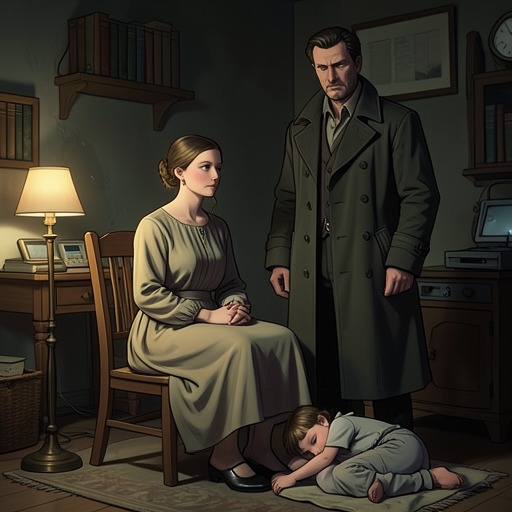
Agnes and Mary: friction and mutual support between daughter- and mother-in-law
HamnetAgnes and Mary: friction and mutual support between daughter- and mother-in-law is a relationship in which domestic conflict and intimate care coexist. Mary often judges Agnes as an unsettling outsider and wants her son to remain within the family household; Agnes, however, refuses to surrender her independence or help confine her husband. Their bond changes most clearly in moments of danger: when Judith falls ill and when Agnes gives birth, resentment gives way to practical cooperation and, at a moment of vulnerability, reassurance.
Household Authority and Difference
Mary’s opposition to Agnes is part of a wider family conflict over who may decide the young couple’s future. When Joan rejects Agnes’s wish to marry the Latin tutor, she invokes his father’s debts and insists that Agnes should marry a prosperous farmer instead. Bartholomew counters Joan’s authority by asserting that the house is his inheritance and that Agnes may stay. These disputes establish how marriage, property, and belonging shape Agnes’s place among her husband’s family, though they do not by themselves define Mary and Agnes’s relationship.
Their household life is marked by ordinary, repeated friction. Mary and Agnes live close to one another amid children, food preparation, washing, mending, and the continual demands of a crowded family. They complain, quarrel, and criticize each other’s work, even sending food to the pigs when they consider it too salty, insufficiently mashed, or too strongly seasoned. Mary’s later perspective makes the difference between them especially sharp: she sees Agnes ignoring family expectations, tending a squirrel, and declining to take part in the conversation about her husband’s proposed move to London. Mary regards Agnes as a strange, almost supernatural presence, and resents the influence she believes Agnes has over her son. This hostility reveals Mary’s fear of losing him as well as her contempt for Agnes; it does not make their practical interdependence disappear.
Conflict over the Move to London
When Mary’s son plans to leave Stratford for London, Mary tries to enlist Agnes in stopping him. She wants him to stay in the family home, work in John’s business, and be present for the coming birth. Mary appeals to Agnes as though they share that objective, expecting her to ask her husband to remain. Agnes instead questions why he should be held against his will. Mary recognizes from Agnes’s enigmatic smile that she has misjudged her daughter-in-law: Agnes will not support keeping him at home simply to satisfy Mary’s wishes.
The disagreement exposes their different ideas of care and obligation. Mary understands a son’s place through the family household and its security; Agnes is willing to let her husband choose a life away from it. Mary’s anger is intense, and she imagines striking Agnes, but this resentment sits beside a real recognition of Agnes’s beauty and presence. The scene does not resolve their conflict. Rather, it shows how Mary’s desire to protect and retain her son can turn against Agnes, while Agnes’s refusal to comply preserves her own judgment and her husband’s freedom to leave.
Care in a Crisis
Judith’s illness brings the women into a different kind of alignment. Agnes is making a medicinal mixture when Mary touches her elbow and asks whether the report is true: Judith has fever and pustules. Agnes confirms it. Mary’s response carries the weight of her own history: her daughter Anne died of plague at eight, covered in swellings and fever, with blackened fingers. Agnes understands that Mary is not simply angry; she sees the grief recalled by Judith’s illness and senses Anne’s presence near them. For Agnes, the boundary between the living and the dead is permeable, and she resolves that Judith must not cross it.
Mary’s response is physical and immediate. She murmurs a quiet prayer or plea, draws Agnes to her, and holds her with a forceful tenderness. Agnes’s face rests against Mary’s cap; then Mary releases her and turns to the work. She clears space by the hearth, plans a bed there for Judith, and sends Hamnet for firewood while Susanna is told to fetch clean sheets. Agnes prepares the medicine and water. The two women move upstairs together and undertake Judith’s care without needing to discuss each step. Their earlier quarrels remain part of their relationship, but in this emergency they function, in the novel’s image, like the two hands of one person.
Agnes’s vigil continues through the night. She stays beside Judith, does not eat or sleep, and cleans her daughter’s forehead, arms, and throat with a cloth while Mary watches. Judith’s fever persists, and a swelling on her neck grows taut enough to threaten to burst. Mary understands the danger, but she remains present as Agnes tends the child. Their care is not interchangeable in every detail: Agnes is the sleepless mother at the bedside, while Mary helps organize the household and stays close. Together they confront a danger Mary has already known through Anne’s death.
Childbirth and Mutual Reassurance
The relationship also shifts during Agnes’s labor. In the pain and fear of childbirth, Agnes tells Mary that her own mother died after Agnes had sent her husband away, and she cannot bear the thought that she may die too. Mary interrupts the midwife’s attempt to speak, tells her to do her work, takes Agnes’s pale face in her hand, and listens. When Agnes repeats that she sent her husband away and that her mother then died, Mary answers that she knows, but insists that Agnes will not die and is strong. Agnes replies that her mother was strong too; Mary takes her hand. Mary’s reassurance does not erase Agnes’s fear, but it makes room for that fear without rebuke.
The birth itself brings another urgent test of care. One newborn girl is small and initially silent. The midwife advises Agnes not to look and offers to take the child for burial, but Agnes insists that the baby be given to her. The child then cries in Agnes’s arms. In the days that follow, the family is uncertain whether Judith will survive, and Mary helps secure the twins’ baptism by urging John to take them to the priest. Agnes, unable to sleep or rise, nurses Hamnet and Judith in turn, sometimes holding both at once. These events show care as sustained labor shared across the family, rather than as a feeling alone.
A Relationship Without a Simple Reconciliation
The novel does not turn Agnes and Mary into an uncomplicatedly affectionate pair. Mary’s anger at Agnes’s independence and her suspicion of her remain real, just as their recurring household irritations persist. Yet their actions in illness and childbirth establish a durable capacity to recognize one another’s needs. Mary can comfort Agnes when her fear becomes overwhelming; Agnes, in turn, meets Mary’s recalled grief with attention rather than dismissal. Under pressure, their relationship becomes less a contest over authority and more a practical alliance.
That alliance also has a domestic afterlife. Later, Susanna cleans the medicine jars, removes dried herbs, and tends the plants under the direction of Judith, while Agnes no longer responds to people seeking remedies. The change shows care and household knowledge passing through the family, even as Agnes withdraws from her former work. Mary and Agnes’s relationship is therefore important not because it settles into harmony, but because repeated acts of care coexist with unresolved disagreement. Their bond is made in the labor of keeping others alive, and in the moments when one woman can hold the other steady.