Susanna and Judith: sisters sharing grief and care
HamnetSusanna and Judith are sisters bound by the death of Hamnet, but their closeness does not make them interchangeable. In the aftermath of their brother’s loss, Susanna becomes the person who can answer Judith’s fear with intimate knowledge: she has always known which twin was which. As they grow older, their lives divide into different kinds of work and attention, yet their shared grief remains present in the household they help sustain.
Family and the First Loss
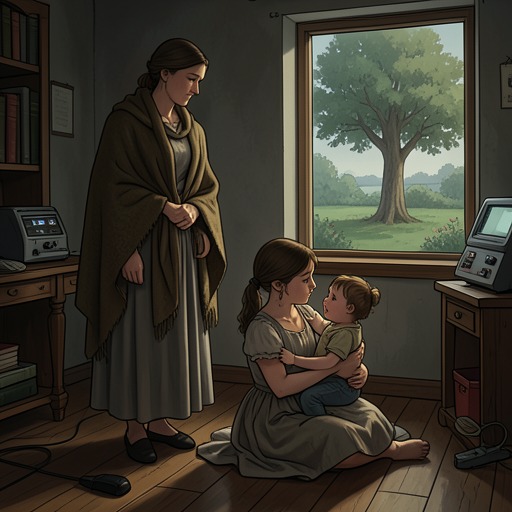
The sisters’ relationship is first seen against the family’s bereavement. After Hamnet’s death, the household is fractured: Susanna is described as stern, her brow furrowed as though she were angry with the world, while Judith cries continuously and quietly. Their mother, Agnes, is pale and silent. The contrast does not mean the sisters grieve separately; it shows how differently grief appears in each of them, and how the loss has altered the atmosphere they share.
The narrative calls Hamnet the pin that had held the family together. Without him, the household seems liable to fall apart. For Susanna and Judith, that image makes their brother’s absence more than a private sorrow: it changes the structure of the family in which they must continue living. Judith’s unceasing tears are visible, while Susanna’s anger and seriousness mark another response to the same rupture.
Judith’s Fear and Susanna’s Reassurance
Years later, the sisters are doing laundry together when Judith asks whether their father stays away because of her face. The question emerges amid an ordinary task: in the heat and steam of the washhouse, they push shirts, nightclothes, and stockings into the water. Judith says she looks so much like him that seeing her might hurt. Her worry turns resemblance into a possible explanation for William Shakespeare’s long absence from home.
Susanna first answers in her customary matter-of-fact tone: their father does come home, and Judith’s face has nothing to do with it. But she cannot wholly dismiss the fear, because it is true that he has not visited since the funeral. Letters arrive; Susanna reads them, while Agnes leaves them on the mantel for several days, sometimes taking them down when she thinks no one sees. The sisters’ conversation thus touches a silence in the family: their father’s absence is discussed indirectly, even as its cause remains unspoken.
Susanna then stops the laundry and places a hand on each of Judith’s shoulders. She acknowledges that people who do not know Judith well think she is just like their father, and that the twins looked astonishingly alike. But those who lived with them could see the differences. When Judith asks whether Susanna really believes this, Susanna tells her she never once confused the twins, even when they played at exchanging clothes or caps. She knew who each child was from the time they were little.
The assurance is grounded in shared memory, not a general claim that Judith looks different. Susanna recalls a specific childhood game and her own certainty within it. She touches Judith’s cheek with a trembling finger, then wipes away her tears with the tip of her apron before returning to the laundry. Care takes the form of both words and a small, practical gesture; the work resumes, but Judith has been given an answer rooted in the years they grew up together.
Different Responsibilities, Shared Household
As adults, Susanna and Judith occupy markedly different roles in the family home. Susanna grows taller than Agnes and takes responsibility for its keys, wearing them on a ring at her waist. She manages accounts, pays the servants, oversees the household’s remedies business and its growing trade in beer and malt, and reports rents, investments, and property matters to their father. At his request, she also arranges furniture for the new house. Her responsibilities make her a central organizer of family affairs.
Judith, by contrast, stays close to Agnes, as if proximity might guarantee safety, survival, or purpose. She tends the garden, runs errands, cleans and tidies her mother’s workbench, and knows where to find the herbs Agnes asks for. She spends hours with the cats, grooming them and speaking to them in high, affectionate sounds; each spring, she has kittens to sell as good rat-catchers. Susanna sees Judith as gentle and alert, with a trusting-looking face. The sisters share a home and family burdens, but their daily attentions diverge: Susanna administers, while Judith works among plants and animals.
That difference also shapes their attempts to teach and help one another. Susanna has promised their father that she will teach Judith her letters, and once a day calls her inside to sit before an old slate. The lessons frustrate Susanna. Judith fidgets, looks out of the window, resists using her right hand, and struggles to retain the letters. She gives the spaces inside them faces, making some sad, others cheerful or charming; it takes her a year to produce a legible signature, and Susanna eventually gives up. When Susanna complains that Judith will not read, write, help with accounts, or take on the management of the house, Agnes answers that each daughter has a different aptitude and that both do their own work well. The reassurance recognizes a real division in their abilities without treating one sister as a failed version of the other.
Recognition Without Sameness
Susanna’s insistence that she never confused the twins becomes especially significant after Hamnet’s death. Judith fears that resemblance to her father might make her painful to look at; Susanna’s memory instead offers a history in which Judith was always distinguishable to someone who knew her closely. Her comfort does not erase the family’s silence or restore their brother. It gives Judith a measure of recognition within a household altered by loss.
Their bond is therefore made visible less through constant agreement than through acts of attention: working side by side at the wash, Susanna noticing Judith’s distress, placing her hands on her shoulders, remembering the twins’ childhood disguises, and drying her tears. Later, their different capacities remain a source of friction, particularly when Susanna feels the burden of running the household, but Agnes’s response confirms that difference need not mean a lack of value. The sisters share grief and a home, while caring for it in distinct ways.