Agnes and Judith: a mother–daughter bond of care after loss
HamnetAgnes and Judith: a mother–daughter bond of care after loss is defined by physical attentiveness and by the limits of protection. Agnes learns to read Judith’s needs through touch, feeding, and watchfulness; after Hamnet dies, her care becomes an effort to keep her surviving daughters safe, even as Judith privately continues to seek the twin she has lost. Their relationship holds both the intimacy of everyday care and the painful truth that a mother cannot prevent every loss or relieve every grief.
Care Before the Loss
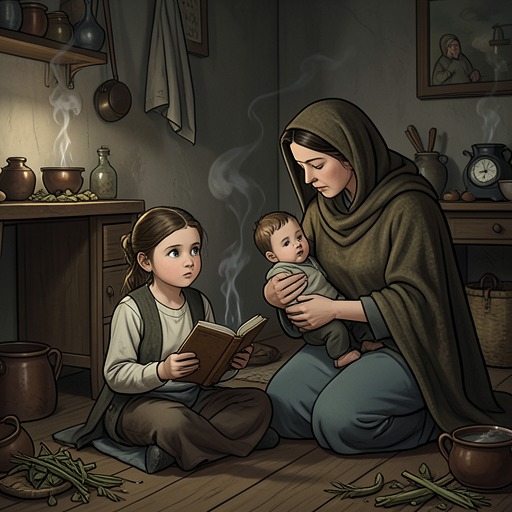
When Judith is dangerously ill, Agnes remains beside her through the night, sitting on the floor next to the rush mattress with a cloth in her hand. She does not get up to eat or sleep. Under Mary’s watch, she wets the cloth and wipes Judith’s forehead, arms, and throat, speaking softly to her daughter. Judith’s fever does not break, and the swelling on her neck appears close to bursting. Agnes’s care is relentless, but the scene also establishes its limit: attention and labor cannot guarantee recovery.
The household’s care is shared rather than solitary. Agnes and Mary, despite their frequent disagreements, work together when Judith needs them. Mary tends the fire and prepares the space by the hearth; Agnes supplies water and medicine. Susanna is sent for clean sheets, and Hamnet brings wood. The women move through the practical tasks together, making a bed near the fire and tending Judith without needing to discuss each step. Agnes’s bond with her daughter is therefore shown within a wider structure of family care, but her own unbroken presence at Judith’s bedside gives that work its emotional center.
The Twins and Unequal Need
After the twins are born, Agnes cannot sleep or leave the bed. One or both babies need to be held, and she feeds them in turn, sometimes nursing both at once with their heads together against her chest. She immediately experiences the two children as requiring different kinds of attention. Hamnet is strong and latches with certainty; Judith is weak and sometimes seems unsure what to do. Agnes stimulates her daughter by touching her cheeks, tapping her chin, and tracing her jaw, prompting her to suck and keep feeding. Motherhood here is repetitive bodily work, adjusted to each child’s particular condition.
Agnes already fears that death can approach the living, and Judith’s uncertain start gives that fear a concrete focus. In the first days, Agnes senses that her daughter may not survive. Mary carries the newborns, wrapped in blankets and dressed, to be baptized urgently; she returns and places Judith in Agnes’s arms. The relief of receiving her daughter back does not make Judith seem invulnerable. Rather, Agnes’s earliest experience of caring for her is bound to the possibility of losing her.
The Reversal of Danger
When Judith later falls gravely ill, Agnes believes her daughter is the child in immediate danger. Once Judith is sitting up, pale but alert, Agnes sees that she has been spared. At the same moment, she understands that Hamnet is the one who may die. She embraces her trembling son, feeling divided: Judith has been returned to her, but Hamnet appears to be taken in exchange. That reversal exposes the painful gap between a mother’s vigilance and her ability to know what will happen.
Agnes has given Hamnet remedies and protections, including the same treatments given to Judith and a stone with a hole placed beneath his pillow. None helps. She realizes that she had concentrated on protecting Judith, whom she believed to be in danger, while Hamnet was the child whose life was failing. The episode does not present her care for Judith as a mistake; it shows how fear can direct a mother’s attention toward the child who appears most vulnerable, without giving her power over the outcome.
Grief Shared Between Mother and Daughter
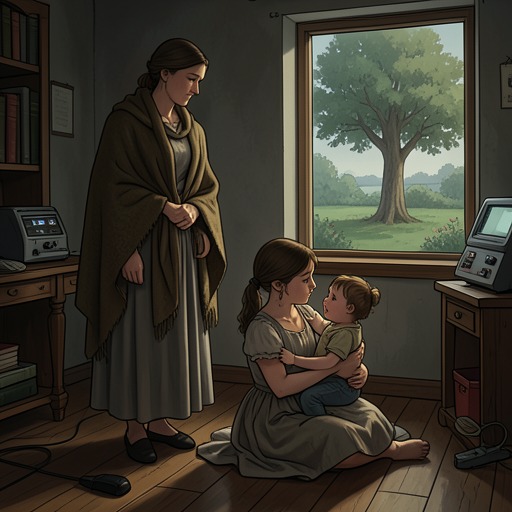
After Hamnet dies, Agnes sits beside his body, touching his still fingers with one hand and his hair with the other. Judith comes down the stairs despite Mary’s attempt to send her back to bed. Agnes makes room for her, tells her that Hamnet’s death was not her fault, and asks whether she wants to see him. Judith approaches, touches her twin’s cheek, and asks whether he will ever return. Agnes discovers that she can bear many hardships but cannot bear the sight of her daughter grieving for her brother. Her tears finally come as she tells Judith that he will not return.
The daughters’ grief is present in the room as well as Agnes’s. As Agnes finishes sewing Hamnet’s shroud in the uncertain light of dawn, Judith rests her cheek against the cloth covering her brother, while Susanna sits beside her with her head bowed. The children share the immediate aftermath of the loss, but they do not grieve in identical ways. At the burial, Judith cries and Susanna holds her hand; Agnes, meanwhile, finds it almost impossible to leave the churchyard, having entered with three children and to depart with two. Mother and daughter are joined by the same bereavement, but each encounters it through a different relation to the dead boy.
Vigilance and the Unfinished Search
After Hamnet’s death, Agnes sleeps with Judith and Susanna in the curtained bed. She surrounds the girls with her arms, checks them for fever, swellings, or changes in skin color, and alternates between lying beside Judith and lying beside Susanna, placing herself between each daughter and the outside world. Her vigilance is a response to the loss: she is determined that nothing will take either girl from her again. The bed becomes a place of comfort and also of watchfulness, where ordinary sleep is repeatedly interrupted by the need to make sure the children are still safe.
Judith’s grief nevertheless develops beyond what Agnes can supervise. She begins slipping out at night to wait for Hamnet, keeping this practice secret from her mother and Susanna. The secret is tied to her twin: Judith has heard that he appears at night, and she does not want to tell anyone in case the meeting never happens. In the room where Hamnet died, she watches the door and longs to see him once more. She wonders whether Agnes recognizes her tiredness, but she chooses not to disclose her vigil. The mother–daughter bond remains close enough for Judith to suspect that her mother may notice, yet grief gives Judith a private course of action that she keeps to herself.
Agnes’s care can shelter Judith, accompany her to the body, and guard her through the nights, but it cannot restore Hamnet or make Judith’s loss interchangeable with her own. The relationship is therefore shaped not by a final resolution but by continuing care under changed conditions: the mother watches over the living, while the daughter keeps searching for the dead.