Hamnet and Judith: twin companionship and the search after death
HamnetHamnet and Judith: twin companionship and the search after death is both a childhood intimacy and a bond made newly painful by separation. The twins seem to mirror one another in their smallest movements; when Judith becomes gravely ill, Hamnet slips into her bed and holds her hand, as if closeness might let him take her place. Judith survives, but Hamnet dies. Their connection then persists in grief: she struggles to name what it means to have lost a twin and, as she grows older, keeps watch at night for the brother she hopes to see again.
A Bond Made Visible
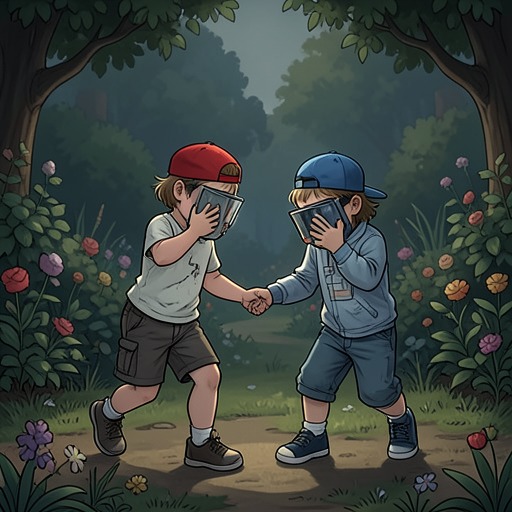
When the twins are very young, William Shakespeare draws attention to their likeness through a small shared piece of apple. He offers a sliver to each child, and they reach for it at precisely the same moment: Hamnet with his right hand, Judith with her left. They bring it to their mouths together, let it go together, look at one another, and reach again, reversing which twin takes the lead. The exchange makes their resemblance active rather than merely visual: each appears to answer the other without needing to speak.
William Shakespeare describes them as a mirror, or as one person divided in half. The image captures both their likeness and their difference. Their movements correspond, but the right hand and the left remain distinct; the children are joined without being interchangeable in every respect. This early scene gives the later crisis its emotional shape. The possibility of one twin standing in for the other is present in their apparent unity, but the story will show the terrible limit of that wish.
Judith’s Illness and Hamnet’s Attempt to Take Her Place
During Judith’s fever, Agnes stays beside her through the night, wiping her forehead, arms, and throat with a wet cloth. The illness is severe, and the swelling on Judith’s neck appears dangerously taut. Hamnet is not the child Agnes expects to find in the bed. When she comes to care for Judith, she discovers two bodies curled together by the dying fire: Hamnet has climbed in beside his twin and fallen asleep holding her hand.
At first, the sleeping children seem like two versions of Judith. Agnes then notices the details that undo the illusion: Judith’s long braid lies around Hamnet’s neck; Hamnet’s wrists emerge from Judith’s apron; and the crescent-shaped scar left by a sickle identifies him. His hair is dark with Judith’s feverish sweat, while Judith sleeps with the composure of a healthy child. When Agnes looks more closely, the taller, sick child is Hamnet. The twins’ resemblance has become a frightening confusion of identities, but their bodies reveal that the illness has not simply transferred from one to the other.
The reversal becomes unmistakable when Judith is able to sit up, pale and weak, and take broth while Agnes embraces Hamnet, who is now trembling with fever. Judith has been returned to her mother, but Hamnet is gravely ill. Agnes gives him remedies she had given Judith, including a purgative and herbal preparations, and places the hole-pierced stone beneath his pillow. Hamnet’s attempt to share his twin’s place has not saved him; the exchange instead leaves Judith alive and her brother in danger.
Grief and the Missing Twin
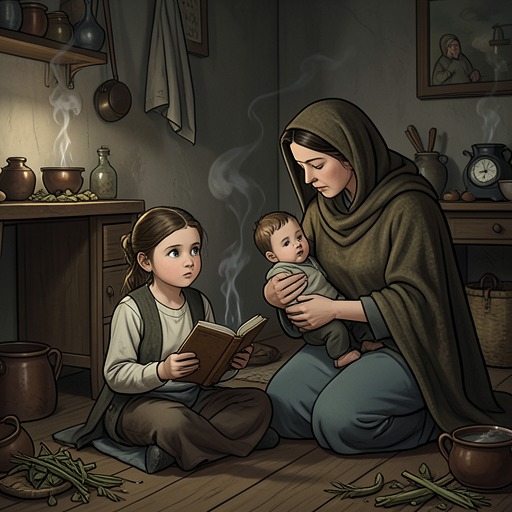
After Hamnet’s death, Judith comes downstairs while Agnes is sewing his shroud. Mary urges her back to bed, but Agnes lets her stay. Judith clings to her mother and speaks through her distress about the kittens, feeling dizzy, and changing places. She blames herself. Agnes tells her that Hamnet’s fever was not her fault and that nothing could be done. When Judith touches her twin’s cheek, she asks whether he will ever return. Agnes can bear many forms of hardship, but not the sight of her daughter grieving over her dead brother; she answers that he will not come back.
Judith’s loss is not easily contained by the ordinary names for bereavement. She keeps a lock of Hamnet’s hair in a small clay pot on the mantel, and Judith has made a silk pouch for it. At times, when she thinks no one is watching, she drags a chair to the mantel and takes down the pot. The hair is the same colour as her own and slips through her fingers like water. Its resemblance offers a tangible trace of her twin while also making the difference between possession and return impossible to ignore.
Judith asks Agnes what a person is called when they once had a twin and no longer have one. She understands the words for a wife whose husband has died and for a child whose parents have died, but cannot find a name for her own condition. The question points to a loss that ordinary kinship terms do not settle: Judith is still a twin in memory and attachment, though Hamnet is gone. In the aftermath, Agnes also repeatedly thinks of where each child is and finds herself asking where Hamnet is, as if the familiar habit of checking on her children continues to reach toward the one who cannot answer.
Night Watch and the Continuing Search
The search becomes an action Judith keeps secret. A midwife tells her that Hamnet appears at Henley Street only at night, never by day. From then on, Judith slips out every night and waits, watching. She tells neither Agnes nor Susanna. The secret is at once an intimate connection to her twin and a hope she is reluctant to expose to anyone else: she fears that speaking of it might make the meeting fail to happen.
Judith returns to the narrow house and the room where Hamnet died in convulsions. There, the many wooden hatter’s heads face the door as silent, featureless witnesses. She looks toward that entrance and longs for Hamnet to come, even once. She thinks of herself as only half a person without him, recalling the earlier image of the twins as one person divided in two. Yet time has sharpened the separation: Judith is growing toward womanhood, while Hamnet will remain a child. She wonders whether he would recognize her if they passed one another in the street.
The bond therefore outlasts the twins’ shared childhood without being repaired by memory or resemblance. Hamnet’s hand in Judith’s, their mirrored reach for the apple, and Judith’s nightly vigil form a progression from effortless closeness to deliberate, unanswered seeking. Her hope keeps the relationship active, but the difference between a living sister and a dead brother cannot be crossed by love alone.