William Shakespeare and Hamnet: a father–son bond shaped by bereavement and transformed through drama
HamnetWilliam Shakespeare and Hamnet: a father–son bond shaped by bereavement and transformed through drama is defined by a loss the father cannot undo and a work of theater that gives the son a form of return. The relationship is shown through a few charged moments: the father’s recognition of Hamnet’s body, his carrying the boy to burial, his attempts to endure grief at a distance in London, and Agnes’s eventual understanding of what he has made onstage. The play does not restore their life together; it turns the father’s grief into an encounter in which the dead child can be seen and heard again.
Fatherhood at the Threshold of Loss
When Hamnet is dying, Agnes remains beside Judith through the night, cooling her daughter’s fever with a damp cloth. The family’s attention is fixed on the sick girl, while the catastrophe that will take Hamnet is not yet understood. After his death, Agnes’s thoughts repeatedly recoil from the fact, turning over what the family will do, how Judith will bear it, and whether she could have saved him. Among these questions is where her husband is. The novel places the father–son bond inside this confusion: the loss has happened before the father can share the vigil or make sense of it with Agnes.
When he comes to the body, Agnes tries to prolong the instant before he knows. She gives a quick nod, and his response is an anguished, involuntary sound that she will remember years later with exactness. He pulls back the shroud and sees Hamnet’s face, pale and still, his eyes closed and lips pressed together. The father touches his son’s cold cheek; his fingers tremble near the wound at the boy’s eyebrow. His disbelief and grief are expressed through the gesture and the broken words he manages, not through any explanation that could make the death intelligible.
The Father Carries His Son
The father takes responsibility for carrying Hamnet to burial. He lifts the board and bears his son, wrapped in a white shroud and laid with flowers and sprigs around him. Agnes follows with Susanna and Judith; Bartholomew carries Judith, who hides her face against her uncle’s neck and weeps. Mary, John, Eliza and her brothers, Joan, Agnes’s brothers, and the baker and his wife join the procession.
The procession moves along Henley Street. The father carries the board alone until Edmond leaves the cortege at a crossroads and takes the foot end, while the father continues at the head. Neighbors and passersby stop, move aside, uncover their heads, and offer prayers or words of consolation. Their attention also fixes on the contrast between the dead child and the father’s altered circumstances: they notice his embroidered sleeves and polished boots, and speak of his standing in London and the money he is said to earn at the playhouse. Public recognition of his success does nothing to lessen the private fact of the burden he carries.
At the grave, Agnes cannot watch her husband lower Hamnet into the earth. She loses the moment when the shroud disappears from view and the boy is committed to the dark, clay soil. Leaving the churchyard feels harder than entering it: she imagines the dead reaching for her skirts and cannot accept that she has entered with three children and must leave with two. At the gate, she sees her husband’s face as unfamiliar, yet finds in it the cheekbones and brow of their dead son. For her, the living father bears a visible likeness to the child he has just buried, while remaining unmistakably alive. She grips the wooden gatepost, unable to leave the place where Hamnet lies.
Grief Across Distance
On the first two nights after the burial, the father walks ceaselessly through the downstairs room while Agnes hears his footsteps from the bedroom above. The movement becomes an image of a man searching for a route back to a place whose map he has lost. Agnes’s whispered admission that she did not see what was happening does not resolve the distance between them; the account leaves them separated in the dark, with the summer heat pressing against the closed bed curtains.
In London, the father finds that historical plays about long-dead kings and comedies offer safer ground than material that could pull him back toward Hamnet’s death. The memories he cannot bear include the shrouded body, a chair with a child’s clothes, and other reminders of the life that has been broken. Night after night, he scans the audience for a boy with Hamnet’s crooked smile and look of perpetual wonder. His continued search shows that physical distance has not released him from the expectation that his son might still be found.
He also sees how work keeps him inside London’s relentless cycle of writing, rehearsing, and performing. Months pass quickly, and he fears that leaving could cost him the position he has secured. More painfully, he imagines Agnes’s grief as a dangerous current: if he came close enough to be pulled under by it, he might not return to the surface, and he fears dragging the others down with him. He persuades himself that, if he stays away, he can almost imagine returning to find the family unchanged, with all three children asleep in their beds. The fantasy makes the separation both a means of survival and a refusal to confront what has happened.
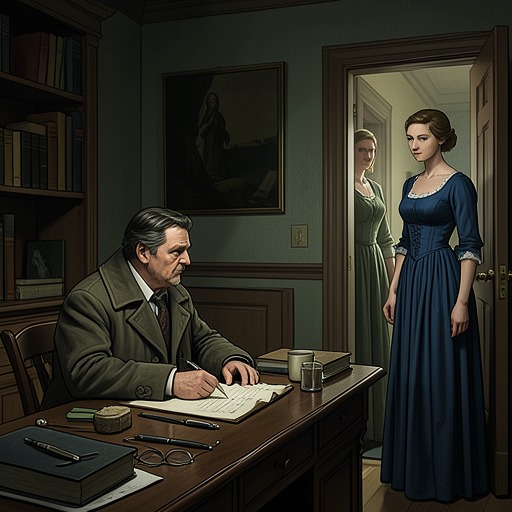
When he is again beside Agnes, she expects him to explain himself or speak of another woman. Instead, he asks how much she thinks about him. Her initial confusion gives way to the recognition that his question concerns Hamnet. The exchange turns their attention away from the presumed marital confession and toward the grief they have not been able to meet in the same way. Their bond as husband and wife is strained by absence, but the question reveals that the dead child remains the subject around which their lives are organized.
Hamlet as a Form of Return
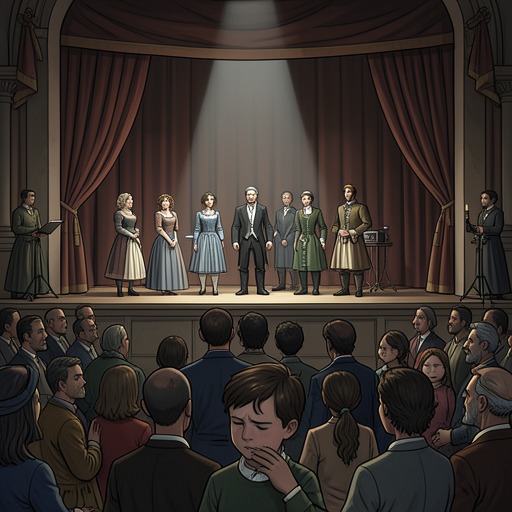
The father’s work eventually brings Hamnet’s presence into the theater. When Agnes watches Hamlet, the young actor’s gestures recall her son: the tilt of his head and the movement of his knuckles toward his mouth when he hears something he does not immediately understand. She cannot see how an actor who never knew Hamnet could seem to embody him. As she presses forward through the crowd, she recognizes the labor behind the resemblance: her husband has found the boy, taught him how to speak and move, rehearsed him, and written both the words he must say and those he must hear.
For Agnes, the stage Hamlet is at once the living young actor and the dead father he encounters. The father’s ghost bears her husband’s hands and beard and speaks with his voice; the young Hamlet carries the mannerisms she associates with her son. This doubling makes the play’s central meeting an image of the family’s own loss: the dead and the living occupy the same theatrical moment without being made identical.
Agnes understands the father’s dramatic act as an exchange of places. In her reading, he has taken his son’s death into himself and put himself within its reach, doing imaginatively what a father might wish to do in life: suffer in the child’s place so the child might live. The play cannot reverse Hamnet’s death, and the actor is not Hamnet restored. Yet the father has shaped performance so that the boy can appear again in gesture and voice, while the father’s grief speaks through the ghost. The relation that began in the helpless recognition of a cold face is thus transformed into a work of remembrance: the father gives his son a place onstage, and Agnes recognizes both the love and the wound carried by that return.