John and his son: family-business constraints and the search for independence
HamnetThe relation between John and his son, William Shakespeare, is a persistent negotiation between family obligation and the wish to make a life of his own. John’s authority rests partly on the family business and the household his son has not yet left; William’s independence takes shape through marriage, a separate dwelling, and the prospect of work in London. Their conflict is conveyed not only through arguments about business, but through the handling of a key, a father’s too-forceful touch, and a son who steps between John and a crying child.
Family Authority and the Marriage
Before William and Agnes marry, Joan makes the family’s financial condition part of the case against the match. She invokes the debts John owes in the town and to her household, and describes his former standing as an officer as something lost. Her account is spoken by an adversary of the marriage, not given as a neutral balance sheet, but it makes the family’s liabilities a practical constraint on William’s future. Joan argues that he cannot offer Agnes the security she deserves and rejects him as a suitor without a reliable trade or means.
After the marriage, John’s authority is visible in the arrangement of a small house beside the family home. The rooms had been used by John for storage, including wool kept there for years; the stored goods are removed before the couple takes possession. Agnes suspects that the separate accommodation is partly the result of Bartholomew’s intervention. Bartholomew inspects the rooms and, after John hesitates, gives his assent before John hands his son the iron key. The dwelling offers William and Agnes a household of their own, but its origin remains entangled with the older household and its authority.
The transfer of the key is no easy act of release. John offers it slowly; William hesitates, takes it between thumb and forefinger, and examines it before accepting. John tries to ease the moment with talk of home, happiness, and wives, then pats his son on the back. Agnes reads the gesture as well-intentioned but awkwardly forceful: William is taken by surprise, stumbles, and quickly straightens as if bracing himself. When he sets the key down on the table with a metallic clatter rather than putting it in his purse, Agnes and Bartholomew exchange a look. The small object marks an unsettled transition: John has handed over a house, but neither father nor son seems at ease with what the handover means.
The Two Households
Agnes comes to understand William’s conduct as sharply divided between the couple’s rooms and the larger family home. In his own house he is the man she recognizes, able to accept her hand and her care. In his parents’ house, he grows irritable and oppositional, answering John’s demands with refusal and challenge. Agnes connects this change to the anger she sees in John, though the narration presents that connection through her observation rather than through a direct explanation from either man.
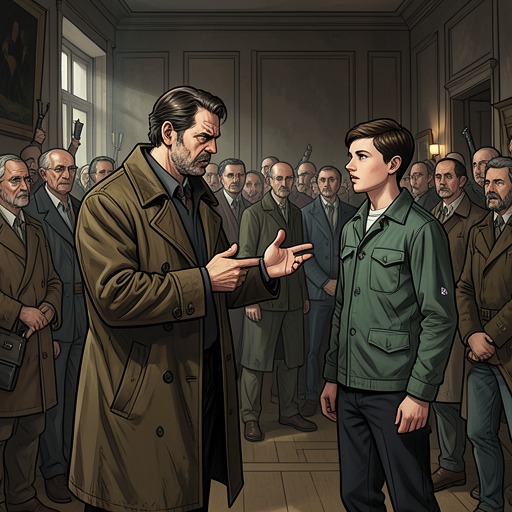
The family dinner over Edmond’s teething distress makes the strain physical. Edmond is tired and unable to eat; his gums are red and inflamed, and he spills his cup, crushes the pie, and throws food. John becomes increasingly angry when a piece of crust marks his sleeve. As Mary lowers her head and Eliza’s eyes fill with tears, John rises in a shout. William springs up and gets between his father and the crying boy. A scuffle follows: William restrains John, there are curses and a shove, and Agnes carries Edmond out of the room before she can take in the whole quarrel.
The immediate aftermath is quieter but does not erase the confrontation. Agnes finds Edmond in the yard, wrapped in her shawl and feeding the chickens; William comes to her and puts his head against hers, holding her. Later, Agnes and William leave the family home by the back door. The contrast between his defensive intervention at the table and his gentleness with Agnes in their own space helps define the division she has begun to see: the conflict with John belongs to a family setting in which William cannot remain simply the husband and father she knows.
Business, Humiliation, and Independence
John’s pressure on William is not limited to a single quarrel. At family meals, Agnes sees William flinch when a cat jumps onto the table, a door slams, or a dish is set down abruptly. John snaps his fingers at him and encourages Gilbert to join in the mockery. When William spills beer, John calls him useless and makes a joke of his inability to pour it. Agnes wants to reach across the table and comfort him, but the crowded meal, the dishes between them, and the demands of the family keep her from doing so. The scene also reveals how easily William’s distress can remain unseen when he keeps it to himself.
The prospect of expanding the family business in London brings the conflict into the open as a question of work and departure. William speaks in favour of John’s idea and suggests that he could take charge of the London operation. Mary answers by recalling his lack of interest in the trade and his past failures: he once lost deer skins on the way back from Charlecote and exchanged a dozen gloves for a book. Her objections attack his fitness to run a business, but the narration makes clear that her deeper wish is for him not to leave. The proposed venture therefore carries two pressures at once: John’s business plans may offer William a route to work beyond the existing household, while his family’s response treats that independence as a danger and a test of competence.
Later, William writes to Bartholomew asking him to act on his behalf in making a purchase. He does not want to tell any of his brothers, explaining that John might interfere. Bartholomew considers the letter over lunch, while Joan anxiously questions him about its contents and warns against lending William money. The request shows that William still needs assistance from his wife’s family to conduct his affairs, and that he anticipates his father’s intervention even when he turns elsewhere for help. The evidence does not establish what is purchased or how Bartholomew answers; the significance lies in William’s effort to act through a trusted intermediary while keeping John out of the transaction.
The Meaning of the Conflict
The relationship is defined by proximity as much as by open opposition. William lives beside his parents, shares their meals, and remains exposed to John’s judgment and business authority; at the same time, marriage gives him a separate home, and his actions repeatedly seek room beyond the paternal household. The iron key makes that tension tangible: it is both permission to occupy a new space and a reminder that John controls the transfer.
John and William’s conflict also changes register from scene to scene. John can present himself as a father speaking of domestic happiness, yet his touch unsettles William; he can make business plans that his son supports, yet also humiliate him publicly over small mistakes. William, in turn, is not shown as wholly detached from the family enterprise: he argues that its London expansion could benefit them all, but he also conducts a later purchase without informing his father. The relation remains unresolved, held between participation and resistance. Its central pattern is not a clean break from John, but William’s repeated attempts to create an independent household and sphere of action while still living within the reach of his father’s authority.