John and his eldest son: father–son conflict
HamnetThe conflict between John and his eldest son, William Shakespeare, is rooted in a household where paternal authority operates through command and physical violence. John directs William’s labor and attempts to govern his future; William’s resistance develops first as a guarded effort to anticipate his father’s temper, then as an explicit refusal to be struck again.
Origins of the Conflict
John commits William to teach the younger children at Hewlands twice a week, presenting the arrangement as settled without first telling his son or asking his agreement. William is sent there as a tutor, but the arrangement also reflects a debt owed by John: the son’s time, Latin grammar, and learning effectively become payment. When William challenges the decision, John refuses discussion and makes clear that obedience, not consent, is expected. The episode extends their conflict beyond the home: John’s authority determines where William must go and how his abilities will be used.
That command sits within a longer history of violence. John has struck and pinched all six children at times, but the punishment inflicted on William has been more regular and brutal. His anger can erupt without warning or consistent cause. William learns to read the signs around him—the sound of the door, the rhythm of John’s steps across the floor, a misplaced boot or a small gesture interpreted as disrespect—and to look for ways to evade a blow. This vigilance gives him a kind of knowledge about his father, but it does not make the household safe: almost anything can become an excuse for violence.
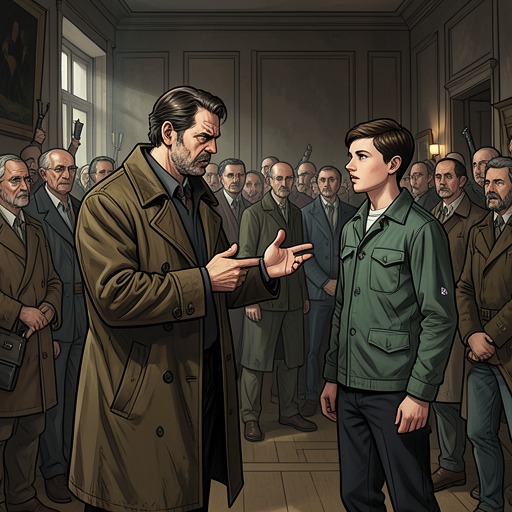
As William grows taller and stronger than John, the balance between them begins to change. After John hits him in the face with a wine flask and raises his arm to strike again, William catches his father’s arm and pushes him against a wall. The childhood figure who had seemed monstrous proves physically vulnerable. William holds him there and warns him that he will never again be allowed to lay hands on him. The confrontation marks a decisive change in their relationship: William’s long-trained anticipation of violence gives way, at last, to a physical boundary John cannot simply overrule.
Marriage, Reputation, and Family Authority
John’s authority reaches beyond William Shakespeare’s work and into the possibility of marriage. When Eliza suggests waiting a year, until William is older and John’s business might recover enough for him to regain standing in the town, William withdraws sharply from her touch and rejects the hope behind her proposal. He does not believe John can be persuaded to change course, even when wrong, or to give up the wool trade. The exchange presents William’s resistance as more than impatience: he sees no reliable path to independence if his future must depend on his father’s consent.
The family’s diminished standing becomes an obstacle to William’s relationship with Agnes. Joan invokes John’s debts across the town, including what he owes her household, and the dishonor associated with his former position as bailiff. She argues that William’s tutoring could not repay the debt and declares him an unsuitable match for Agnes, whom she expects to marry a prosperous farmer. Agnes rejects Joan’s arrangement and affirms that she wants William. The dispute makes social reputation and money part of the conflict between father and son: John’s conduct has consequences for William’s prospects, while Joan uses those consequences to deny him a place in Agnes’s family.
When John moves to negotiate the marriage, his public show of welcome gives way to private intimidation. He takes William by the shirt collar in the passage and demands to know whether there are other women he has made pregnant. Holding him by the shoulder and pressing an arm against his throat, John turns the impending marriage into another occasion to exert physical control. He threatens to kill William if he has impregnated anyone else, and warns that Agnes’s brother would do the same. The threat frames the marriage as a matter John can manage through bargains and fear, not as a choice William can make freely. William tries to answer, but cannot get the words out while his father holds him.
The strained balance between them also appears in the transfer of a house beside John’s own. The building, previously used by John for storage, becomes William and Agnes’s home; its key passes from father to son only after Bartholomew has inspected the rooms and twice signaled his assent. William takes the iron key tentatively, holding it at arm’s length between thumb and forefinger. John tries to soften the moment with talk of domestic happiness and a pat on his son’s back, but the gesture is forceful enough to make William stagger. Agnes perceives the exchange as almost a contest of blows rather than a simple handover. The house offers William a measure of separate domestic life, yet the awkward ceremony of receiving it preserves the tension of dependence and reluctant authority.
That wariness persists beyond the initial arrangements. Later, William asks Bartholomew in a letter to act for him in making a purchase, explaining that he does not want to approach his brothers because John might interfere. The request shows that William continues to route practical and financial matters around his father’s influence. Bartholomew considers the letter while Joan presses to know whether William is asking for money, and warns against lending it. Even at a distance, John remains a possible obstacle in his son’s dealings, while the wider family becomes the channel through which William seeks help and the means by which that help may be restrained.
The Bodily Grammar of Authority
The conflict is registered in William’s body before it becomes an open contest of wills. John’s violence is not simply harsher toward his eldest son than toward the other children; it leaves William learning the physical imbalance between an adult’s hard bones and a child’s still-tender flesh. John pins his arm with a calloused hand while striking him with the other, and a wooden tool bites into the backs of his legs. The punishments last long enough for helplessness and humiliation to become part of the experience, while their suddenness makes the body anticipate what the mind cannot predict.
That unpredictability is itself a form of control. No consistent offense explains John’s attacks, so William learns to read minute shifts in his father’s mood and expression, as if small changes might disclose what is coming. Such vigilance offers tactics for evasion, not security: any minor disturbance or perceived lack of respect can become a pretext. The relationship’s later physical encounters therefore carry more than immediate threat. They expose a reversal in the bodily power that had once seemed absolute, while leaving visible how long William had been made to organize himself around it.
A Counterweight Within the Family
When Joan declares Agnes banished from Hewlands, Bartholomew intervenes in front of the people gathered in the yard. He claims the house as his by inheritance from his father and says Agnes may stay. His answer provides a counterweight to the authority William has experienced under John: family power can also be used to shelter a sibling, and inheritance can establish a boundary Joan cannot simply erase. William’s place within the family remains shaped by conflict, but the episode shows that his household’s prospects do not depend on John alone.