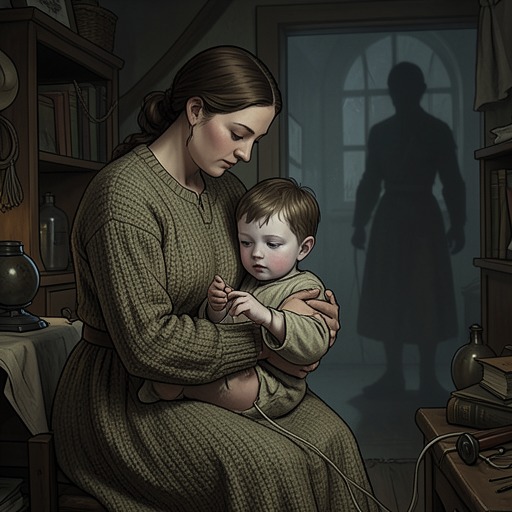
Agnes and Hamnet: mutual devotion and a son’s sacrifice for his sister
HamnetAgnes and Hamnet’s relationship is shown through care that is both physical and perceptive: she steadies him with an embrace, examines Judith with practiced attention, and recognizes how quickly her son understands what she is thinking. Their closeness does not spare them fear or misunderstanding. When Judith becomes gravely ill, Hamnet has searched for Agnes in her absence; she returns to find his distress already turning into anger. The crisis exposes a bond built on tenderness, need, and the knowledge that neither can shield the other from loss.
Maternal Care Under Pressure
When Hamnet tells Agnes that Judith has taken ill, he recounts how he noticed her worsening condition after she complained of a sore throat and went to lie down. He had tried to finish some of the wood-splitting, gone back upstairs to check on her, and then searched for help. He could not find Agnes, his grandmother, or the physician, so he ran from place to place calling for them. His account breaks off in distress, unable to complete what he had been trying to say. The failed search makes his need for his mother part of the emergency itself: he is frightened for Judith and overwhelmed by having had to act without the adults he expected to find.
Agnes approaches and draws him against her shoulder, taking his trembling head in her hand and feeling his unsteady breathing. She tells him that he has done well and that the unfinished wood does not matter. Her response first answers the guilt and agitation visible in his account, rather than asking him to defend what he did. Hamnet pulls away, however, and confronts her for having been absent while he searched everywhere. The scene holds comfort and reproach together: his familiarity with her does not prevent anger, and her embrace does not immediately resolve his fear.
Agnes explains that she had gone to Hewlands because Bartholomew sent word that the Bees were swarming; she had taken longer than expected and is sorry she was not there. She reaches to touch Hamnet again, but he avoids her and goes to Judith’s bed. Agnes does not insist on being comforted or on receiving his forgiveness. Instead, they kneel beside Judith together, and Agnes takes the sick girl’s hand. Their shared position beside the bed marks a shift from Hamnet’s solitary effort to summon help toward a family crisis they now face in one another’s presence.
Reading What the Other Cannot Say
At Judith’s bedside, Hamnet asks Agnes whether this is the Plague, and whether she is thinking of it. Agnes does not answer him directly at first. She knows how quickly he reads other people and recognizes that he is interpreting her thoughts; she tries to lower that unspoken signal by controlling what she thinks. Their closeness is therefore presented not only as affection but as alertness to one another’s inner states. Hamnet’s fear is sharpened by what he sees in his mother, while Agnes understands that concealing her thoughts from him may be difficult.
Agnes’s examination of Judith gives the fear a concrete bodily form. She checks each fingertip for discoloration, finds the fingertips pink and the nails white, and examines the girl’s feet and vulnerable ankles. She feels an irregular pulse at the wrist and finds a swollen lump on the neck, followed by more lumps forming in the armpits. Hamnet’s question and Agnes’s silent inspection run alongside one another: he names the danger he believes she is considering, while she searches Judith’s body for signs that might confirm it. Their connection in this moment is mediated by attention—to each other’s expressions and thoughts, and to the child whose condition holds them at the bedside.
The Pull Toward His Mother
After the household has spent the night with Judith, Hamnet wakes from sleep confused by the strangeness of the world, his dry mouth, the weight in his heart, and a severe pain in his head. He remembers that Judith is ill and is startled that he had forgotten. At eleven, he still feels an urgent need to reach his mother: the need to be within her sight and close enough to touch her, a need he recognizes as having belonged to him when he was much younger. The remembered persistence of that childhood impulse gives the maternal bond a physical measure. In sickness and confusion, proximity to Agnes remains the form of reassurance he seeks.
He climbs down the stairs as the new day’s weak, milk-white light enters the rooms, turning his head toward the wall because everything else seems to move. Agnes is asleep, bent forward with her head on the pallet and a cloth in her hand; Eliza is asleep at the table, and the candles have burned out into pools of wax. Judith is awake and looking directly at him. The scene places Hamnet’s desire to find his mother beside the exhaustion of her vigil: she has been attending to Judith, but at this moment he reaches the room while she sleeps. The narrative does not turn that missed encounter into a rejection. Instead, it shows how the family’s care is strained by a night of illness, and how Hamnet’s instinct remains directed toward the mother he needs near him.
A Son’s Devotion and the Family’s Loss
At Judith’s bedside, the twins’ attachment gives Hamnet’s fear its most extreme expression. Judith tells him not to cry and assures him that nothing bad will happen to him. He refuses that reassurance, saying that he will go with her and that they will leave together. His response echoes the closeness between Agnes and her son without making the two relationships identical: the boy who sought his mother in his own disorientation now cannot imagine surviving separation from his sister.
Hamnet experiences Judith as the other side of himself, as if they fit together like the halves of a walnut. He imagines her absence as an open wound and life without her as impossible. When he notices tears on her cheeks, he understands them as his own tears, though they might equally belong to her; the image makes the twins’ distress difficult to divide. Judith, despite her weakness, tells him that he must stay because he is needed. Her insistence pulls him back toward the living family even as he tries to follow her into death.
Hamnet then imagines defeating death by repeating the twins’ childhood trick of exchanging places and clothes so that other people mistake one for the other. Their identical faces have made the deception work before: a shawl or hat, a changed seat at the table, or a doublet can prompt a mistaken identification before someone discovers the switch. In the crisis, that familiar game becomes an attempt to make death take the wrong child. Judith understands what he is trying to do and weakly shakes her head, while Hamnet holds the sheet over them both. He breathes into her ear and offers her his life. This is a sacrifice directed toward his sister, not an exchange with Agnes, but it illuminates the depth of feeling within the family whose closeness shapes his understanding of love and separation.
The Bond’s Emotional Shape
Agnes and Hamnet’s bond is neither presented as effortless harmony nor reduced to a single act of mothering. He can seek her urgently, accept her embrace, and then turn away in anger when she was not there; she can be absent for a reason, apologize, and still remain unable to prevent the fear taking hold. Their connection appears in gestures rather than explanations: her hand around his head, his trembling against her shoulder, her attempt to touch him again, and his later need to get within reach of her. The crisis makes attachment visible as a bodily urgency, while illness and exhaustion limit what even devoted care can accomplish.
Hamnet’s choice to offer himself for Judith deepens this portrait of a child whose ties are not confined to his mother. Agnes’s relationship with him belongs to a family shaped by overlapping forms of dependence and devotion: a son who needs his mother, a twin who cannot bear to lose his sister, and a mother who watches over the children while confronting the possibility of Plague. The movement between these bonds gives the scenes their emotional force. Hamnet’s need to return to Agnes and his wish to remain with Judith are distinct impulses, but both reveal how profoundly he experiences love as closeness—and separation as something he cannot accept.