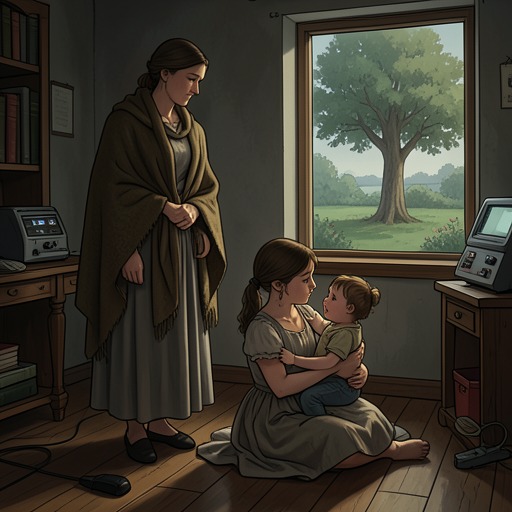
William Shakespeare and Judith: a father–daughter reunion after a long separation
HamnetWilliam Shakespeare and Judith’s father–daughter relationship is defined by a painful gap between affection and presence. After the family’s bereavement, he stays away long enough for Judith to wonder whether her likeness to him is the reason he cannot bear to visit. When he finally returns to Henley Street, she runs to meet him, then pushes him and weeps with anger at how long he has been gone. The reunion restores physical closeness, but does not erase the absence that preceded it.
A bond shaped by absence
The family’s communication continues while William is away: letters arrive, and Susanna reads them. Agnes leaves them on the mantel for several days and sometimes takes them down when she thinks no one is watching. Judith does not know what her mother does with the letters afterward. The correspondence offers a trace of the absent father, but it does not substitute for seeing him. The household receives his words while Judith measures the relationship by his failure to come home.
That absence becomes especially difficult for Judith to understand in the washhouse, amid heat, steam, soap bubbles and the work of laundering clothes. She asks Susanna whether their father stays away because of her face. Her question turns resemblance into a possible cause of rejection: if she looks like him, perhaps looking at her hurts him. Susanna’s first response is an instinctive denial, but the thought cannot be dismissed so easily. The family has not openly spoken of his long absence since the burial, and the silence leaves Judith to supply her own explanation.
Resemblance and reassurance
Susanna answers Judith’s fear by looking closely at her rather than offering reassurance without detail. She acknowledges that outsiders can mistake Judith for their father and that the two of them once looked remarkably alike. Then she distinguishes them feature by feature: Judith’s face is narrower, her chin smaller, and her eyes a little lighter; William had more flecks in his eyes and more freckles, while Judith’s teeth are straighter. These particulars make resemblance neither imaginary nor absolute. Judith carries a likeness to her father, but she is not a copy of him.
Susanna adds that their father knows the differences too. Her assurance matters because it answers Judith’s fear on its own terms: not by denying the resemblance, but by insisting that William can see Judith as herself. Judith looks at her sister in astonishment and asks if she really believes it; Susanna nods. The exchange gives the father-daughter bond an intimate, indirect form. In his absence, Susanna becomes the person who names the distinctions Judith cannot yet trust her father to recognize.
The reunion on Henley Street
When William returns, Judith is outside with Edmond’s dog, braiding a green ribbon into its long neck hair. A man approaches along Henley Street with his hat in his hand and a bundle over his shoulder. He calls to her and raises a hand. Judith runs before she has even said his name to herself; the dog bounds after her, and William lifts her into the air. His affectionate greeting makes the physical ease between them visible, but Judith’s response is not uncomplicated happiness. She pushes him, suddenly furious, and cries as she demands to know where he has been and why it took him so long to come.
William does not visibly answer her anger with anger. He picks up the bundle, scratches the dog behind the ears, takes Judith by the hand and leads her home. The sequence holds together what a simple reunion might separate: the child’s eagerness to reach her father, the hurt that breaks through as soon as she is near him, and his quiet resumption of care. She can run into his arms and still reproach him for being absent. He can take her hand without the narrative suggesting that her grievance has been settled.
Return to the family and the meaning of likeness
At home, William asks loudly where everyone is. During the family gathering, he tells a story involving an innkeeper, a horse and a mill dam; the others laugh, and the room fills with the commotion of family life. Judith is among those around him, and he rests an arm around her chair while listening attentively to Eliza. His attention is now present and specific, a striking contrast with the long interval in which Judith could only imagine what his absence meant.
The return comes in summer, close to the anniversary of the death of their son Hamnet, and nearly a year after William’s previous visit. The family welcomes him with embraces and shared laughter, but the timing keeps reunion beside grief rather than beyond it. He brings gifts from his bundle, including a hammered-silver bracelet with a ruby clasp for Agnes; Judith’s welcome likewise takes place within a family still living with the loss that preceded his absence. The narrative does not explain why William stayed away or claim that his return resolves Judith’s question. Instead, it sets her fear of being painful to look at against Susanna’s detailed reassurance and William’s returned attentiveness. Their bond is shown through this tension: resemblance can trouble Judith, absence can wound her, and recognition must be made visible through attention, touch and the act of coming home.